Abstract
Introduction
The CRISPR-Cas system has revolutionized genome editing, providing a versatile platform for precise genetic manipulation across diverse organisms ( Jiang et al. 2013; Tang et al. 2016; Zhong et al. 2018; Yan et al. 2019; Anzalone et al. 2020; Pacesa et al. 2024; Li et al. 2025; Tuncel et al. 2025). In this system, a single-guide RNA (sgRNA) directs the Cas nuclease to the complementary genomic target, where the protein introduces a site-specific double-strand break (DSB) adjacent to a protospacer-adjacent motif (PAM). The DSB is then repaired by endogenous pathways, enabling targeted genome modification.
The best-known Cas nuclease, Cas9 from Streptococcus pyogenes, has been widely adopted for plant genome editing due to its robust activity and simple design (Le Cong et al. 2013; Tang et al. 2016; Pacesa et al. 2024). However, Cas9 is constrained by its specific PAM requirement (5′-NGG-3′) and large size (1368 amino acids), which complicate vector delivery and multiplex applications (Jinek et al. 2012). Cas12a (Cpf1), another type V CRISPR nuclease, provides certain advantages, including a smaller size (~1300 amino acids), a T-rich PAM (5′-TTTN-3′), and a distinct cleavage pattern that generates sticky ends ( Zetsche et al. 2015; Tang et al. 2017; Zhong et al. 2018; Pacesa et al. 2024). Nonetheless, the editing efficiency and PAM preferences of Cas9 and Cas12a remain suboptimal for some plant species.
CasX (Cas12e), a recently discovered type V nuclease (Burstein et al. 2017; Liu et al. 2019). consists of only ~986 amino acids, significantly smaller than Cas9 and Cas12a. Its compact size facilitates packaging into small delivery vectors such as AAV and allows additional regulatory or multiplex editing modules to be incorporated within the same construct. CasX recognizes a 5′-TTCN-3′ PAM, complementing the PAM specificities of Cas9 (5′-NGG-3′) and Cas12a (5′-TTTV-3′), thereby expanding the editable sequence space. Functional studies have demonstrated that CasX supports targeted genome modifications in bacterial and human cells (Liu et al. 2019; Tsuchida et al. 2022). Given its small molecular weight and distinct PAM preference, CasX represents a potentially valuable addition to the CRISPR toolbox for functional genomics and crop biotechnology (Yu & Marchisio 2023).
Here, we evaluated the feasibility of CasX-mediated genome editing in rice (Oryza sativa). Although the initial editing activity of CasX in rice protoplasts and transgenic lines was modest compared with Cas9 and Cas12a, we demonstrate its ability to induce defined fragment deletions at target loci. Our findings provide insights into the performance of CasX in plant cells and support its potential as a compact genome editing platform for plant biotechnology.
Materials and methods
Phylogenetic Tree Construction
The protein sequences for constructing the phylogenetic tree were referenced from the literature (Chen et al. 2023). Sequence alignment and phylogenetic tree construction of Cas12 protein sequences were performed using MEGA 11 software, employing the Neighbor Joining method. The resulting phylogenetic tree was then visualized and beautified using the iTOL tool.
Vector construction
The vectors constructed in this study were based on previous research from our laboratory, as described below. The DNA sequences of DpbCasX and PlmCasX, optimized for rice codons, along with the sgRNA scaffold_v2 sequence, were synthesized as fragments by Beijing Tsingke Biotech. The synthesized DpbCasX and PlmCasX fragments were then ligated with the ZmUbi1 promoter and AtHSP terminator using Golden Gate Assembly. The sgRNA scaffold_v2 was ligated between the OsU6-2 promoter and polyT via Gibson Assembly, with a BsaI restriction site included for subsequent sgRNA insertion. The CasX expression cassette and the sgRNA expression cassette were then cloned into the pTX1500 vector using Golden Gate Assembly to complete the construction of the editing vector backbone.
All vectors used in this study are listed in Supplementary Table 1, and all targeted loci are listed in Supplementary Table 2.
Plant material and growth condition
In this study, the rice variety Nipponbare was used as the experimental material. The seeds of Nipponbare were propagated and stored by the Plant Genome Editing Laboratory. For rice protoplast transformation, after sterilization, rice seeds were germinated on 1/2 MS medium and cultured in the dark at 28°C for 10 days. For rice stable transformation, sterilized rice seeds were germinated on N6-D medium and cultured under light at 32°C for 7 days.
Rice protoplast transformation and mutation analysis
The protoplast transformation protocol for rice was adapted from previous studies, as follows: Rice seedlings, germinated for 10 days, were cut into 1-2 mm fragments and digested with cellulase for 6 hours to fully dissociate the rice cells. After enzyme digestion, the rice cells were washed twice with W5 buffer and then diluted to 2 million cells/ml in MMG solution. A 200 µl aliquot of cells was slowly added to a tube containing 30 µg of plasmid DNA. Next, 40% PEG4000 was added, and the mixture was gently vortexed before reacting for 30 minutes. After the reaction, 1 mL of W5 buffer was immediately added to stop the transformation. The cells were then centrifuged to collect the pellet, resuspended by pipetting, and plated onto a 12-well plate. The plate was incubated in the dark at 32°C for 48 hours for recovery. After recovery, the cells were collected and genomic DNA was extracted (Stewart & Via 1993) for subsequent editing efficiency analysis.
The precise editing efficiency was determined through high-throughput sequencing. After amplifying the target region from protoplast DNA, the samples were pooled and sent to Novogene for sequencing according to the Illumina-PE150 protocol. The raw sequencing data were processed in CRISPRMatch, where the sequences were merged, split, and aligned to determine the editing efficiency in the protoplasts (Han et al. 2024; You et al. 2018).
Protein Sequence Alignment
Protein sequence alignment was performed using local alignment (Smith-Waterman) in SnapGene software. The aligned sequences were subsequently visualized and beautified using ESPript 3.0 (ESPript).
Rice stable transformation and mutation detection
The rice callus, cultured for 7 days, was harvested by removing seeds and shoots. The callus was then infected for 2.5 minutes with an Agrobacterium EHA105 suspension containing AAM-As, followed by co-cultivation on N6-As medium at 28°C in the dark for 3 days. After co-cultivation, the callus was transferred to N6-S medium and cultured at 32°C until new secondary callus was regenerated. The new secondary callus was sequentially transferred to REIII regeneration medium and HF rooting medium to obtain T0 generation rice plants, which were used for subsequent editing efficiency assessment and mutant generation.
DNA extracted from rice plants was amplified (Stewart & Via 1993) and sent to Sangon Biotech for Sanger sequencing to determine the mutation genotypes of each individual plant. Editing efficiency was calculated as the ratio of the number of edited plants to the total number of plants screened.
Data analysis
Data in this study were generated and analyzed using GraphPad software, and the final figures were arranged and adjusted for presentation using Adobe Illustrator.
Results
Characterization of CRISPR-CasX for genome editing in plants
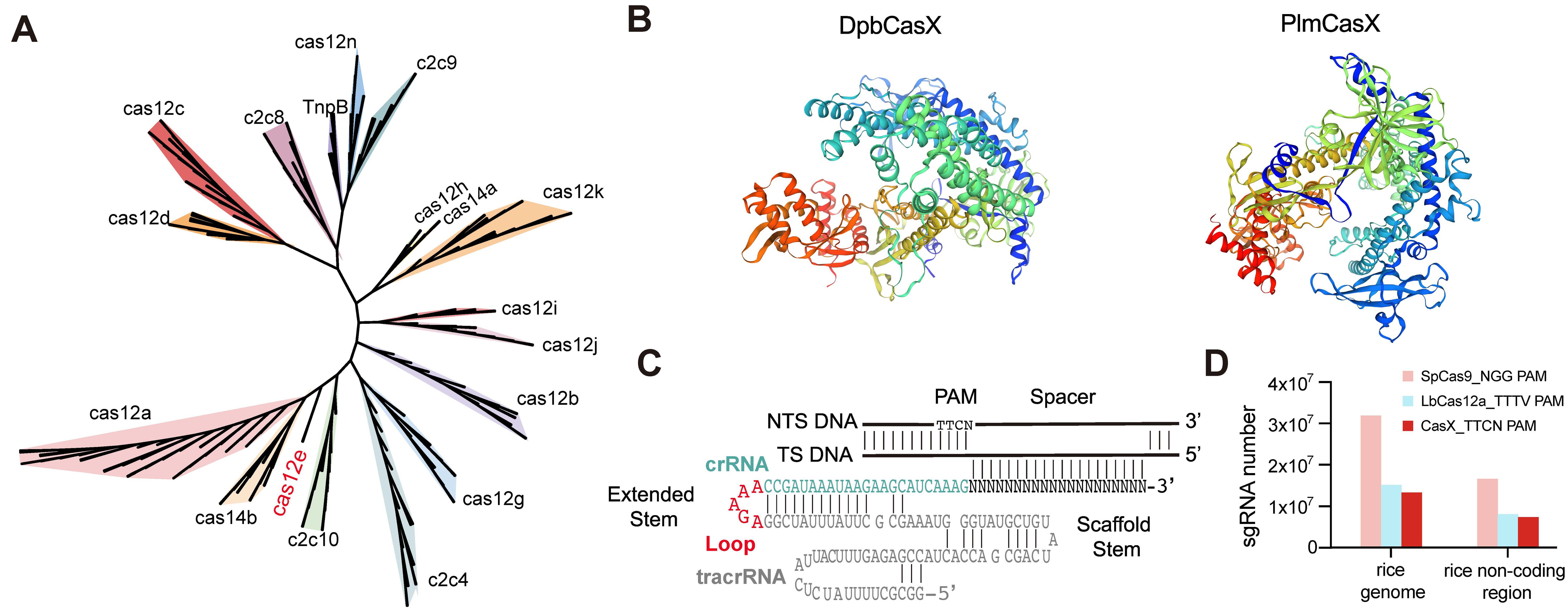
CasX (Cas12e) belongs to the type V CRISPR-Cas family (Fig. 1A) and has been shown to mediate DNA cleavage in mammalian cells. We selected two orthologs, DpbCasX and PlmCasX, and predicted their structures using SWISS-MODEL (Fig. 1B). Unlike other Cas12 proteins that rely solely on crRNA for target recognition, CasX uses a dual RNA structure-crRNA and tracrRNA-to form a single guide RNA scaffold that directs target binding and cleavage (Fig. 1C). Despite demonstrated activity in animal systems, the genome editing capability of CasX in plants remains largely unexplored due to species-specific differences in genome composition and chromatin accessibility.
In the rice genome, the CasX PAM (5′-TTCN-3′) occurs less frequently than the 5′-NGG-3′ PAM of SpCas9 but is enriched in A/T-rich genomic regions, similar to LbCas12a (Fig. 1D). This complementary PAM specificity expands the range of editable loci, highlighting CasX as a promising addition to the plant genome editing toolkit.
DpbCasX and PlmCasX exhibit limited editing activity in rice protoplasts
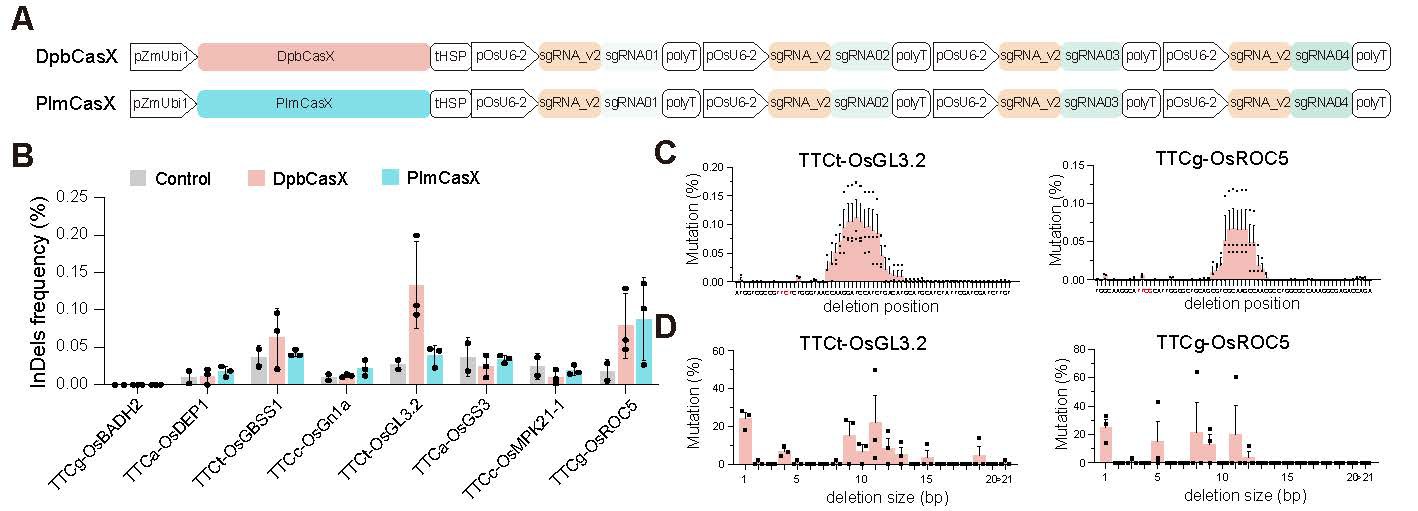
To test CasX function in rice, we codon-optimized DpbCasX and PlmCasX for expression under the maize ZmUbi1 promoter, with sgRNAs driven by the OsU6-2 promoter (Fig. 2A). Eight target sites carrying 5′-TTCN-3′ PAM were selected across different rice genes and grouped into two sgRNA arrays. These constructs were transiently introduced into rice protoplasts, followed by genomic DNA extraction and amplicon sequencing after 48 hours.
Both DpbCasX and PlmCasX showed minimal editing activity in rice protoplasts (Fig. 2B). Editing profiles of detectable sites indicated that CasX primarily induced multi-nucleotide deletions distal to the PAM, consistent with the cleavage pattern of other type V nucleases (Fig. 2C-D, Fig. S1-S2). However, the overall editing frequency remained low, suggesting that wild-type CasX enzymes require further optimization for plant genome editing.
Engineered CasX variants improve editing frequency in rice cells
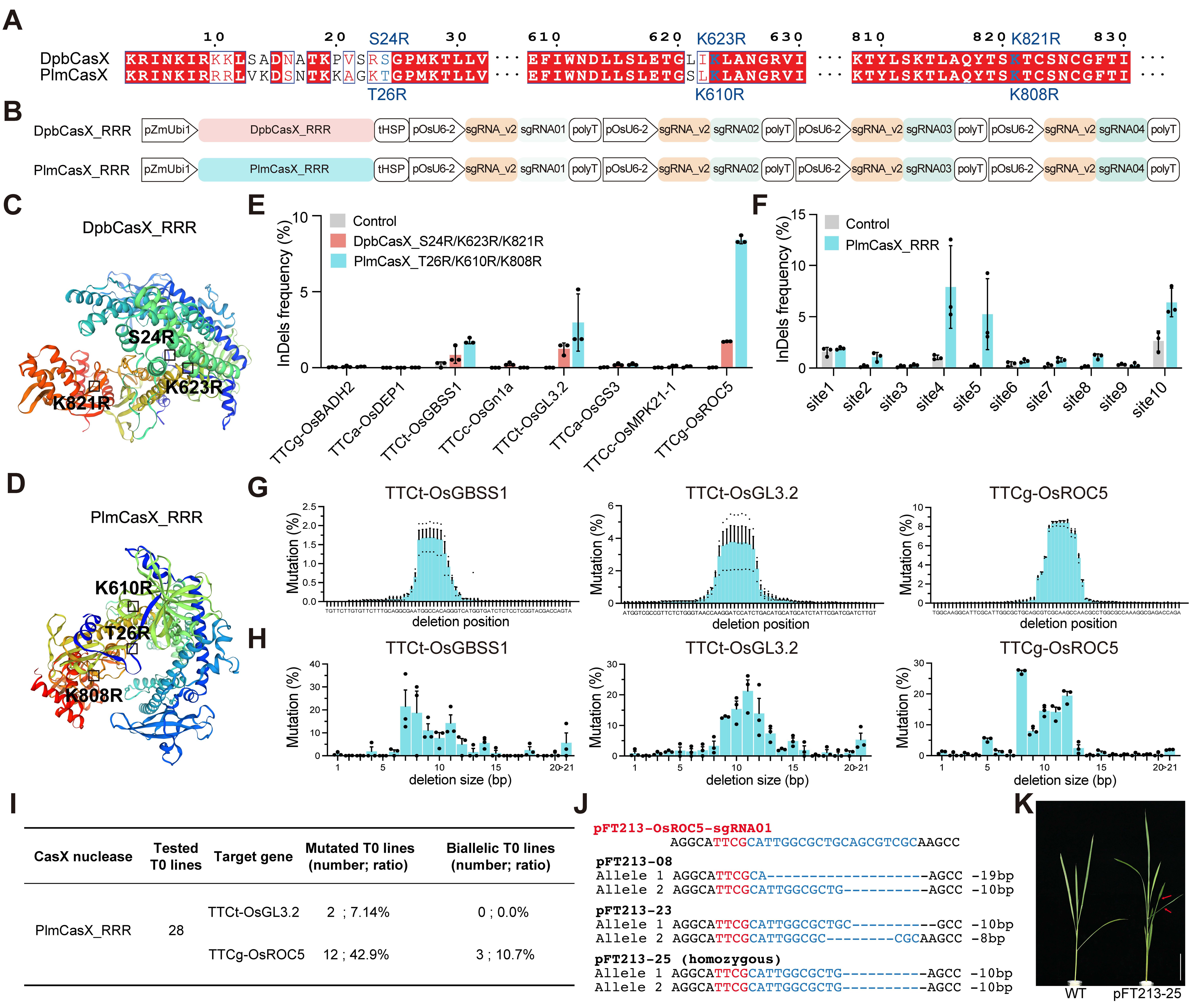
Previous studies have reported enhanced editing by the PlmCasX-T26R/K610R/K880R variant in mammalian cells (Chen et al. 2022). To assess whether similar substitutions could enhance activity in plants, we generated DpbCasX-S24R/K623R/K821R and PlmCasX-T26R/K610R/K880R variants (Fig. 3A-B). Structural modeling revealed that these mutations likely strengthen DNA-protein interactions (Fig. 3C-D).
In protoplast assays, the DpbCasX-S24R/K623R/K821R variant exhibited detectable editing at three loci, whereas PlmCasX-T26R/K610R/K880R achieved higher editing frequencies, up to 8% at certain sites (Fig. 3E). When tested with additional sgRNAs targeting previously validated genomic loci (Zhong et al. 2018), editing was observed at eight of ten targets, with three showing efficiencies above 5% (Fig. 3F).
Deletion profiling revealed that both variants predominantly induced 8-13 bp deletions located 15-27 bp downstream of the PAM (Fig. 3G-H; Fig. S3-S4), consistent with prior studies in non-plant systems (Liu et al. 2019). These results indicate that rationally engineered CasX variants can substantially improve editing frequency while maintaining characteristic deletion patterns (Fig. 3G-H, Fig. S4).
PlmCasX_RRR mediates stable genome editing in transgenic rice
Given its superior activity, the PlmCasX-T26R/K610R/K880R (PlmCasX_RRR) variant was selected for stable transformation via Agrobacterium-mediated delivery. Genotyping of regenerated T₀ plants revealed targeted mutations at multiple loci (Fig. 3I-J; Fig. S5). Notably, OsROC5 biallelic mutants exhibited the characteristic curly-leaf phenotype, we selected the homozygous mutant (pFT213-25) for phenotype display (Fig. 3K), which is consistent with previous functional studies (lowder et al. 2015; Tang et al. 2017).
Among tested targets, the OsROC5 locus showed the highest mutation frequency (Fig. 3I), confirming that CasX_RRR can induce stable, site-specific mutations in rice. In plants edited with PlmCasX_RRR, no off-target mutations were detected, indicating high editing specificity of this variant. (Fig. S6). Collectively, these results establish PlmCasX_RRR as a compact and functional nuclease capable of targeted genome editing and mutant generation in plants.
Discussion
In this study, we evaluated the genome-editing potential of CasX, a compact Type V CRISPR-Cas nuclease, in rice. Our findings demonstrate that CasX, particularly the engineered PlmCasX-T26R/K610R/K880R variant, can mediate targeted mutagenesis in rice with editing frequencies of up to 42.9% at specific loci. These results align with previous observations of robust CasX activity in mammalian systems (Liu et al. 2019; Tsuchida et al. 2022), indicating its broad potential as a genome-editing platform across kingdoms.
Compared with the widely adopted SpCas9 and LbCas12a nucleases ( Zhou et al. 2019; Kuang et al. 2020; Hu et al. 2021; Zhou et al. 2022; Zheng et al. 2023; Pacesa et al. 2024; Zhou et al. 2024; Tuncel et al. 2025), CasX recognizes a distinct 5′-TTCN-3′ PAM, which occurs at a lower frequency in the rice genome. Although this feature may limit the number of editable sites, it also expands the CRISPR targeting landscape by granting access to genomic regions inaccessible to 5′-NGG-3′ or 5′-TTTV-3′ dependent nucleases. Thus, CasX represents a valuable complement to existing CRISPR systems for plant genome engineering.
Mutation profiling revealed that CasX-induced edits predominantly consisted of multi-nucleotide deletions located distal to the PAM, consistent with cleavage patterns reported for other Cas12 family enzymes (Tang et al. 2017; Zhong et al. 2018; Malzahn et al. 2019; Zetsche et al. 2020; Liu et al. 2022; Cheng et al. 2023; Hillary & Ceasar, 2023; Li et al. 2023; Zhang et al. 2023; Karmakar et al. 2024; Liu et al. 2024; Pacesa et al. 2024; Gilbertson et al. 2025; He et al. 2025; Tuncel et al. 2025). Such deletions are particularly advantageous for generating gene knockouts, as they often result in frameshift mutations and complete loss of gene function. CasX predominantly induces multi-nucleotide deletions, mainly 8-13 bp in length, located 15-27 bp downstream of the PAM. Compared to the widely used Cas9, which typically causes 1-bp insertion or deletion, CasX can generate larger deletions, offering a distinct advantage for editing non-coding regions such as promoters and enhancers. Nonetheless, the relatively low activity observed at certain loci suggests that the catalytic efficiency of CasX may still be suboptimal for some genomic contexts in plants.
Several compact nucleases have been developed and successfully applied for genome editing in plants, including Cas12j, Cas12i and TnpB. Cas12j proteins consist of 700-800 amino acids and recognize 5′-VTTV-3′/5′-VTTTV-3′ PAMs (Liu et al. 2022). Cas12i proteins consist of 1000-1100 amino acids and recognize 5′-NTTN-3′ PAMs (He et al. 2025). TnpB family nucleases, such as IsDge10, are composed of 391 amino acids and recognize 5′-TTAT-3′ motifs (TAM) (Zhang et al. 2024). In this study, we developed a CasX nuclease consisting of 986 amino acids, recognizing the 5′-TTCN-3′ sequence. This further expands the toolbox of compact nucleases and provides additional options for targeting more genomic sites.
Further optimization will be required to fully exploit CasX for crop improvement. Strategies such as refining sgRNA architecture, enhancing protein expression and nuclear localization, and engineering variants with broadened PAM compatibility could substantially increase its efficiency and versatility. Exploring natural CasX orthologs or directed evolution approaches may also yield nucleases with improved activity and relaxed PAM recognition suitable for plant systems.
Collectively, our results establish CasX as a compact and functional nuclease capable of generating heritable mutations in rice. The distinct PAM preference and characteristic deletion pattern of CasX expand the current genome-editing repertoire, offering new opportunities for plant functional genomics and molecular breeding.
Acknowledgments
This research was supported by the National Key Research and Development Program of China (2023YFD1202900) to Tang X., the National Natural Science Foundation of China (32471542) to Tang X., and Sichuan Science and Technology Program (2025ZNSFSC0991) to Liu S.-S.
Author contributions
Zhang Y conceived and designed the experiments. Tang X constructed the backbone vector. Fan TT and Yuan M generated all T-DNA editing constructs for rice. Fan TT performed rice protoplast transformation and analyzed mutation frequencies. Fan TT, Yuan M, He Y, Liu, SS and Zheng XL conducted stable rice transformation. Fan TT prepared seedling samples for Sanger sequencing, and Fan TT and Yuan M analyzed sgRNA distributions. Zhang Y, Fan TT and He Y organized the main figures and data analyses, and wrote the manuscript with input from all authors. All authors read and approved the final version of the paper.
ORCID
Ting-Ting Fan: https://orcid.org/0009-0005-5548-4174
Yao He: https://orcid.org/0009-0004-3153-6497
Yong Zhang: https://orcid.org/0000-0003-3704-4835
Conflict of interest statement
The author list includes members of the Editorial Board of PhytoMycology. They were not involved in the journal’s review of, or decisions related to, this manuscript. The authors declare no competing interests.
Data availability
The NGS data generated in this study have been deposited in the National Center for Biotechnology Information (NCBI) database under the Sequence Read Archive (SRA), with the BioProject ID PRJNA1524588.
Supplementary Information
The online version contains supplemental information available at https://doi.org/10.65390/phytomyc.2026.2002
Rights and permissions
The Author(s) 2026. Published by BioAcademic Press on behalf of School of Life Science and Technology, University of Electronic Science and Technology of China and Faculty of Agriculture, Chiang Mai University. This is an open access article under the Creative Commons Attribution license (http://creativecommons.org/licenses/by/4.0), which permits use, distribution and reproduction in any medium, provided the original work is properly cited.
References
- Anzalone AV, Koblan LW, Liu DR (2020) Genome editing with CRISPR-Cas nucleases, base editors, transposases and prime editors. Nature Biotechnology 38:824–844.
https://doi.org/10.1038/s41587-020-0561-9 - Burstein D, Harrington LB, Strutt SC, Probst AJ, Anantharaman K, Thomas BC, Doudna JA, Banfield JF (2017) New CRISPR-Cas systems from uncultivated microbes. Nature 542:237–241.
https://doi.org/10.1038/nature21059 - Chen W, Ma J, Wu Z, Wang Z, Zhang H, Fu W, Pan D, Shi J, Ji Q (2023) Cas12n nucleases, early evolutionary intermediates of type V CRISPR, comprise a distinct family of miniature genome editors. Molecular Cell.
https://doi.org/10.1016/j.molcel.2023.06.014 - Chen Y, Hu Y, Wang X, Luo S, Yang N, Chen Y, Li Z, Zhou Q, Li W (2022) Synergistic engineering of CRISPR-Cas nucleases enables robust mammalian genome editing. The Innovation 3:100264.
https://doi.org/10.1016/j.xinn.2022.100264 - Cheng Y, Zhang Y, Li G, Fang H, Sretenovic S, Fan A, Li J, Xu J, Que Q, Qi Y (2023) CRISPR-Cas12a base editors confer efficient multiplexed genome editing in rice. Plant Communications 4:100601.
https://doi.org/10.1016/j.xplc.2023.100601 - Gilbertson L, Puchta H, Slotkin RK (2025) The future of genome editing in plants. Nature Plants 11:680–685.
https://doi.org/10.1038/s41477-025-01956-4 - Han Y, Liu G, Wu Y, Bao Y, Zhang Y, Zhang T (2024) CrisprStitch: fast evaluation of the efficiency of CRISPR editing systems. Plant Communications 5:100783.
https://doi.org/10.1016/j.xplc.2023.100783 - He Y, Liao S, Ren Q, Tang X, Zheng X, Qi Y, Zhang Y (2025) CRISPR-Cas12i confers efficient genome editing and gene regulation in plants. Plant Physiology 198.
https://doi.org/10.1093/plphys/kiaf125 - Hillary VE, Ceasar SA (2023) A review on the mechanism and applications of CRISPR/Cas9/Cas12/Cas13/Cas14 proteins utilized for genome engineering. Molecular Biotechnology 65:311–325.
https://doi.org/10.1007/s12033-022-00567-0 - Hu D, Yu Y, Wang C, Long Y, Liu Y, Feng L, Lu D, Liu B, Jia J, Xia R et al (2021) Multiplex CRISPR-Cas9 editing of DNA methyltransferases in rice uncovers a class of non-CG methylation specific for GC-rich regions. The Plant Cell 33:2950–2964.
https://doi.org/10.1093/plcell/koab162 - Jiang W, Bikard D, Cox D, Zhang F, Marraffini LA (2013) RNA-guided editing of bacterial genomes using CRISPR-Cas systems. Nature Biotechnology 31:233–239.
https://doi.org/10.1038/nbt.2508 - Jinek M, Chylinski K, Fonfara I, Hauer M, Doudna JA, Charpentier E (2012) A programmable dual-RNA-guided DNA endonuclease in adaptive bacterial immunity. Science 337:816–821.
https://doi.org/10.1126/science.1225829 - Karmakar S, Panda D, Panda S, Dash M, Saha R, Das P, Avinash SP, Shih J, Yang Y, Nayak AK et al (2024) A miniature alternative to Cas9 and Cas12: transposon-associated TnpB mediates targeted genome editing in plants. Plant Biotechnology Journal 22:2950–2953.
https://doi.org/10.1111/pbi.14416 - Kuang Y, Li S, Ren B, Yan F, Spetz C, Li X, Zhou X, Zhou H (2020) Base-editing-mediated artificial evolution of OsALS1 in planta to develop novel herbicide-tolerant rice germplasms. Molecular Plant 13:565–572.
https://doi.org/10.1016/j.molp.2020.01.010 - Le Cong, Ran FA, Cox D, Lin S, Barretto R, Habib N, Hsu PD, Wu X, Jiang W, Marraffini LA et al (2013) Multiplex genome engineering using CRISPR-Cas systems. Science 339:819–823.
https://doi.org/10.1126/science.1231143 - Li G, An L, Yang W, Yang L, Wei T, Shi J, Wang J, Doonan JH, Xie K, Fernie AR et al (2025) Integrated biotechnological and AI innovations for crop improvement. Nature 643:925–937.
https://doi.org/10.1038/s41586-025-09122-8 - Li G, Zhang Y, Dailey M, Qi Y (2023) Hs1Cas12a and Ev1Cas12a confer efficient genome editing in plants. Frontiers in Genome Editing 5:1251903.
https://doi.org/10.3389/fgeed.2023.1251903 - Liu JJ, Orlova N, Oakes BL, Ma E, Spinner HB, Baney KLM, Chuck J, Tan D, Knott GJ, Harrington LB et al (2019) CasX enzymes comprise a distinct family of RNA-guided genome editors. Nature 566:218–223.
https://doi.org/10.1038/s41586-019-0908-x - Liu S, He Y, Fan T, Zhu M, Qi C, Ma Y, Yang M, Yang L, Tang X, Zhou J et al (2024) PAM-relaxed and temperature-tolerant CRISPR-Mb3Cas12a single transcript unit systems for efficient singular and multiplexed genome editing in rice, maize, and tomato. Plant Biotechnology Journal.
https://doi.org/10.1111/pbi.14486 - Liu S, Sretenovic S, Fan T, Cheng Y, Li G, Qi A, Tang X, Xu Y, Guo W, Zhong Z et al (2022) Hypercompact CRISPR-Cas12j2 (CasPhi) enables genome editing, gene activation, and epigenome editing in plants. Plant Communications 3:100453.
https://doi.org/10.1016/j.xplc.2022.100453 - Lowder LG, Zhang D, Baltes NJ, Paul JW III, Tang X, Zheng X, Voytas DF, Hsieh TF, Zhang Y, Qi Y (2015) A CRISPR/Cas9 toolbox for multiplexed plant genome editing and transcriptional regulation. Plant Physiology 169:971–985.
https://doi.org/10.1104/pp.15.00636 - Malzahn AA, Tang X, Lee K, Ren Q, Sretenovic S, Zhang Y, Chen H, Kang M, Bao Y, Zheng X et al (2019) Application of CRISPR-Cas12a temperature sensitivity for improved genome editing in rice, maize, and Arabidopsis. BMC Biology 17:9.
https://doi.org/10.1186/s12915-019-0629-5 - Pacesa M, Pelea O, Jinek M (2024) Past, present, and future of CRISPR genome editing technologies. Cell 187:1076–1100.
https://doi.org/10.1016/j.cell.2024.01.042 - Stewart CN Jr, Via LE (1993) A rapid CTAB DNA isolation technique useful for RAPD fingerprinting and other PCR applications. Biotechniques 14:748–750.
- Tang X, Lowder LG, Zhang T, Malzahn AA, Zheng X, Voytas DF, Zhong Z, Chen Y, Ren Q, Li Q et al (2017) A CRISPR-Cpf1 system for efficient genome editing and transcriptional repression in plants. Nature Plants 3:17018.
https://doi.org/10.1038/nplants.2017.18 - Tang X, Zheng X, Qi Y, Zhang D, Cheng Y, Tang A, Voytas DF, Zhang Y (2016) A single transcript CRISPR-Cas9 system for efficient genome editing in plants. Molecular Plant 9:1088–1091.
https://doi.org/10.1016/j.molp.2016.05.001 - Tsuchida CA, Zhang S, Doost MS, Zhao Y, Wang J, O'Brien E, Fang H, Li CP, Li D, Hai ZY et al (2022) Chimeric CRISPR-CasX enzymes and guide RNAs for improved genome editing activity. Molecular Cell 82:1199–1209.e6.
https://doi.org/10.1016/j.molcel.2022.02.002 - Tuncel A, Pan C, Clem JS, Liu D, Qi Y (2025) CRISPR-Cas applications in agriculture and plant research. Nature Reviews Molecular Cell Biology.
https://doi.org/10.1038/s41580-025-00834-3 - Yan WX, Hunnewell P, Alfonse LE, Carte JM, Keston-Smith E, Sothiselvam S, Garrity AJ, Chong S, Makarova KS, Koonin EV et al (2019) Functionally diverse type V CRISPR-Cas systems. Science 363:88–91.
https://doi.org/10.1126/science.aav7271 - You Q, Zhong Z, Ren Q, Hassan F, Zhang Y, Zhang T (2018) CRISPRMatch: an automatic calculation and visualization tool for high-throughput CRISPR genome-editing data analysis. International Journal of Biological Sciences 14:858–862.
https://doi.org/10.7150/ijbs.24581 - Yu L, Marchisio MA (2023) Scaffold RNA engineering in type V CRISPR-Cas systems: a potent way to enhance gene expression in the yeast Saccharomyces cerevisiae. Nucleic Acids Research.
https://doi.org/10.1093/nar/gkad1216 - Zetsche B, Abudayyeh OO, Gootenberg JS, Scott DA, Zhang F (2020) A survey of genome editing activity for 16 Cas12a orthologs. Keio Journal of Medicine 69:59–65.
https://doi.org/10.2302/kjm.2019-0009-OA - Zetsche B, Gootenberg JS, Abudayyeh OO, Slaymaker IM, Makarova KS, Essletzbichler P, Volz SE, Joung J, van der Oost J, Regev A et al (2015) Cpf1 is a single RNA-guided endonuclease of a class 2 CRISPR-Cas system. Cell 163:759–771.
https://doi.org/10.1016/j.cell.2015.09.038 - Zhang L, Li G, Zhang Y, Cheng Y, Roberts N, Glenn SE, DeZwaan-McCabe D, Rube HT, Manthey J, Coleman G et al (2023) Boosting genome editing efficiency in human cells and plants with novel LbCas12a variants. Genome Biology 24:102.
https://doi.org/10.1186/s13059-023-02929-6 - Zhang R, Tang X, He Y, Li Y, Wang W, Wang Y, Wang D, Zheng X, Qi Y, Zhang Y (2024) IsDge10 is a hypercompact TnpB nuclease that confers efficient genome editing in rice. Plant Communications:101068.
https://doi.org/10.1016/j.xplc.2024.101068 - Zheng X, Zhang S, Liang Y, Zhang R, Liu L, Qin P, Zhang Z, Wang Y, Zhou J, Tang X et al (2023) Loss-function mutants of OsCKX gene family based on CRISPR-Cas systems revealed their diversified roles in rice. The Plant Genome 16:e20283.
https://doi.org/10.1002/tpg2.20283 - Zhong Z, Zhang Y, You Q, Tang X, Ren Q, Liu S, Yang L, Wang Y, Liu X, Liu B et al (2018) Plant genome editing using FnCpf1 and LbCpf1 nucleases at redefined and altered PAM sites. Molecular Plant 11:999–1002.
https://doi.org/10.1016/j.molp.2018.03.008 - Zhou J, Xin X, He Y, Chen H, Li Q, Tang X, Zhong Z, Deng K, Zheng X, Akher SA et al (2019) Multiplex QTL editing of grain-related genes improves yield in elite rice varieties. Plant Cell Reports 38:475–485.
https://doi.org/10.1007/s00299-018-2340-3 - Zhou J, Zhang R, Jia X, Tang X, Guo Y, Yang H, Zheng X, Qian Q, Qi Y, Zhang Y (2022) CRISPR-Cas9 mediated OsMIR168a knockout reveals its pleiotropy in rice. Plant Biotechnology Journal 20:310–322.
https://doi.org/10.1111/pbi.13713 - Zhou S, Cai L, Wu H, Wang B, Gu B, Cui S, Huang X, Xu Z, Hao B, Hou H et al (2024) Fine-tuning rice heading date through multiplex editing of the regulatory regions of key genes by CRISPR-Cas9. Plant Biotechnology Journal 22:751–758.
https://doi.org/10.1111/pbi.14221