Abstract
Introduction
Modern mycology has shifted from traditional morphology-based approaches, and multigene phylogenetics to data-driven, globally connected systems for taxonomy, phylogeny, biodiversity assessment, and species identification (Hyde et al. 2023, 2024a; de Hoog et al. 2024; Gherbawy et al. 2025). With the advent of digital taxonomy, traditional monographs and regional floras are being enhanced and complemented by global online databases that store fungal names, descriptions, and DNA sequence information (Prakash et al. 2017; Chaiwan et al. 2021; Ullah et al. 2022; Zhou and May 2023; Hyde et al. 2024a). These advances have transformed how fungal diversity is studied, classified, and communicated. Today, fungal research relies heavily on these online databases that standardize and integrate fungal knowledge and serve as global repositories for fungal names, sequences, and taxonomic frameworks (Prakash et al. 2017; Gautam et al. 2022; Ullah et al. 2022; Abarenkov et al. 2024; Hyde et al. 2024a). Among these online databases, Species Fungorum, MycoBank, Fungal Names, GenBank, and UNITE are widely used for mycological research, each playing a distinct role in name registration, molecular identification, and taxonomic reference (Prakash et al. 2017; Wijayawardene et al. 2020a; Gautam et al. 2022; Ullah et al. 2022; Wang et al. 2023a; Abarenkov et al. 2024; Hyde et al. 2024b; de Hoog et al. 2024).
Since 2013, the effective publication of any new fungal name under the International Code of Nomenclature for algae, fungi, and plants (ICNafp) must include a unique identifier issued by a recognized repository; i.e. Fungal Names, Index Fungorum and MycoBank (Turland et al. 2025). Each of these three databases has an associated taxonomic database, providing a “current name,” while explicitly stating that they are not authoritative sources for fungal taxonomy. Thus, these three databases function as integrated resources for nomenclature, taxonomy, and type information (Lücking et al. 2020). They contain some of the most comprehensive data on fungal names and are widely used by end users to verify the correct form and usage of a name. The name database (nomenclator) is provided within the same web interface in MycoBank and Fungal Names, whereas Species Fungorum is the taxonomic database linked to the name database Index Fungorum (although Index Fungorum also provides a taxonomy in search results). GenBank is primarily a global database for DNA sequences, while UNITE is a system for assigning sequences to species hypotheses (Abarenkov et al. 2024).
Complementing these resources, researchers continuously provide the most up-to-date fungal classifications via annual publications (Wijayawardene et al. 2020b; Hyde et al. 2024b) and continuously updated websites such as 2024 Outline of Fungi (OUTLINE OF FUNGI). Together, these digital platforms open a new era of precision, accessibility, and collaboration in fungal research.
These mycological databases play an essential role in modern fungal taxonomic research by providing the authoritative infrastructure needed to name, classify, and track fungal taxa across diverse disciplines (Crous et al. 2004; Hawksworth et al. 2010; Gautam et al. 2022; Hyde et al. 2024a; Gherbawy et al. 2025). Taxonomists rely on these platforms to stabilize names and update classifications, while ecologists, medical mycologists, and agricultural scientists use them to monitor biodiversity, detect pathogens, and support disease management (Crous et al. 2004; Hawksworth et al. 2010; Gautam et al. 2022; Hyde et al. 2024a, b). These digital resources are routinely used as reference points for species identification, sequence submission, biodiversity surveys, and nomenclatural verification (Crous et al. 2004; Hawksworth et al. 2010; Gautam et al. 2022). As global fungal diversity studies, together with molecular data, environmental sequencing and phylogenomics continue to expand, the accuracy and consistency of these databases have become increasingly important (Rawson & Zahn 2023).
Despite their importance, different research groups independently update these mycological databases. Frequent taxonomic revisions are incorporated into different databases at different times, or sometimes not at all; therefore, substantial discrepancies persist among these platforms (Prakash et al. 2017; Hyde et al. 2024a). As a result, inconsistencies frequently arise in family assignments, hierarchical placement, synonymy, and the continued use of outdated or conflicting names, creating confusion for researchers and leading to inconsistent applications of taxonomic concepts (Prakash et al. 2017; Hyde et al. 2024a).
Inconsistencies among major fungal databases have farreaching implications for research and applied mycology. Conflicting classifications can lead to misidentifications, incorrect ecological interpretations, reduced reproducibility of research outcomes, and inflated diversity estimates in metabarcoding and environmental DNA studies, thereby undermining biodiversity assessments, ecological, biogeographic, and conservation analyses, and distorting inferred community patterns and species distributions (Prakash et al. 2017; Rawson & Zahn 2023; de Hoog et al. 2024; Hyde et al. 2024a). In medical and agricultural fields, unstable nomenclature complicates disease diagnostics, quarantine decisions, and pathogen surveillance, prompting concerns from clinical mycologists about the confusion caused by inconsistent taxonomic frameworks (Rawson & Zahn 2023; de Hoog et al. 2024). However, it is important to recognize that name changes are an inherent and necessary aspect of scientific progress.
There are two main reasons for name changes. The first is nomenclatural, due to the application of the rules of nomenclature as laid out in the ICNafp (Turland et al. 2025). Nomenclatural changes occur for reasons such as (1) a name is a homonym of an earlier name and must therefore be replaced, (2) a name is illegitimate (because its circumscription includes the type of an earlier name) and therefore should not be used, or (3) a name that would not be available is conserved, for example to keep using a name in current use over a recently discovered earlier synonym. Name changes for nomenclatural reasons must be followed, because they occur as a result of the application of the Code. Nomenclatural changes are adopted relatively quickly in name databases because the name databases are curated by experts in nomenclature.
The second reason for name changes is taxonomic. Taxonomic changes are an opinion, not governed by any set of rules, but accepted by community uptake especially in authoritative sources. Taxonomic changes include (1) synonymy, the placing of a later name under an earlier name because it is determined that both names apply to the same taxon, (2) splitting, where a name is found to apply to two different taxa, one of which needs to be named as new (or an earlier name formerly placed in synonymy needs to be re-instated), (3) rank changes, where a name at a certain rank is considered to apply at a different rank, such as when a subgeneric name is elevated to generic rank, (4) alterations to the placement of a name in the taxonomic hierarchy, such as when a generic name is moved from one family to another. Name changes for taxonomic reasons occur when new information comes to light or existing information is re-assessed. Taxonomic changes are the commonest types of name changes (May 2021).
While adapting to updated taxonomy can create short-term confusion and resistance among taxonomists, uptake of the most current names can ultimately lead to improved accuracy and communication. The placement of a name in a taxonomic hierarchy, at all levels from genus to phylum, is a shorthand for the relationships of an organism and the relationships of organisms have predictive value across various phenotypic properties (traits), including for aspects such as trophic mode (Põlme et al. 2020). Resistance to taxonomic changes often reflects transitional difficulties in a rapidly evolving field (Kidd et al. 2023). Recent studies suggest that the effects of name instability are often exaggerated and that taxonomic changes are both inevitable and a beneficial part of advancing knowledge when properly managed (Kidd et al. 2023). These views suggest that the primary challenge lies not in taxonomic change itself, but in the lack of coordinated and transparent systems to support its implementation across databases, emphasizing the need to balance taxonomic stability with ongoing refinements to classification systems.
Standardizing the main mycological databases, or at least synchronizing their taxonomic backbones, is therefore needed. Many mycological studies report on the different classifications presented by the major databases as if there were fundamental differences between the opinions of each database. Regularly coordinated updates and systematic crossreferencing between databases would save needless comparisons and allow researchers to work from a unified framework, rather than navigating conflicting classifications and outdated names (Wijayawardene et al. 2020a). This article documents the extent of taxonomic discrepancies among the major mycological databases and interrogates the reasons for such discrepancies. By examining representative inconsistencies and discussing their implications, we aim to encourage a dialogue towards building a unified and regularly updated reference framework for the Kingdom Fungi.
Material and methods
Data sources and database selection
A comparative spreadsheet was prepared to evaluate classification inconsistencies among major fungal taxonomic resources. The genus-level classification in the 2024 Outline of Fungi (Hyde et al. 2024b) was used as the primary reference framework. Corresponding classifications for the same genera were then compiled from Species Fungorum (Species Fungorum), MycoBank (MYCOBANK Database), Fungal Names (Fungal Names), The Yeasts.org database (The Yeasts Database), GenBank (National Library of Medicine) and UNITE (UNITE). These resources were selected since they are widely used for fungal name registration, taxonomic verification, molecular identification, sequence annotation and biodiversity studies.
Compilation of taxonomic classifications
For each genus listed in the 2024 Outline of Fungi, available classification information was compiled from Species Fungorum, MycoBank, GenBank and UNITE. The recorded classification included higher-rank placements at family, order, subclass, class, subphylum and phylum levels. When a source did not provide information for a particular rank, the field was treated as missing. Only genus-level classifications were compared in the main dataset. Species-level discrepancies were not systematically analysed. However, selected species-level examples are discussed where they helped explain broader genus-level problems, such as outdated names, cross-code homonyms, or sequence-based misclassification.
Identification of classification discrepancies
Classification discrepancies were identified by comparing the placement of each genus across the data sources included in the compiled spreadsheet. Comparisons were made separately at each taxonomic rank: family, order, subclass, class, subphylum and phylum. A discrepancy was recorded when the same genus had two or more different non-missing classifications at the same rank. Genera with identical classifications across the compared sources were treated as non-conflicting for the relevant rank. Missing values were not treated as direct taxonomic conflicts. Instead, they were analysed separately as indicators of incomplete taxonomic information. Records listed as incertae sedis, “unclassified” or with rank-specific terms such as “Ascomycota fam. incertae sedis” or “Pezizomycotina ord. incertae sedis” were recorded as unresolved or uncertain classifications and considered separately from precise taxonomic placements.
Treatment of missing data and unresolved classifications
Missing taxonomic fields were recorded when a data source did not provide classification information at a particular rank. The number of missing records was summarized for each data source and taxonomic rank. This allowed us to evaluate the completeness of the compiled taxonomic information in addition to the level of classification agreement. Unresolved placements were recorded when a data source used terms such as incertae sedis, “unclassified” or similar term classifications. These were not automatically interpreted as errors, because they may reflect genuine taxonomic uncertainty. However, inconsistent use of such terms among sources was noted as a source of classification incompatibility.
Detection of cross-code homonyms
Cross-code homonyms occur when exactly the same name has been introduced by different author/s for two different taxa that are treated under different codes of nomenclature, such as when a name has been introduced for a taxon in the fungal kingdom and the same name has been introduced for a different taxon in the animal kingdom. Cross-code homonyms were identified when a genus name treated as fungal in specialist fungal resources was linked to a non-fungal lineage in GenBank or another source. These cases were recorded separately because they represent a different type of problem from ordinary disagreement within fungal classification. The non-fungal classifications were grouped according to major lineages, including animals, plants, bacteria, algae, protists and viruses. Particular attention was given to cases where the same genus name was associated with fungal classifications in the 2024 Outline of Fungi, Species Fungorum, MycoBank, or UNITE, but with animal classifications in GenBank.
Data analysis and summary
The compiled spreadsheet was analysed to identify how often the same genus had different classifications among the data sources included in the dataset. For each genus, classifications were compared at six major taxonomic ranks: family, order, subclass, class, subphylum, and phylum. A conflict was recorded when the same genus had two or more different non-missing classifications at the same rank. Missing information was analysed separately. For each data source in the spreadsheet, we counted how many genera lacked classification information at each taxonomic rank. This allowed us to evaluate both classification disagreement and completeness of the compiled taxonomic information. Representative examples were selected to show the main types of inconsistencies observed in the dataset. These included family- and order-level disagreements, higher-rank conflicts, incertae sedis placements, missing classifications, outdated classifications, and cases where the same genus name was linked to fungal and non-fungal classifications.
The results are summarized descriptively because the aim of the study was to document the extent and types of classification discrepancies in the compiled dataset, rather than to test a statistical hypothesis. Case studies from major fungal groups were also included to explain how these database-level inconsistencies affect taxonomic, ecological, and sequence-based studies.
Global Scientific Footprint and Adoption of Mycological Databases
To understand the use of each database in this study, we conducted a bibliometric analysis by retrieving documents indexed in Scopus in May 2026. These targeted entities were structured into two operational niches: nomenclatural and taxonomic repositories, comprising Species Fungorum, MycoBank, and Fungal Names; and molecular sequence databases, comprising GenBank and UNITE. The collected data, including publication years, author affiliation countries, and keyword configurations, were exported. Data was processed using a standardized data pipeline to clean regional naming variants and to compute annual citation aggregates. The final analytical results comprise a temporal line trajectory from 2010 to 2026. This resulted in a global geospatial distribution choropleth map tracking total citation density and a 100% horizontally stacked bar chart evaluating the proportional repository preferences among the top 20 most prolific-citing countries.
Results
The dataset comprised 10,693 genus-level records. For each genus, available classification information was compiled at the ranks of family, order, subclass, class, subphylum, and phylum. The spreadsheet was completed on 10 October 2025. Therefore, some records may have changed subsequently because online databases are continuously updated (Supplementary dataset 1). Of the 10,693 records, 6,127 (57.29%) had conflicting classifications. The following case studies highlight representative examples from different fungal lineages and applied fields. Together, they show how classification inconsistencies emerge from different sources and why a standardized, regularly updated and interoperable fungal classification framework is needed.
Comparative overview across major groups
Ascomycota Caval.-Sm.
Dothideomycetes O.E. Erikss. & Winka
Dothideomycetes is one of the largest and most taxonomically complex classes in Ascomycota, comprising saprobes, endophytes, epiphytes, lichenized fungi, and numerous economically important plant pathogens (Pem et al. 2024). The broad ecological range and morphological heterogeneity of Dothideomycetes, combined with increasing multigene and phylogenomic evidence, have led to frequent revisions of family- and order-level classification. In recent years, higher-level relationships in this group have been revised repeatedly. These changes reflect not only the discovery of new taxa but also the continuing re-evaluation of long-established concepts (Hongsanan et al. 2020a, b; Pem et al. 2024; Hyde et al. 2024a). Changes in the circumscription of orders and families in Dothideomycetes are frequent and arise from several related factors. Firstly, many morphological characters traditionally used in classification tend to be homoplasious. Features such as bitunicate asci, pseudothecial ascomata, septate ascospores, and similar asexual morphs occur across unrelated lineages, often making it difficult to infer natural relationships based on morphology alone (Hongsanan et al. 2020a). Secondly, multigene phylogenetic studies, and more recently phylogenomic data, have shown that many families and orders, as previously defined, are either polyphyletic or not well-delimited. Thirdly, many new taxa are being described, particularly from underexplored habitats such as freshwater, marine environments, bamboo-associated niches, and tropical microfungal communities, and this continues to affect how existing families are defined (Pem et al. 2024; Hyde et al. 2024b; Xu et al. 2025). As a result, higher-level taxonomy in Dothideomycetes is in flux, rather than simply being refined.
These taxonomic changes are further complicated by inconsistencies among major fungal databases. Since Species Fungorum, MycoBank, Fungal Names, and GenBank differ in their purpose, curation, and update frequency, they often represent different stages in the adoption of revised classifications. The comparative dataset prepared for this study shows that discrepancies in the placement of Dothideomycetes genera are common across databases. These inconsistencies are not just taxonomic issues; they also influence how taxa are interpreted in ecological, phylogenetic, diagnostic, and biodiversity studies. Several examples highlight this issue. Fumagospora is placed in Readerielliopsidaceae (Capnodiales) in Abdollahzadeh et al. (2020). In the comparative dataset, Species Fungorum, MycoBank, and UNITE placed it in Capnodiaceae, while the 2024 Outline of Fungi and GenBank updated it to Readerielliopsidaceae. This example reflects a common issue in Dothideomycetes, that newly defined or recently recognized families are not adopted consistently across databases, and some follow broader or older family concepts. Similarly, Neoplatysporoides is treated as a member of Libertasomycetaceae in the 2024 Outline of Fungi, Species Fungorum, MycoBank, Fungal Names and the UNITE, but appears under Pleosporaceae in GenBank. Another notable example is Brunneoclavispora which is placed in Didymosphaeriaceae in Species Fungorum, but in MycoBank, Fungal Names, GenBank, and UNITE it is assigned to Halotthiaceae. Together, these examples show that higher-level placements in Dothideomycetes is often inconsistent, not only in the literature but also across the databases used in fungal taxonomy.
The uneven recognition of newly introduced families is a common issue in Dothideomycetes. Many families have been established or redefined based on phylogenetic evidence, but they are not always adopted consistently across databases. The difference between availability of names and taxonomic uptake is important. Databases focused on name registration often adopt new names quickly, while sequence- or identification-based platforms tend to retain older taxonomic frameworks. As a result, genera belonging to recently established families may be placed in different families or remain without a clear family placement, depending on the database used (Prakash et al. 2017; Abarenkov et al. 2024; Hyde et al. 2024b).
Differences between GenBank and UNITE are particularly relevant in Dothideomycetes. Although both are widely used as reference resources, they are based on different taxonomic frameworks. GenBank is based on the GenBank framework and serves as a repository for sequence submissions across all domains of life. Consequently, its taxonomy is broad in scope and often reflects historical annotations associated with submitted records. UNITE is a database developed for the molecular identification of fungi, based on ITS sequence data and the use of Species Hypotheses (SHs) to facilitate taxonomic communication (Abarenkov et al. 2024). In Dothideomycetes, where many taxa remain poorly sampled and family concepts are evolving, different frameworks can lead to different interpretations. GenBank often reflects older taxonomic usage, whereas UNITE emphasizes sequence-based clustering and more recent taxonomic concepts. Consequently, the two databases may differ not only in family assignments but also in the definition of taxonomic units.
Another issue in Dothideomycetes is the large number of taxa treated as incertae sedis. This status reflects genuine uncertainty arising from incomplete or conflicting evidence, rather than simply missing information. Hongsanan et al. (2020a, b) reported that many families and genera in Dothideomycetes remain difficult to place with confidence due to limited molecular data, lack of sequence data from type or representative material, and incongruence between morphological and phylogenetic evidence. In many cases, taxa originally assigned based on morphology alone have not been re-evaluated with sufficient molecular data. In other cases, available sequence data suggest affinities that remain weakly supported or inconsistent across analyses. Under these conditions, retaining taxa as incertae sedis may be preferable to assigning them to families of uncertain affinity. However, incertae sedis taxa are not treated consistently across databases. One database may retain a genus as Dothideomycetes incertae sedis, whereas another may assign it to a family to maintain classification structure. This may create an impression of consensus where none exists. For users who are not taxonomic specialists, such differences may be difficult to detect and may be interpreted as evidence of stable placement. In this context, incertae sedis in Dothideomycetes reflects both unresolved taxonomy and differences between database structure and taxonomic caution.
These inconsistencies have important implications. In systematic and phylogenetic studies, the use of different taxonomic backbones can make comparable datasets difficult to accommodate. Genera assigned to different families in different databases may appear to support conflicting interpretations of relationships, even when based on the same underlying biological material. The effects may be even more pronounced in metabarcoding and environmental sequencing studies, where taxonomic assignments are highly sensitive to the reference database used. Differences among GenBank, UNITE, and literature-based frameworks can affect species richness estimates, ecological interpretations, and community composition (Abarenkov et al. 2024). This is particularly relevant for Dothideomycetes, which is well-represented in environmental datasets but remains unstable at higher taxonomic levels. The consequences also extend to applied mycology. Many members of Dothideomycetes are plant-associated fungi, including important pathogens. Instability in names and higher-level placement can complicate disease diagnosis, literature retrieval, quarantine documentation, and communication between taxonomists, plant pathologists, and regulatory authorities. More broadly, inconsistencies among taxonomic databases reduce reproducibility and make it difficult to integrate data, an issue that has been widely recognized in fungal taxonomy (Prakash et al. 2017; de Hoog et al. 2024).
In summary, Dothideomycetes highlights how taxonomic instability can arise when rapid phylogenetic revision interacts with independently curated databases. Frequent changes in family and order concepts, uneven recognition of newly established families, differences among major taxonomic databases (including Species Fungorum, MycoBank, GenBank, and UNITE), and the persistent presence of incertae sedis taxa all contribute to a fragmented classification. These issues affect taxonomy, phylogeny, biodiversity studies, metabarcoding, and plant pathology. Better coordination among major fungal databases, together with clear reporting of the taxonomic backbone used in individual studies, will be important for improving consistency and data integration in Dothideomycetes.
Frequent transformations of orders and families in Dothideomycetes
Dothideomycetes is a taxonomically complex class, and as more taxa are sampled with multi-gene phylogenies, many morphology-based placements turn out to be unstable or incomplete. Based on multigene phylogeny, Schoch et al. (2006) split Dothideomycetes into two main lineages (Sub-Classes), Pleosporomycetidae and Dothideomycetidae, and proposed the new order Botryosphaeriales (Order incertae sedis). Also, Schoch et al. (2006) moved Chaetothyriales and Coryneliales from Dothideomycetes and placed them in Eurotiomycetes.
Hyde et al. (2013) accepted 105 families in Dothideomycetes with ten new families and seven new orders. Later, Wijayawardene et al. (2014) listed 23 orders, 110 families, and 1,261 genera as an outline and proposed single generic names for pleomorphic genera. Liu et al. (2017) provided an updated phylogenetic assessment of Dothideomycetes with additional ten orders and 35 families, signifying divergence times for most orders and families. Pem et al. (2019) revealed three new families from incertae sedis genera. Hongsanan et al. (2020b) accept three orders with 25 families and four orders with 94 families in Dothideomycetidae and Pleosporomycetidae, respectively. Hongsanan et al. (2020a) placed 31 orders and 41 families as incertae sedis while adding a new order and four new families. Barreto et al. (2024) worked on incertae sedis genera associated with Myriangiales, using morphology, lifestyle and phylogenetic inferences. Nevertheless, some black meristematic fungi could not be accommodated in Myriangiales; hence, Barreto et al. (2024) introduced three new orders and two new families. This shows that even fairly specialized clades within Dothideomycetes can get reorganized when fresh materials and DNA data become available.
Taxonomic discrepancies and update lags of Dothideomycetes across databases
Dothideomycetes may show considerable variation in the number of recorded genera across databases, with 1,862 in MycoBank, 1,853 in UNITE, 1,831 in Index Fungorum, 1,319 in GenBank and only 1,121 genera in the 2024 Outline of Fungi. These discrepancies arise due to inconsistent classification practices, including the absence of class-level assignments, treatment of taxa as incertae sedis, or placement in different classes. For example, there are 747 Dothideomycetes orders in incertae sedis in the 2024 Outline of Fungi.
There are significant differences among the databases, as one database classifies certain genera into specific families, orders, and classes, while in other databases, these genera may be marked as unclassified or placed in different families, orders, and classes. At the class level, several genera are assigned to entirely different classes across databases, creating further ambiguity. Cyrtidula, Muriformispora, and Sclerophoma are placed in Taphrinomycetes in the 2024 Outline of Fungi, whereas the other four databases treat them as Dothideomycetes. Graphiopsis, Mycodiella and Scleroramularia are placed in Sordariomycetes in Index Fungorum, whereas the other four databases placed them in Dothideomycetes. Dictyoarthrinium and Neosonderhenia are placed in Sordariomycetes in the UNITE database, whereas the other four databases place them in Dothideomycetes. In addition, the genus Saccardoella is placed in Dothideomycetes in UNITE and GenBank, whereas it is placed in Sordariomycetes in MycoBank, Index Fungorum, and the 2024 Outline of Fungi. Staninwardia is placed in Dothideomycetes in UNITE and GenBank, whereas it is placed in Eurotiomycetes in MycoBank, Index Fungorum, and the 2024 Outline of Fungi.
Incertae sedis taxa are not treated consistently across databases. For instance, Acrodontium, Bahusandhika, Camposporium, Eriosporella, Inflatispora, Neooccultibambusa, Paraepicoccum, Spiroplana, Trochophora, and Wongia are treated as Incertae sedis in Index Fungorum, whereas the other four databases place them in Dothideomycetes. Bricookea, Neocurreya, Paralentithecium, Pseudoaurantiascoma, Pseudomisturatosphaeria, and Vaginospora have not been recorded in UNITE and GenBank, but are placed in Dothideomycetes in MycoBank, Index Fungorum, and the 2024 Outline of Fungi.
It is noteworthy that Henningsomyces, Jaapia, and Schizostoma are mentioned under Dothideomycetes in Index Fungorum, while they are placed in Agaricomycetes (Basidiomycota) in the other four databases. Aenigmatomyces is classified under Dothideomycetes in the 2024 Outline of Fungi, Index Fungorum, and MycoBank, but in UNITE it is mentioned under Zoopagomycotina class incertae sedis. More intensely, some genera are assigned to taxa outside the Kingdom Fungi, particularly in the GenBank database. Butleria, Petrophila and Preussia are placed under Dothideomycetes in the 2024 Outline of Fungi, Index Fungorum, MycoBank and UNITE, while they are placed in incertae sedis (Arthropoda) in GenBank. Liua and Testudina are placed under Dothideomycetes in the 2024 Outline of Fungi, Index Fungorum, MycoBank, and UNITE, while they are placed in Chordata (an animal kingdom) in GenBank.
Furthermore, it is more common for genera within Dothideomycetes to be placed in entirely different orders or families than in different classes across databases. At the order level, Brunneomycosphaerella and Xenodevriesia are placed in Mycosphaerellales in the 2024 Outline of Fungi, whereas they are placed in Capnodiales in the other four databases. The genera Dactuliophora, Gibbera, and Malacaria are noted as Dothideomycetes families incertae sedis in the 2024 Outline of fungi, whereas four other databases place them in Pleosporales, Venturiales, and Tubeufiales, respectively. In UNITE, Alternaria and Dictyoarthrinium are placed in Tubeufiales and Amphisphaeriales, respectively, whereas they are placed in Pleosporales in the other four databases. Erichansenia and Mycomicrothelia are placed in Pleosporales in UNITE, whereas the four databases placed them in Teloschistales and Trypetheliales, respectively. Bricookea, Neocurreya, Paralentithecium, and Vaginospora are absent from the UNITE and GenBank databases but are placed in Pleosporales in the 2024 Outline of Fungi, Index Fungorum, and MycoBank databases.
At the family level, the taxonomic annotation information of Abrothallus, Cirsosia, Haudseptoria, Neoacrodictys, Neoheleiosa, and Paramycocentrospora is consistent across Index Fungorum, MycoBank, GenBank, and UNITE, but differs in the 2024 Outline of Fungi. The taxonomic annotation information of Bambusaria, Dictyoarthrinium, Dictyothyriella, Erichansenia, Forliomyces, Lineolata, Pachyramichloridium and Tumidispora is consistent across the 2024 Outline of Fungi, Index Fungorum, MycoBank, and GenBank, but differs in the UNITE database. The genetic information of Apoa, Knudsenia, Neotrematosphaeria and Xanthopyrenia is consistent across the 2024 Outline of Fungi, Index Fungorum, and MycoBank, but is absent from the UNITE and GenBank databases. Arthopyrenia is placed in Arthopyreniaceae in GenBank and UNITE, whereas it is placed in Parmulariaceae in the 2024 Outline of Fungi, Index Fungorum, and MycoBank.
Fungal taxonomy is inherently dynamic and continues to expand rapidly with the redefinition of taxa. New data often leads to updates in how fungi are classified, but different databases do not apply these updates at the same time. For instance, Catinellales was introduced as a new order, with the family Catinellaceae and the genus Catinella. Originally, Catinella was recognised as a member in Leotiomycetes based on its morphology. However, molecular data show that this genus formed a distinct clade within Dothideomycetes (Hongsanan et al. 2020a). Currently, Catinella is placed in its accurate position in the 2024 Outline of Fungi, MycoBank, and UNITE, but it has not been updated in GenBank, meanwhile, it is placed in Leotiomycetes in Index Fungorum. Hongsanan et al. (2020a) introduced a new family, Morenoinaceae, to accommodate the Morenoina clade, which forms a distinct lineage within Asterinales. However, Morenoina is retained in Asterinaceae in Index Fungorum and MycoBank, and it has not been recorded in GenBank. As another example, Thyrinulaceae was introduced to accommodate species that are phylogenetically related to Asterinales sensu lato (Hongsanan et al. 2020a). The taxonomic position of Thyrinula, has been updated in the 2024 Outline of Fungi and UNITE, but not in Index Fungorum, MycoBank, and GenBank, where it is placed under Asterinaceae (Asterinales). In addition, Neodactylaria is an aquatic hyphomycete found on submerged decaying leaves in southwest China. To accommodate this genus, a new family (Neodactylariaceae) and a new order (Neodactylariales) within Dothideomycetes were introduced. However, Neodactylaria is currently listed as Dothideomycetes order incertae sedis in the 2024 Outline of Fungi, and its placement should be updated to Dothideomycetes (Qiao et al. 2020).
Eurotiomycetes O.E. Erikss. & Winka
Eurotiomycetes is one of the most diverse groups of fungi in terms of morphology and ecology (Geiser et al. 2006; Chen et al. 2015; Réblová et al. 2017; Thakshila et al. 2026). Inconsistencies within this class are reflected across taxonomic databases and largely stem from the inconsistent placement of families and genera due to phylogenetic revisions and poor synchronization of family concepts (Gibas et al. 2002; Gueidan et al. 2014; Chen et al. 2015).
The delimitation of families within Eurotiales remains problematic due to the shifting boundaries of several genera. Phylogenetic revisions based on multilocus datasets have led to the redefinition of family-level concepts, including the circumscription of Aspergillaceae and Trichocomaceae. However, databases have not uniformly adopted these revisions, resulting in inconsistent placement of taxa that were historically grouped under broader morphological frameworks. Houbraken & Samson (2011) segregated Trichocomaceae (Eurotiales) into three families (Aspergillaceae, Thermoascaceae and Trichocomaceae) and placed Paecilomyces and Thermoascus under Thermoascaceae. However, Paecilomyces and Thermoascus are classified under Aspergillaceae in Index Fungorum while MycoBank, GenBank, UNITE and the 2024 Outline of Fungi currently reflect its updated placement in Thermoascaceae. Inconsistencies are also evident in the placement of Talaromyces which was segregated from Penicillium (Benny & Kimbrough 1980; Houbraken & Samson 2011), yet the familial circumscription has not been uniformly adopted across databases. Talaromyces is listed under Aspergillaceae in Index Fungorum based on broader family concepts while GenBank, MycoBank, UNITE and the 2024 Outline of Fungi reflect its current placement in Trichocomaceae.
In Chaetothyriales, which includes many extremotolerant and opportunistic fungi, the placement of several taxa remains uncertain due to limited phylogenetic resolution and sparse sampling. Bacillicladium is a relatively recently introduced genus, of which the higher-level placement remains unsettled across taxonomic databases (Réblová et al. 2016). Bacillicladium has been variably treated within Chaetothyriales (MycoBank) or within Trichomeriaceae (GenBank) or as incertae sedis within Eurotiomycetes (Index Fungorum, 2024 Outline of Fungi). This instability highlights the broader challenge of introducing novel lineages when their ordinal or familial affiliations remain uncertain or lack sufficient supporting evidence.
Additional inconsistencies are frequently observed in specific genera and families within Eurotiomycetes, where different databases adopt conflicting classifications or synonymies. One example involves the relationship between Aspergillus and Eurotium. Historically, Eurotium referred to the sexual morph of certain xerophilic Aspergillus species, but under the “one fungus–one name” system, Eurotium is synonymized under Aspergillus (Hubka et al. 2013, GenBank, Index Fungorum, 2024 Outline of Fungi). Nevertheless, MycoBank still preserves Eurotium as a separate genus.
A similar inconsistency has been reported in Emericella, which was formerly used for the sexual morph of Aspergillus species (Geiser 2009). Modern classifications generally synonymize Emericella with Aspergillus (Taylor et al. 2016), which is reflected in GenBank, Index Fungorum and 2024 Outline of Fungi, yet MycoBank and GenBank contain entries under both names. Petromyces represents another example of such inconsistency, with its species generally synonymized with Aspergillus (GenBank, Index Fungorum, 2024 Outline of Fungi), yet MycoBank contains entries under both names. These inconsistencies create parallel records for the same organism across repositories.
Neosartorya presents another example, as it is commonly treated as a member of Aspergillus (Taylor et al. 2016), a classification that is also reflected in GenBank, Index Fungorum and 2024 Outline of Fungi; however, MycoBank continues to use the older generic name, possibly because it is more common in medical mycology literature.
Eurotiomycetes is undergoing rapid taxonomic expansion, driven by environmental sequencing and integrative, multi-locus approaches that continue to reveal novel lineages and higher-rank taxa. However, the timely curation of publicly accessible databases does not match this accelerated rate of discovery, leading to persistent taxonomic inconsistencies. The failure to integrate updated taxonomic frameworks into these widely used platforms has direct consequences for taxa delineation. Inaccurate or outdated classifications can distort taxon sampling, compromise phylogenetic inference, and ultimately lead to misleading interpretations of evolutionary relationships. This issue is especially pronounced in Eurotiomycetes, where extensive morphological convergence and pervasive cryptic diversity obscure lineage boundaries, with direct consequences for medically and industrially important taxa, including challenges in accurate pathogen identification and reliable epidemiological tracking. Eurotiomycetes also includes many singleton lineages and taxa with uncertain placements, exacerbating the challenges faced in constructing accurate phylogenetic trees due to inaccurate or outdated classifications.
Sordariomycetes O.E. Erikss. & Winka
Rapid expansion and unstable boundaries of families
Sordariomycetes is one of the most rapidly expanding classes within Ascomycota (Hyde et al. 2020). The number of recognized families has increased substantially in recent years, from 105 (Maharachchikumbura et al. 2016) to 167 families (Hyde et al. 2020, additionally with 308 genera incertae sedis), then to 172 families (Wijayawardene et al. 2022), and most recently to 214 families (Hyde et al. 2024b, additionally with 345 genera incertae sedis). Classification of Sordariomycetes has undergone substantial changes with the increasing use of multilocus phylogenetic data together with morphological characteristics (Maharachchikumbura et al. 2015). However, these approaches have not consistently resolved relationships among taxa. Many families are weakly supported or lack resolution since commonly used loci (e.g., SSU, LSU, tef1-α, rpb2) provide insufficient phylogenetic signals for deep nodes (Chen et al. 2023), particularly in species-rich orders such as Diaporthales, Hypocreales, and Xylariales (Senanayake et al. 2018; Hyde et al. 2020; Samarakoon et al. 2022; Sun et al. 2022; Perera et al. 2023). As a result, family delimitations frequently change across studies, reflecting uncertainty rather than stability.
In several cases, families have been shown to be polyphyletic or paraphyletic, necessitating repeated reclassification and the introduction of new families. For example, taxa traditionally assigned to Lasiosphaeriaceae and Sordariaceae have been redistributed following molecular analyses (Wang et al. 2019; Marin-Felix et al. 2020; Huang et al. 2021), while the placement of families such as Pseudoproboscisporaceae has shifted depending on phylogenetic interpretation (Hyde et al. 2020). Similarly, within Diaporthomycetidae, many newly introduced families and orders lack stable positions, with relationships among lineages remaining unresolved or conflicting across studies (Senanayake et al. 2018; Hyde et al. 2021). The case of Distoseptisporaceae, which has been variably placed within Magnaporthales (Hongsanan et al. 2017) or elevated to its own order, Distoseptisporales (Luo et al. 2019), illustrates how family- and order-level boundaries can fluctuate depending on the analytical approach and dataset.
Additional instability arises from the use of inconsistent taxonomic criteria in families and other higher ranks. While early classifications relied heavily on morphology, later systems incorporated molecular phylogenies, and more recent studies have emphasized divergence time estimates (Lumbsch & Huhndorf 2007, 2010; Maharachchikumbura et al. 2015, 2016; Hongsanan et al. 2017; Hyde et al. 2020; Samarakoon et al. 2022). The lack of consensus on how to delimit families, whether based on morphology, phylogeny, or temporal thresholds, has led to non-equivalent and inconsistently applied taxonomic ranks (Chen et al. 2023). Furthermore, convergent evolution of morphological traits, particularly among asexual morphs (e.g., acremonium-like or sporidesmium-like forms), has obscured natural relationships and contributed to artificial groupings (Shenoy et al. 2007; Summerbell et al. 2011; Hou et al. 2023; Delgado et al. 2024).
Recently, phylogenomics has become an emerging and increasingly influential approach in resolving higher-level classification within Sordariomycetes, overcoming issues associated with methods that rely on a limited number of loci or morphological characters, providing substantially greater resolution and statistical support for deep phylogenetic relationships (Chen et al. 2023; Hensen et al. 2023; Zhang et al. 2025). This approach reduces the uncertainty associated with single- or few-gene datasets, which often fail to resolve backbone nodes or produce conflicting topologies. For example, Hensen et al. (2023) demonstrated that relationships within Podosporaceae inferred in previous studies using four loci (rpb2, tub2, ITS, and LSU; Wang et al. 2019; Ament-Velásquez et al. 2020) were unstable and largely dependent on the signal of a single gene (rpb2; Ament-Velásquez et al. 2020), whereas their phylogenomic approach provided strong and consistent support with minimal conflict among gene trees. Moreover, phylogenomics improves the delimitation of natural groups by minimizing the effects of convergent morphology (Chen et al. 2023).
As phylogenomic datasets become more widely available, they are expected to play a central role in stabilizing the higher-level classification of Sordariomycetes and refining its taxonomic framework (Chen et al. 2023; Wang et al. 2023b). Chen et al. (2023) assembled one of the first large-scale phylogenomic datasets for the class, comprising 638 genomes representing 50 families, 17 orders, and five subclasses of Sordariomycetes. In addition, several recent studies have applied phylogenomic approaches to resolve higher-level relationships and address longstanding taxonomic ambiguities within the class (Hensen et al. 2023; Zhang et al. 2024, 2025). However, despite its advantages, phylogenomics is not without limitations, including uneven taxon sampling, the limited availability of high-quality genomes for many lineages, potential biases in gene selection and model assumptions, and the high computational demands associated with large-scale analyses (Simion et al. 2020; Chen et al. 2023; Wang et al. 2023b; Zhang et al. 2025).
Taxonomic discrepancies across databases
Apart from taxonomic instability arising from classification approaches, the resulting taxonomy is not applied uniformly across major fungal databases (Supplementary dataset 1). As a result, the same genus may be assigned to different families, orders, or even different classes depending on the database consulted. At the class level, Sordariomycetes shows considerable variation in the number of recorded genera across databases, with 1,878 genera in the 2024 Outline of Fungi, 1,805 in Index Fungorum, 1,761 in UNITE, 1,750 in MycoBank, and 1,364 in GenBank. These discrepancies arise from inconsistent classification practices, including the absence of class-level assignment, the treatment of taxa as incertae sedis (e.g., Pezizomycotina incertae sedis or Ascomycota incertae sedis), or placement in different classes. For example, Annellolacinia, Antennopsis, Cryptomycella, Biflagellospora, Coleodictyospora, Gangliostilbe, Hoehneliella, Linkosia, Paracryptophiale, Penzigomyces, Phialoarthrobotryum, and Stephembruneria are placed in Sordariomycetes in the 2024 Outline of Fungi, whereas Index Fungorum treats them as incertae sedis, MycoBank and GenBank do not assign them to any class and UNITE places them in Pezizomycotina incertae sedis.
In other cases, genera are assigned to entirely different classes across databases, creating further ambiguity. For instance, Pseudomeliola is placed in Sordariomycetes in the 2024 Outline of Fungi, whereas other databases assign it to Dothideomycetes. Similarly, Arthropsis is classified in Sordariomycetes in the 2024 Outline of Fungi and GenBank but is assigned to Eurotiomycetes in other databases. Conversely, genera such as Copromyces, Endophragmiella, and Pleurodesmospora are placed in Taphrinomycetes in the 2024 Outline of Fungi, while other databases assign them to Sordariomycetes. Likewise, Subbaromyces is classified in Laboulbeniomycetes in MycoBank, GenBank, and UNITE, but is placed in Sordariomycetes in the 2024 Outline of Fungi and Index Fungorum. In contrast, Marssoniella is assigned to Sordariomycetes in Index Fungorum, whereas the 2024 Outline of Fungi, GenBank, and UNITE place it in the phylum Rozellomycota (Microsporidia).
At the order level, substantial discrepancies are also evident among major fungal databases. In some cases, certain genera are assigned to specific orders in one database, whereas they are treated as incertae sedis or left unassigned in other databases. For example, Bullimyces and Ceratolenta are placed in Ceratolentales in the 2024 Outline of Fungi, whereas Index Fungorum treats them as incertae sedis, MycoBank and GenBank do not assign them to any order and UNITE places them in Sordariomycetidae incertae sedis. Similarly, Rhodoveronaea and Xylolentia are assigned to Rhamphoriales in the 2024 Outline of Fungi, but are treated as incertae sedis in Index Fungorum, remain unassigned in MycoBank and GenBank, and are placed in Diaporthomycetidae incertae sedis in UNITE.
In some cases, genera are assigned to totally different orders across databases. For example, Helminthosphaeria is placed in Chaetosphaeriales in the 2024 Outline of Fungi, whereas other databases assign it to Sordariales. Parasympodiella is classified in Coronophorales in the 2024 Outline of Fungi and GenBank but is assigned to Parasympodiellales in other databases. Likewise, Sphaerodes is placed in Melanosporales in Index Fungorum and in Hypocreales in MycoBank, while other databases assign it to Coronophorales. Plectosphaera shows greater inconsistency, being placed in Amphisphaeriales in the 2024 Outline of Fungi and UNITE, Phyllachorales in MycoBank, and Xylariales in Index Fungorum and GenBank.
Some genera are even assigned to orders belonging to entirely different fungal classes. For example, Neofracchiaea is placed in Pleosporales (Dothideomycetes) in Index Fungorum, while Hiogispora and Kaseifertia are assigned to Pleosporales in GenBank. In contrast, other databases assign these genera to orders within Sordariomycetes (e.g., Coronophorales, Lulworthiales, and Savoryellales, respectively). More strikingly, some genera are assigned to orders outside the fungal kingdom, particularly in GenBank. For instance, Erikssonia, Amesia, Isia, and Guestia are placed in the order Lepidoptera, and Polynema in Hymenoptera, both of which belong to the class Insecta (Gullan & Cranston 2014). The genus Pumilus is assigned to Terebratulida, an order of marine invertebrates (López Carranza & Carlson 2019; Bitner & Molodtsova 2020).
Similar discrepancies also exist among major fungal databases at the family level. For example, Cytospora is placed in Valsaceae in Index Fungorum, whereas other databases assign it to Cytosporaceae. Allomusicillium is placed in Trichosphaeriaceae in the 2024 Outline of Fungi, in Bionectriaceae in Index Fungorum, and in Plectosphaerellaceae in other databases. In the 2024 Outline of Fungi, Bullimyces and Ceratolenta are placed in Bullimycetaceae and Ceratolentaceae, respectively; however, Index Fungorum treats them as incertae sedis, while both MycoBank and GenBank do not assign them to any family and UNITE places them in Sordariomycetidae incertae sedis. Plectosphaerella and Dimerosporiella, which are classified in Sordariomycetes, are placed in the Dothideomycetes families, Dothideaceae and Dysrhynchaceae, respectively in Index Fungorum. In addition, Trailia is placed in Pucciniaceae (Pucciniomycetes, Basidiomycota) in Index Fungorum, while it is placed in Halosphaeriaceae (Sordariomycetes) in other databases. In GenBank, placements of families also extend beyond the Kingdom Fungi. For example, Carteria is placed in Chlamydomonadaceae (algae), Petchia in Apocynaceae, and Romanoa in Euphorbiaceae (plant families), while Amesia, Bertia, Nectria, Nais, Polynema, and Pumilus are assigned to animal families Dyakiidae, Oreasteridae, Naididae, Mymaridae, Pumilus, and Zygaenidae, respectively.
The comparisons at the class, order, and family levels clearly show that several discrepancies persist among major fungal databases. These inconsistencies range from differences in hierarchical placement and treatment of taxa as incertae sedis, as well as, in some cases, assignments outside the Kingdom Fungi. Such variation reflects the absence of a fully synchronized and universally accepted taxonomic backbone across platforms. Fungal taxonomy is inherently dynamic and continues to expand rapidly as taxa are redefined. As new datasets are generated, taxonomic concepts are frequently revised; however, these updates are not incorporated simultaneously across databases. For example, Senanayake et al. (2015) introduced the family Pestalotiopsidaceae to accommodate Ciliochorella, Lepteutypa, Monochaetia, Neopestalotiopsis, Pestalotiopsis, Pseudopestalotiopsis, and Seiridium. However, Jaklitsch et al. (2016) later synonymized Pestalotiopsidaceae under Sporocadaceae. This taxonomic change has been adopted in the 2024 Outline of Fungi, GenBank, and UNITE for Neopestalotiopsis, Pestalotiopsis, and Pseudopestalotiopsis, whereas Index Fungorum and MycoBank retain them in Pestalotiopsidaceae. In addition, Seiridium remains classified in Pestalotiopsidaceae in Index Fungorum. Similarly, the systematic position of Cainiella was clarified by Kruys & Castlebury (2012), who showed that the genus belongs to the family Sydowiellaceae. However, Index Fungorum places it in Sordariaceae, while other databases assign it to Sydowiellaceae.
The comparisons also reveal several cases where taxa are assigned to orders and families outside the Kingdom Fungi. This is mainly due to the use of identical names across different kingdoms. GenBank serves as a general repository for all organisms, unlike the other fungi-specific databases considered here, and may therefore assign taxa based primarily on name matching without sufficient taxonomic validation. For example, Palmaria is assigned to Palmariales (red algae) in GenBank, whereas Index Fungorum places it in Amphisphaeriales, and other databases place it in Xylariales. The reason for this confusion is that there are in fact two genera named Palmaria: the earliest is Palmaria Stackhouse (1802), a genus of red algae (Rhodophyta) (Selivanova and Zhigadlova 2010; Skriptsova and Kalita 2020) while Palmaria K.D. Hyde, J. Fröhl. & Joanne E. Taylor is the name of a fungus introduced in Wijayawardene et al. (2017) to replace Palmomyces K.D. Hyde, J. Frohl. & Joanne E. Taylor (Hyde et al. 1998) because that name was illegitimate, and currently includes a single species, Palmaria montana. In contrast, the algal genus Palmaria Stackhouse is well-established, with Palmaria palmata as the type species and five other accepted species (Guiry 2024; Guiry & Guiry 2025). According to the International Code of Nomenclature for algae, fungi, and plants (Turland et al. 2025), the earliest validly published name has priority. Therefore, Palmaria Stackhouse has priority over Palmaria K.D. Hyde, J. Fröhl. & Joanne E. Taylor, rendering the latter an illegitimate later homonym. Consequently, the fungal genus Palmaria must be disallowed, and Palmaria montana, requires reassignment to a valid genus. For names of fungi, prior homonyms only make a later name illegitimate when they are within the group of organisms covered by the Code that covers fungi (the International Code of Nomenclature for algae, fungi and plants). However, names of fungi published on or after 1 January 2019 are illegitimate if they are later homonyms of names of prokaryotes or protozoa (Art. F.6.1). Therefore, no action is required in terms of re-naming genera of fungi that have homonyms in Animalia (such as Amesia, Bertia, Erikssonia, Guestia, Isia, Nais, Nectria, Polynema and Pumilus) but particular care is required to keep these names separated in databases from their animal name counterparts. For the genera Carteria and Petchia, that are both preoccupied by algal and plant homonyms respectively, replacement names Carteromyces and Petchiella have been introduced. The name Romanoa Thirum. remains a later homonym of the plant genus Romanoa Trevis, without a replacement name. In general, it is advisable to cross-check taxon names with either specific databases for other organismal groups, such as AlgaeBase and IPNI, or with the Catalogue of Life, rather than relying solely on fungal databases, to avoid introducing homonyms when coining new names and to identify cross-code homonyms.
In addition, the treatment of asexual morphs remains inconsistent. Despite adoption of the “one fungus–one name” principle (McNeill et al. 2012), some databases continue to list asexual and sexual morphs separately or apply outdated synonymies. For example, Ceratocystis represents the sexual morph of Thielaviopsis, and Chalaropsis is a synonym of Thielaviopsis (Paulin-Mahady et al. 2002). However, all three genera appear in the five databases discussed here. These discrepancies affect genus-level identification, family circumscription, and the interpretation of phylogenetic and ecological studies. Together, these highlight the need for closer coordination among mycological databases and a more regularly updated, harmonized reference framework for Sordariomycetes.
Implications
Inconsistencies among the databases have several implications for research and other applications on Sordariomycetes. Frequent taxonomic revisions and inconsistent genera concepts in databases (e.g., MycoBank and GenBank), particularly in Fusarium and related genera, often result in misidentifications and unstable nomenclature across studies, which is especially problematic in plant pathology, where species complexes such as the Fusarium oxysporum complex and formae speciales complicate disease diagnosis, pathogen identification, and quarantine decisions (Summerell et al. 2011; Geiser et al. 2013; Sandoval-Denis et al. 2019). In addition, unresolved synonymies and conflicting species boundaries, as seen in Diaporthe–Phomopsis, further complicate taxonomic resolution in public databases (Udayanga et al. 2011, 2014). Udayanga et al. (2014) reported that over half of the ITS sequences retrieved from GenBank for Diaporthe and Phomopsis lack species-level identification, while many of the remaining sequences are likely misidentified or lack properly curated voucher specimens, making the database unreliable for accurate pathogen identification. This can inflate diversity estimates in metabarcoding and environmental DNA studies, thereby distorting ecological interpretations and species distributions (Nilsson et al. 2019a). However, Dissanayake et al. (2024a) re-structured Diaporthe, based on single gene phylogenies (ITS, tef, tub, cal and his), multi-gene phylogeny justified by applying GCPSR (Genealogical Concordance Phylogenetic Species Recognition) methodology as well as the coalescence-based models (PTP—Poisson Tree Processes and mPTP—multi-rate Poisson Tree Processes).
Furthermore, incomplete implementation of the “one fungus–one name” principle results in duplicate entries and ambiguity in the genus-level identification. These issues extend to clinical contexts, where taxonomic changes in opportunistic pathogens can lead to problems, including clinical confusion when familiar pathogens are reported under new names and dismissed as contaminants, and loss of traceability of epidemiological and antifungal susceptibility data, which may ultimately result in patient harm (Borman & Johnson 2021, 2023; Kidd et al. 2021, 2023).
Collectively, these examples highlight how inconsistencies across databases undermine taxonomic stability, data integration, and the reliability of ecological, agricultural, and medical studies. To minimize these discrepancies, several curated reference datasets have been developed, including FUSARIUM-ID and Fusarium MLST (O’Donnell et al. 2012) for Fusarium, TrichoBLAST (Kopchinskiy et al. 2005) for Trichoderma, and the ISHAM ITS database (Irinyi et al. 2015) for medically important fungi, while broader tools such as the RDP Classifier (Deshpande et al. 2015) provide reference coverage across fungi. Furthermore, MycoBank continues to develop high-quality reference datasets (e.g., ITS RefSeq) using sequences derived from verified type specimens (Robbertse et al. 2017).
Diaporthales Nannf. 1932
Nannfeldt (1932) introduced Diaporthales (Sordariomycetes, Ascomycota) as one of the largest monophyletic orders in Ascomycota with over 3500 species worldwide (Check List Bank, accessed in April 2026). Gomes et al. (2013), Maharachchikumbura et al. (2015, 2016), Braun et al. (2018), Fan et al. (2018), Boonmee et al. (2021), Jiang et al. (2021), Bai et al. (2023), Zhang et al. (2023), and Dissanayake et al. (2024a) have all reported Diaporthales as a significant fungal group widely distributed throughout the world. The taxonomic classification of Diaporthales has recently been greatly improved by DNA sequence research. Using nrLSU sequence analysis, Castlebury et al. (2002) recognized four families in Diaporthales: Cytosporaceae, Diaporthaceae, Gnomoniaceae, and Melanconidaceae. Significantly, nrLSU or nrSSU sequence data excluded Vialaeaceae and Togniniaceae from Diaporthales (Castlebury et al. 2002; Réblová et al. 2004; Mostert et al. 2006; Maharachchikumbura et al. 2015), whereas Cryphonectriaceae, Sydowiellaceae, and Schizoparmaceae were subsequently added to Diaporthales (Gryzenhout et al. 2006; Rossman et al. 2007). Until now, based on both traditional data and molecular data, 32 families (Apiosporopsidaceae, Apoharknessiaceae, Asterosporiaceae, Aurantiopycnidiellaceae, Coryneaceae, Cryphonectriaceae, Cytosporaceae, Diaporthaceae, Diaporthostomataceae, Diaporthosporellaceae, Dwiroopaceae, Erythrogloeaceae, Foliocryphiaceae, Gnomoniaceae, Harknessiaceae, Juglanconidaceae, Lamproconiaceae, Macrohilaceae, Mastigosporellaceae, Melanconidaceae, Melanconiellaceae, Neomelanconiellaceae, Phaeoappendicosporaceae, Prosopidicolaceae, Pseudomelanconidaceae, Pseudoplagiostomataceae, Pyrisporaceae, Schizoparmaceae, Stilbosporaceae, Sydowiellaceae, Synnemasporellaceae and Tubakiaceae) and 169 genera have been accepted in Diaporthales (Hyde et al. 2024b).
Discrepancies in Diaporthales, are a major focus of fungal taxonomy due to high levels of inter- and intraspecific variabilities, which complicate species identification. These issues arise from phenotypic plasticity, overlapping morphological traits, and the limitations of molecular phylogenetic analyses. To mitigate these issues, researchers are increasingly adopting polyphasic approaches. As an example, Dissanayake et al. (2024a) provided a well-established method to identify the species boundaries in Diaporthe, based on single-gene phylogenies (ITS, tef1-α, tub2, cal and his) and multi-gene phylogeny justified by applying GCPSR methodology as well as the coalescence-based models of PTP and mPTP. Recent studies emphasize that significant recombination levels within closely related species should be considered when defining species boundaries (Hilário et al. 2021a, b; Dissanayake et al. 2024a).
Taxonomic discrepancies of Diaporthales across databases
Diaporthales taxonomy is not consistently implemented across fungal databases (2024 Outline of Fungi, Index Fungorum, MycoBank, GenBank and UNITE), aside from taxonomic unpredictability arising from classification approaches. Depending on the database used, the same genus may be allocated to distinct orders. For example, Biophomopsis, Harpostroma, Hendersoniopsis, Hypodermina, Murogenella, Nagrajomyces, Neomarssoniella, Pseudodiplodia and Uniseta are placed in Diaporthales in the Index Fungorum and MycoBank, whereas the 2024 Outline of Fungi treats them as Ascomycota families incertae sedis and UNITE database assigns them to the Pezizomycotina order incertae sedis, while GenBank does not assign them to any order. Although Vestergrenia is placed in Diaporthales in Index Fungorum, the 2024 Outline of Fungi places it in Botryosphaeriales, while MycoBank and the UNITE place Vestergrenia in Dothideales; however, GenBank did not assign it to any fungal order. Dothivalsaria is assigned to Diaporthales in Index Fungorum, but the 2024 Outline of Fungi and MycoBank placed Dothivalsaria in Dothideomycetes families incertae sedis and in Pleosporales, respectively, while GenBank or UNITE did not allocate Dothivalsaria into any order. Chaetoconis is assigned to Diaporthales in the 2024 Outline of Fungi, MycoBank, and UNITE, while in Index Fungorum and GenBank it is assigned to Annulatascales and Botryosphaeriales, respectively.
In some cases, certain genera are assigned to the same order in most databases, whereas the other database treats them as belonging to another fungal order (Table 1). For instance, the 2024 Outline of Fungi, MycoBank, GenBank and UNITE assigned Cainiella, Chromendothia, Crinitospora, Diversimorbus, Endothia, Gnomoniopsis, Greeneria, Hapalocystis, Lasmenia, Melanamphora, Natarajania, Phaeocytostroma, Plagiophiale, Rossmania, Stilbospora and Waydora into Diaporthales, while Index Fungorum assigned them into other fungal orders. Similarly, Pachytrype has been assigned to Diaporthales in all databases, except MycoBank.
GenBank seems to be less informative for Diaporthales taxonomy, as Apioporthella, Asteroma, Bagcheea, Ceratoporthe, Chadefaudiomyces, Clypeoporthe, Cryptascoma, Cryptoleptosphaeria, Cytomelanconis, Dictyoporthe, Diplacella, Ditopellina, Durispora, Exormatostoma, Flavignomonia, Fremineavia, Gloeosporidina, Hypophloeda, Hypospilina, Kapooria, Keinstirschia, Kensinjia, Lambro, Leucodiaporthe, Macrodiaporthe, Maculatipalma, Massariovalsa, Mebarria, Melanosporella, Millerburtonia, Paravalsa, Phragmodiaporthe, Phylloporthe, Plagiostigme, Prostratus, Pseudocryptosporella, Pseudothis, Pseudovalsella, Saprothyrium, Savulescua, Sheathospora, Skottsbergiella, Sphaerognomoniella, Stioclettia, Trematovalsa, Uleoporthe, Vismaya and Wehmeyera are placed in Diaporthales in all databases except GenBank. Unlike the other fungus-specific databases taken into consideration here, GenBank is a universal repository for all species; therefore, it may assign taxa based largely on name matching without adequate taxonomic confirmation.
When taken as a whole, these examples highlight how database inconsistencies compromise data integration, taxonomic stability, and the validity of ecological, agricultural, and medical research. Carefully selected reference datasets for Diaporthales should be created to reduce these discrepancies. The interpretation of phylogenetic and ecological studies, family circumscription, and genus-level identification are all impacted by these database disparities. Collectively, these demonstrate the necessity of improved coordination amongst mycological databases and a more frequently updated, standardized reference framework for Diaporthales.
| Genus | 2024 Outline of fungi | Index Fungorum | MycoBank | GenBank | Unite |
| Anisomyces | Diaporthales | Gloeophyllales | Diaporthales | Gloeophyllales | Gloeophyllales |
| Apiosphaeria | Diaporthales | Phyllachorales | Phyllachorales | Phyllachorales | Diaporthales |
| Bacusphaeria | Tirisporellales | - | Diaporthales | - | - |
| Cryptonectriella | Diaporthales | Hypocreales | Hypocreales | - | - |
| Diatractium | Phyllachorales | Phyllachorales | Diaporthales | Diaporthales | Phyllachorales |
| Diatrypoidiella | Diaporthales | Calosphaeriales | - | - | Calosphaeriales |
| Gibellia | Diaporthales | Phyllachorales | Diaporthales | Phyllachorales | Diaporthales |
| Mangifericola | Xylariales | Diaporthales | Xylariales | Xylariales | Xylariales |
| Marssoniella | - | Diaporthales | - | - | - |
| Microstoma | Pezizales | Diaporthales | Pezizales | Pezizales | Pezizales |
| Pedumispora | Xylariales | Xylariales | Diaporthales | Xylariales | Xylariales |
| Phaeochorella | Diaporthales | Diaporthales | Diaporthales | Phyllachorales | Phyllachorales |
| Sphaeronaemella | Diaporthales | Melanosporales | Microascales | Microascales | Diaporthales |
| Stagonosporopsis | Pleosporales | Pleosporales | Diaporthales | Pleosporales | Pleosporales |
| Thailandiomyce | Tirisporellales | Diaporthales | - | - | Diaporthales |
Xylariomycetidae O.E. Erikss & Winka
A major inconsistency at higher taxonomic levels in Xylariomycetidae concerns the delimitation of Amphisphaeriales and Xylariales. This uncertainty reflects across the different databases and largely arises from the placement of newly introduced families without consistent agreement on their ordinal affiliation. For example, Anungitiomycetaceae and Nothodactylariaceae were introduced by Crous et al. (2019) within Xylariales. However, subsequent phylogenetic studies have placed these families in Amphisphaeriales. As a result, their taxonomic placement varies among databases, leading to inconsistencies even within the same resource (Hyde et al. 2024b).
Polystigmataceae, typified by Polystigma, represents another case of conflicting higher-level classification. It is treated as part of Xylariales in the 2024 Outline of Fungi, while Index Fungorum, GenBank, and Fungal Names place it in Phyllachoraceae within Phyllachorales. In contrast, MycoBank lists it as incertae sedis. These inconsistencies likely stem from earlier classifications based primarily on morphology, combined with limited molecular data, which has led to inconsistent adoption of updated phylogenetic frameworks (Guterres et al. 2022). Appendicosporaceae, with the type genus Appendicospora, was originally introduced in Amphisphaeriales. However, its placement differs among public databases, being accepted either in Amphisphaeriales (Index Fungorum, Fungal Names, 2024 Outline of Fungi) or in Xylariales (MycoBank). Such inconsistencies complicate the establishment of a stable taxonomic framework, particularly when introducing new families closely related to these higher-level taxa, as they may be omitted from one order or inadequately represented in phylogenetic analyses.
Xylariomycetidae is a subclass experiencing rapid expansion, with numerous newly described species and higher taxonomic ranks (Dissanayake et al. 2024b). Therefore, timely updates of publicly available databases are essential to avoid taxonomic inconsistencies. Neoarthrineaceae, recently introduced with Neoarthrinium as the type genus (Mukhopadhyay et al. 2025), illustrates this issue. Despite its recent establishment, Neoarthrinium is treated inconsistently across databases: as incertae sedis within Sordariomycetidae (Index Fungorum), as a genus incertae sedis in Amphisphaeriales (2024 Outline of Fungi), or within Apiosporaceae in Amphisphaeriales (GenBank). Only MycoBank currently reflects its updated placement in Neoarthrineaceae within Amphisphaeriales. Similarly, Wendt et al. (2018) and Daranagama et al. (2018) accepted Calceomyces as incertae sedis within Xylariomycetidae based on morpho-molecular evidence indicating uncertain phylogenetic placement. However, public databases continue to assign it inconsistently to Xylariaceae or Lopadostomataceae within Xylariales, or to Xylariales incertae sedis (GenBank), without incorporating updated phylogenetic insights.
In contrast, Durotheca has been phylogenetically resolved and placed in Hypoxylaceae (de Long et al. 2019; Cedeño-Sanchez et al. 2023). Nevertheless, its classification remains inconsistent across databases, where it is listed under Xylariaceae in Index Fungorum, MycoBank, GenBank, and Fungal Names, while the 2024 Outline of Fungi reflects its placement in Hypoxylaceae. When updated taxonomy is not incorporated into widely used databases such as GenBank, it directly affects taxon selection in phylogenetic analyses. Reliance on outdated classifications can lead to incorrect interpretation of molecular phylogenetic relationships, particularly in groups such as xylarialean taxa, which include a substantial number of singleton lineages and taxa with uncertain placement.
Basidiomycota R.T. Moore
The goal of modern taxonomy is to determine the true phylogenetic relationships among different taxa to build a natural and stable taxonomic system. A key criterion for proposing higher ranks is that taxa must be monophyletic and statistically well-supported by molecular phylogenies (Vellinga et al. 2015; Qu et al. 2025; He et al. 2026). Furthermore, divergence time estimation, which was initially practiced during reconstruction of the taxonomic system for Agaricus, has become a vital secondary criterion (Zhao et al. 2016). To clarify the backbone phylogeny of Basidiomycota, the initial phylogenomic analysis of the phylum, combined with multigene phylogeny and order-level divergence time estimations, laid a stable foundation and established research strategies for subsequent taxonomic revisions (Zhao et al. 2017). By 2019, the outline of Basidiomycota was comprehensively revised at the generic level, utilizing detailed family-level divergence times and phylogenomics (He et al. 2019). This represented the most significant progress in Basidiomycota taxonomy since Kirk (2008). Most recently, the outline, divergence times, and phylogenomics of Basidiomycota were updated using more comprehensive sampling (He et al. 2024a). These advancements have culminated in the 2024 Outline of Fungi, contributing to a more stable and accurate taxonomic system for the Kingdom Fungi.
The number of accepted families in Basidiomycota rose from 241 to 305 between 2019 and 2025 (He et al. 2019, 2024a). The majority of these new families are proposed in Agaricales (16), Pucciniales (10), and Hymenochaetales (7). In Agaricales, most newly proposed families are well supported based on multigene phylogenies using ITS, LSU, SSU, rpb1, rpb2, and tef1-α genes, which are the same genes applied in the first multigene phylogenetic study of Agaricales (Matheny et al. 2006). In Hymenochaetales, besides the six genes used in Agaricales, mtSSU is also included in the phylogenetic analyses when proposing new families. In Pucciniales, most families are proposed based on three genes, LSU, SSU, and CO3 (Aime & McTaggart 2021). Advances in genome sequencing have ushered fungal taxonomy into the phylogenomic era. Thousands of genes can be applied in molecular phylogenies, and phylogenomics is thought to be the key to resolving the fungal tree of life (James et al. 2020; Li et al. 2021; He et al. 2024a; Qu et al. 2025). Partly, phylogenomics has stabilized the taxonomic system built in the multigene era. For example, the phylogenetic relationships among genera in Inocybaceae are consistent between phylogenomics and multigene phylogenies. Thus, the taxonomic system of Inocybaceae is relatively stable (Matheny et al. 2019; Khan et al. 2024). However, phylogenomics also yields different topologies, leading to incongruence between gene trees and species trees, which are mainly caused by incomplete lineage sorting (ILS) and introgressive hybridization. Furthermore, inefficient sampling is another main problem when using phylogenomics in fungal taxonomy. He et al. (2024a) conducted a relatively comprehensive phylogenomic study of Basidiomycota, including 127 families. However, considering there are 297 families in Basidiomycota, there is a huge gap to get the true family tree of Basidiomycota.
Mycological databases play essential roles in presenting the results of fungal taxonomic studies as discussed above. However, inconsistencies between different mycological databases erode both the scientific and communicative values of fungal taxonomic studies. These inconsistencies are particularly evident when recent phylogenetic studies have resulted in changes in family-level circumscription, but the revised classifications have not been incorporated into all databases at the same time.
Agaricales Underw.
Over the past decade, application of phylogenomics has led to a rapid expansion and redefinition of family boundaries within Agaricales. These changes provide clear examples of the challenges associated with incorporating recent taxonomic revisions into major fungal databases.
One such example is Hygrophoraceae, commonly known as waxcap fungi. What was once treated as a single large family has now been split into smaller, more phylogenetically coherent families. Vizzini et al. (2024) used multigene data to reorganize the suborder Hygrophorineae. Earlier studies such as Lodge et al. (2014), Dentinger et al. (2016), and Wang et al. (2018) laid the groundwork for these revisions. Each subsequent analysis has uncovered cryptic lineages or polyphyly. For instance, Chrysomphalina Clémençon was recently shown to belong in Hygrocybaceae (rather than Hygrophoraceae), along with Gliophorus, Humidicutis and Porpolomopsis, which form a well-supported ‘Humidicuteae’ clade (Wang et al. 2018; Vizzini et al. 2024).
The circumscription of Hygrophoraceae is largely inconsistent between different databases. There are 30 Hygrophoraceae-related genera intermixed with the following eight families, viz. Aphroditeolaceae, Atheliaceae, Cantharellulaceae, Cuphophyllaceae, Hygrocybaceae, Lichenomphaliaceae, Physalacriaceae, and Tricholomataceae (Table 2). Athelicium is listed in Hygrophoraceae by MycoBank, while other databases list it in Atheliaceae, which belongs to another order, Atheliales. According to the latest taxonomic study of Hygrophorineae, five families are accepted, viz. Cantharellulaceae, Cuphophyllaceae, Hygrocybaceae, Hygrophoraceae, and Lichenomphaliaceae (Vizzini et al. 2024).
| Genus | 2024 Outline of fungi | Index Fungorum | MycoBank | GenBank | Unite |
| Acantholichen | incertae sedis /Hygrophorineae | Hygrophoraceae | Hygrophoraceae | Hygrophoraceae | Hygrophoraceae |
| Ampulloclitocybe | Cuphophyllaceae | Hygrophoraceae | Hygrophoraceae | Hygrophoraceae | Hygrophoraceae |
| Aphroditeola | Aphroditeolaceae | Hygrophoraceae | Aphroditeolaceae | Hygrophoraceae | Hygrophoraceae |
| Arrhenia | Lichenomphaliaceae | Hygrophoraceae | Hygrophoraceae | Hygrophoraceae | Hygrophoraceae |
| Athelicium | Atheliaceae/Atheliales | Atheliaceae/Atheliales | Hygrophoraceae | - | incertae sedis/Atheliales |
| Cantharellula | Cantharellulaceae | Cantharellulaceae | Cantharellulaceae | Hygrophoraceae | Hygrophoraceae |
| Cantharocybe | Cuphophyllaceae | Hygrophoraceae | Hygrophoraceae | Hygrophoraceae | Hygrophoraceae |
| Cercopemyces | incertae sedis/ Agaricineae | incertae sedis/Agaricales | Hygrophoraceae | incertae sedis/ Agaricales | incertae sedis/Agaricales |
| Chromosera | Hygrocybaceae | Hygrophoraceae | Hygrocybaceae | Hygrophoraceae | Hygrophoraceae |
| Chrysomphalina | Hygrocybaceae | Hygrophoraceae | Hygrocybaceae | Hygrophoraceae | Hygrophoraceae |
| Cora | Lichenomphaliaceae | Hygrophoraceae | Hygrophoraceae | Hygrophoraceae | Hygrophoraceae |
| Corella | Lichenomphaliaceae | Hygrophoraceae | Hygrophoraceae | Hygrophoraceae | Hygrophoraceae |
| Cuphophyllus | Cuphophyllaceae | Cuphophyllaceae | Cuphophyllaceae | Hygrophoraceae | Hygrophoraceae |
| Cyphellostereum | Lichenomphaliaceae | Hygrophoraceae | Hygrophoraceae | Hygrophoraceae | Hygrophoraceae |
| Dictyonema | Lichenomphaliaceae | Hygrophoraceae | Hygrophoraceae | Hygrophoraceae | Hygrophoraceae |
| Eonema | Lichenomphaliaceae | Hygrophoraceae | Hygrophoraceae | Hygrophoraceae | Hygrophoraceae |
| Gliophorus | Hygrocybaceae | Hygrophoraceae | Hygrocybaceae | Hygrophoraceae | Hygrophoraceae |
| Gloioxanthomyces | Hygrocybaceae | incertae sedis/ Agaricales | Hygrocybaceae | Hygrophoraceae | Hygrophoraceae |
| Haasiella | Hygrophoraceae | Hygrophoraceae | Hygrophoraceae | Hygrophoraceae | Hygrophoraceae |
| Humidicutis | Hygrocybaceae | Hygrophoraceae | Hygrocybaceae | Hygrophoraceae | Hygrophoraceae |
| Hygrocybe | Hygrocybaceae | Hygrocybaceae | Hygrocybaceae | Hygrophoraceae | Hygrophoraceae |
| Lichenomphalia | Lichenomphaliaceae | Lichenomphaliaceae | Hygrophoraceae | Hygrophoraceae | Hygrophoraceae |
| Melanomphalia | Hygrophoraceae | incertae sedis/ Agaricales | Cortinariaceae | Hygrophoraceae | incertae sedis/Agaricales |
| Neohygrocybe | Hygrocybaceae | Hygrophoraceae | Hygrocybaceae | Hygrophoraceae | Hygrophoraceae |
| Owingsia | Physalacriaceae | Hygrophoraceae | Physalacriaceae | Physalacriaceae | Physalacriaceae |
| Porpolomopsis | Hygrocybaceae | Hygrophoraceae | Hygrocybaceae | Hygrophoraceae | Hygrophoraceae |
| Pseudoarmillariella | Cantharellulaceae | Hygrophoraceae | Cantharellulaceae | Tricholomataceae | Hygrophoraceae |
| Pseudoporpoloma | Tricholomataceae | Tricholomataceae | Hygrophoraceae | Tricholomataceae | Tricholomataceae |
| Sinohygrocybe | Hygrocybaceae | Hygrophoraceae | Hygrocybaceae | Hygrophoraceae | Hygrophoraceae |
| Spodocybe | Cuphophyllaceae | Hygrophoraceae | Hygrophoraceae | Hygrophoraceae | Hygrophoraceae |
Focusing on the family placement of selected waxcap fungi and related genera across major databases in the comparative dataset (Supplementary dataset 1), a clear pattern is observed. The 2024 Outline of Fungi and recent phylogenomic studies provide the most up-to-date and phylogenetically informed classifications. However, major databases such as Index Fungorum, GenBank, and UNITE frequently retain outdated placements. Although MycoBank largely reflects current taxonomy, its classifications remain variable and are not always synchronized across datasets.
Chromosera, Chrysomphalina, Gliophorus, Humidicutis, Hygrocybe, Neohygrocybe, Porpolomopsis, and Sinohygrocybe are placed in Hygrocybaceae in the 2024 Outline of Fungi and MycoBank, whereas Index Fungorum, GenBank, and UNITE classify them under Hygrophoraceae. Gloioxanthomyces has also undergone taxonomic revision. Although historically treated within Hygrophoraceae (tribe Chromosereae) (Wang et al. 2018), it is currently placed in Hygrocybaceae (Vizzini et al. 2024) in the 2024 Outline of Fungi. However, GenBank, UNITE, and Index Fungorum retain it in Hygrophoraceae, while MycoBank lists it as Agaricales incertae sedis. Similarly, phylogenetic studies indicate that Aeruginospora clusters with Hygrophorus within Hygrophoraceae (Wang et al. 2018; Vizzini et al. 2024), a placement followed by the 2024 Outline of Fungi and Index Fungorum. In contrast, MycoBank and UNITE assigned Aeruginospora to Tricholomataceae, reflecting earlier taxonomic uncertainty, while GenBank shows missing classifications. Melanomphalia remains a poorly resolved genus with highly variable placement across metadata sources. 2024 Outline of Fungi and GenBank currently place it within Hygrophoraceae, whereas Index Fungorum and UNITE treat it as incertae sedis in Agaricales, and MycoBank classifies it under Cortinariaceae.
These discrepancies illustrate that inconsistencies among fungal databases do not necessarily reflect differences in current phylogenetic evidence, but may instead arise from different update schedules, taxonomic policies, and levels of curation. Phylogenetic studies are published frequently, but database curation does not occur at the same pace. For example, MycoBank may already reflect updated placements of Chrysomphalina in Hygrocybaceae following recent studies, whereas Index Fungorum and other databases may retain its earlier classification in Hygrophoraceae. Update policies and criteria also differ among databases. Index Fungorum and MycoBank may delay updates until formal taxonomic revisions are published, whereas UNITE prioritizes sequence clustering into species hypotheses rather than maintaining higher-level taxonomy. However, there is no single system that updates all databases in real time. As a result, updates depend on manual curation, leading to ongoing inconsistencies and a lack of alignment across major taxonomic databases.
Similarly, Agaricaceae provides another clear example of database inconsistency resulting from recent changes and competing opinions in family-level circumscription. Agaricaceae has long been taxonomically complex as it includes agaricoid, secotioid, and gasteroid forms, and the placement of gasteroid lineages has remained controversial (Vellinga 2004; Larsson & Jeppson 2008; Vellinga et al. 2011; Li et al. 2025). This controversy has led to different higher-level classification schemes. Kalichman et al. (2020), based on earlier studies, presented two possible treatments for this group: either recognizing all genera in a broadly defined Agaricaceae s.l., or dividing the clade into five families, namely Agaricaceae, Coprinaceae, Lepiotaceae/Verrucosporaceae, Lycoperdaceae, and Tulostomataceae/Battarreaceae. Recent studies have also adopted different solutions. Kooij et al. (2024) retained Agaricaceae as a single broad family and treated the internal lineages as tribes, whereas Li et al. (2025) recognized seven families, including Mycenastraceae and Phelloriniaceae. In contrast, Li et al. (2025) treated the monotypic Mycenastraceae as a synonym of Lycoperdaceae and synonymized both Phelloriniaceae and Tulostomataceae with Battarreaceae. Building on the classifications proposed by Kalichman et al. (2020) and Li et al. (2025), Niskanen et al. (2026) further proposed the provisional recognition of Podaxaceae, including the subfamilies Macrolepioideae and Podaxioideae, as independent families until its relationships within the “superfamily” are fully resolved.
These alternative treatments indicate that the family-level circumscription of Agaricaceae s.l. is not fully standardized. This instability is also reflected in the comparative dataset. Dictyocephalos and Phellorinia are assigned to Agaricaceae in the 2024 Outline of Fungi, Index Fungorum, MycoBank, and UNITE, whereas GenBank places them in Phelloriniaceae. Holocotylon is assigned to Agaricaceae in the 2024 Outline of Fungi, Index Fungorum, and UNITE, but is placed in Lycoperdaceae by MycoBank and GenBank. Similarly, Mycenastrum is treated as a member of Agaricaceae in the 2024 Outline of Fungi, Index Fungorum, MycoBank, and UNITE, whereas GenBank retains it in Mycenastraceae. These examples indicate that, as in Hygrophoraceae, recent changes in family-level circumscription within Agaricaceae s.l. have not been uniformly incorporated into major databases, resulting in conflicting placements for the same genera across different metadata sources.
Yeasts
In an investigation of the use of fungal names across three repositories (MycoBank, Index Fungorum and Fungal Names), The Netherlands Commission on Genetic Modification (COGEM) analyzed a list of more than 600 fungal names belonging to 123 families, in addition to several species that were not assigned to any family (COGEM; CGM 2025-04, Accessd May 2026). The dataset consisted of 322 pathogenic species belonging to 91 families, although some species were not assigned to any family, and 288 non-pathogenic species belonging to 70 families, again with some species lacking family assignment. In addition to the web-based databases for MycoBank and Index Fungorum, an Excel version of those two databases was also included in the analysis. Approximately 15% of the species names showed conflicts in at least one of the fungal name repositories. Eighty-one families showed no conflicting names across the repositories, whereas 18 families exhibited at least one conflicting species name. The proportion of conflicting names ranged from 4% in Saccharomycetaceae to 80% in Glomeraceae. An important resource for taxonomic information on yeasts is the 5th edition of The Yeasts: A Taxonomic Study (TYTS; Kurtzman et al. 2011) and its electronic successor, The Yeasts. It is to be noted that for several generic names, a formal selection of one of the anamorph/teleomorph name pairs has to be made.
Yeast names
From the 123 families, 89 contained no species with conflicting names across the fungal name repositories. These included Debaryomycetaceae (17 species), Malasseziaceae (8 species), and Sporidiobolaceae (6 species). Filobasidiaceae, Pichiaceae, and Saccharomycetaceae showed 14% (7), 18% (11), and 4% (24) inconsistently used names, respectively, across the three repositories. At the genus level, conflicts in generic names were observed for the following pairs: Cryptococcus/Filobasidium (epithet uniguttulatus), Kazachstania/Arxiozyma (epithet telluris), Magnusiomyces/Dipodascus/Saprochaete (epithets capitatus, clavata), and Pichia/Issatchenkia (epithets kudriavzevii, orientalis).
In Dipodascaceae, the names Magnusiomyces capitatus and Dipodascus capitatus are used for the same species. MycoBank, and GenBank list this species as M. capitatus, whereas Index Fungorum, and Fungal Names refer to it as D. capitatus. The TYTS and the Yeasts.org database also refer to this species as M. capitatus. The taxonomy of arthroconidia-forming Saccharomycotina yeasts has long been problematic, but the introduction of molecular phylogenetic studies has clarified their relationships. Among the first studies to use DNA sequence data was that of de Hoog and Smith (2004), which made a major effort to resolve the taxonomy of these yeast-like fungi. Using ITS sequences and DNA/DNA reassociation studies, they identified two distinct lineages, each containing both sexual and asexual states: Galactomyces/Dipodascus with ‘Geotrichum anamorphs’, and Magnusiomyces with ‘Saprochaete anamorphs’. Zhu et al. (2024) revisited the taxonomic structure of these yeasts by analyzing the D1/D2 domains of LSU rDNA and the ITS rDNA. They recognized two monophyletic groups at the genus level: (1) Dipodascus, Galactomyces, and Geotrichum, with Geotrichum selected as the genus name; and (2) Magnusiomyces and Saprochaete, with Magnusiomyces selected as the genus name. Although considerable intracladal variation was observed, we follow the generic concept proposed by Zhu et al. (2024). In this framework, M. capitatus clusters within the Magnusiomyces clade. Based on this evidence, the correct name for the species is Magnusiomyces capitatus (de Hoog, M.T. Smith & E. Guého) de Hoog & M.T. Smith. Important and widely used synonyms include Blastoschizomyces capitatus (Diddens & Lodder) Salkin, Saprochaete capitata (Diddens & Lodder) de Hoog & M.Th. Smith, and Geotrichum capitatum (Diddens & Lodder) von Arx.
In the basidiomycetous family Filobasidiaceae, a nomenclatural discrepancy exists between Filobasidium uniguttulatum and Cryptococcus uniguttulatus. MycoBank, the MycoBank Excel dataset, and GenBank list this species as F. uniguttulatum, whereas Index Fungorum, the Index Fungorum Excel dataset, and Fungal Names refer to it as C. uniguttulatus. Interestingly, searches for C. uniguttulatus in the name repositories reveal a different picture, despite both names referring to the same species. MycoBank and its Excel dataset, in this case, link the name to Cryptococcus neoformans var. uniguttulatus (Zach) Lodder & Kreger-van Rij, whereas the other databases treat it consistently as synonymous with F. uniguttulatum. Cryptococcus has been revised based on multilocus phylogenetic analyses (Hagen et al. 2015; Liu et al. 2015). Its type species, C. neoformans, belongs to Tremellales, whereas F. uniguttulatum (syn. C. uniguttulatus) belongs to the Filobasidiales. Therefore, the correct name for this species is Filobasidium uniguttulatum Kwon-Chung.
In Pichiaceae, a nomenclatural controversy exists regarding the names Pichia kudriavzevii, Candida krusei, and Issatchenkia orientalis. MycoBank, the MycoBank Excel dataset, GenBank, TYTS, and theyeasts.org list this species as Pichia kudriavzevii, whereas Index Fungorum, the Index Fungorum Excel dataset, and Fungal Names use I. orientalis. Douglass et al. (2018) analysed the genomes of representative strains, including type material, of Candida krusei, Pichia kudriavzevii, Issatchenkia orientalis, and Candida glycerinogenes. They demonstrated that these taxa belong to a single species, based on highly collinear genomes sharing 99.6% sequence identity. They further concluded that this species should be classified in Pichia as P. kudriavzevii. Kurtzman et al. (2008) investigated the molecular phylogeny of species assigned to Pichia, Issatchenkia, and Williopsis, which are characterized by the presence of ubiquinone CoQ-7 and the inability to utilize methanol. Using sequences of LSU, SSU rDNA and tef1-α, they showed that species of Issatchenkia belong to the Pichia membranifaciens clade and should therefore be transferred to Pichia. It remains unclear why Index Fungorum and Fungal Names continue to use the name Issatchenkia orientalis for this species, which is of both clinical and biotechnological importance. Based on the available evidence, the use of the name Pichia kudriavzevii Boidin, Pignal & Besson is strongly recommended. The name Candida krusei (Castellani) Berkhout remains widely used in clinical contexts and should be retained as an important synonym.
Within the same family, the names Ogataea methanolica and Pichia methanolica are used for the same species. All fungal name repositories, with the exception of the MycoBank, list this species as Ogataea methanolica. This name is also adopted in TYTS and on theyeasts.org. Yamada et al. (1994) established Ogataea based on LSU and SSU rDNA sequence data, accommodating species that were previously classified in Pichia. This genus has been supported by numerous subsequent studies, including Kurtzman & Robnett (2010), and is also recognized in recent monographs such as TYTS and theyeasts.org. Kurtzman & Robnett (2010), using sequence data from LSU and SSU rDNA, tef1-α, and mt SSU rRNA, demonstrated that Pichia methanolica belongs to the Ogataea clade. Consequently, the species was recombined in Ogataea. Thus, Ogataea methanolica (Makig.) Kurtzman & Robnett is the currently accepted name.
In Saccharomycetaceae, the names Arxiozyma telluris and Kazachstania telluris are used for the same species. This species is listed as Arxiozyma telluris in MycoBank, the MycoBank Excel dataset, Index Fungorum, and the Index Fungorum Excel dataset, whereas Fungal Names lists it as Kazachstania telluris. The same applies to TYTS and theyeasts.org. It should be noted that TYTS was published by Kurtzman et al. (2011), well before the study by Liu et al. (2024), and that theyeasts.org has not yet been updated for this species (T. Boekhout, pers. comm.). Arxiozyma was established by van der Walt & Yarrow (1984) to accommodate Saccharomyces telluris, based on characteristics such as diploid anamorphic hyphae, differences in cell wall structure observed by electron microscopy, and the presence of coenzyme Q-6. Subsequently, Kurtzman & Robnett (2003) reclassified many yeast taxa that had previously been assigned to Saccharomyces (sensu lato) using a multigene phylogenetic approach, including SSU, LSU, and ITS rDNA, mitochondrial SSU rDNA, tef1-α, actin-1, rpb2 and cytochrome oxidase II. One of their conclusions was that A. telluris belonged to the genus Kazachstania, and the species was therefore recombined as K. telluris. However, a recent phylogenomic study of the Saccharomycetaceae reinstated Arxiozyma, leading to the reintroduction of the name A. telluris (Liu et al. 2024). Accordingly, Arxiozyma telluris (van der Walt) van der Walt & Yarrow is the currently accepted name for this species.
In the basidiomycetous family Ustilaginaceae, the names Anthracocystis flocculosa and Pseudozyma flocculosa are used for a biocontrol yeast-like fungus. MycoBank, Index Fungorum, and the Index Fungorum Excel dataset list this species as Anthracocystis flocculosa, whereas the MycoBank Excel dataset and Fungal Names list it as Pseudozyma flocculosa. The nomenclature of this fungus has a complex history. It was initially described as an ascomycetous fungus, Stephanoascus flocculosus (Traquair et al. 1988). However, Boekhout (1995) recognized its basidiomycetous nature and its affinity with smut fungi (Ustilaginomycotina, genus Ustilago), and recombined the species in the anamorphic genus Pseudozyma. This placement was subsequently supported by Begerow et al. (2000). Later, Piątek et al. (2015) re-examined its molecular phylogeny and suggested an affiliation with the smut genus Anthracocystis. However, this conclusion was based on an incorrect type strain (R. Bélanger and T. Boekhout, unpublished results). Therefore, until the correct name is established based on the phylogenetic position of the authentic type strain, it is recommended to use the name Pseudozyma flocculosa (Traquair, L.A. Shaw & Jarvis) Boekhout & Traquair.
As the content of the three name and taxonomic repositories is, in principle, regularly shared among them, one would expect a high degree of consistency in the information provided. It is therefore unfortunate that 15% of the species names examined showed conflicts among the repositories. This inconsistent use of names for the same fungal species hampers reliable species recognition in important fields such as medicine, agriculture, food and fermentation, biotechnology, and fundamental research. It is therefore strongly recommended either to harmonize the content of the three repositories on a very frequent basis (e.g., weekly) or to consolidate them into a single, unified database of fungal names.
Plant pathogens
Species identification in the fungal kingdom is becoming increasingly complex due to its exponential growth of new species introduction. In plant pathology, most fungal plant pathogens belong to cryptic, species-rich genera, making it challenging for pathologists to keep up with new names and changes (Crous et al. 2015; Manawasinghe et al. 2021). Furthermore, constant revisions to DNA sequences make it hard to rely on species- or generic-level identification (Xu 2016; Cai & Druzhinina 2021), however higher-level ranks provide a stable understanding of pathogenic taxa. Even if species names change rapidly, family or order names remain reliable anchors in the scientific literature and global disease databases. However, what will happen if the global fungal databases have discordance? Taxonomic discordance across major fungal databases can pose complex research challenges for quarantine protocols and genomic studies of fungal pathogens, as plant pathologists rely on a handful of major primary repositories, such as Index Fungorum and MycoBank, and secondary databases, such as the USDA Fungal Databases.
One fungus one name impacted database operations by requiring a single priority name, leading to discrepancies for a short period while systems synchronized (Hawksworth et al. 2011). In plant pathology, some researchers prefer the broad concept of genera such as Fusarium sensu lato, while taxonomically these were split into distinct genera (e.g., Neocosmospora). In such a situation, databases like MycoBank may adopt these splits more rapidly than Index Fungorum or the USDA, leading to confusion for researchers (O'Donnell et al. 2013). Therefore, the objectives of this paper are to understand the discordance across major global databases, namely: 2024 Outline of Fungi, Index Fungorum, MycoBank, GenBank, and UNITE. Following the database, we selected a few examples as case studies based on the 100 most cited genera (Bhunjun et al. 2024). Our dataset highlights how the same genus can be classified into entirely different families or orders depending on the database's specific phylogenetic or historical criteria.
Verticillium comprises soil-borne fungi that cause Verticillium wilt (Kowalska 2021). Verticillium wilt is particularly difficult to manage as the fungus infects the vascular system (the xylem) of the plant, leading to a sudden death (Fradin & Thomma 2006; Zhang et al. 2011). According to our observations, the classification of Verticillium shows extreme variation across the databases. In 2024 Outline of Fungi and MycoBank, Verticillium is placed in Trichosphaeriaceae, while Index Fungorum, GenBank, and UNITE, place it in Plectosphaerellaceae. This has been a source of confusion in both taxonomic and plant pathology studies, where Zhao et al. (2025) studied Plectosphaerellaceae diversity, treating Verticillium as a genus in Plectosphaerellaceae. In addition, Ninkuu et al. (2025) provided genome sequencing of a novel Verticillium dahlia strain, which is a soilborne pathogenic fungus that causes vascular discoloration and wilting in a broad spectrum of plant hosts and treated this species as belonging to Plectosphaerellaceae. However, in contrast, Verticillium, as a member of Trichosphaeriaceae, is commonly accepted in many publications (Ma et al. 2025; Luque-Cruz et al. 2026; Zhao et al. 2026). In addition, the order which Verticillium belongs to, is having conflicts as it shifts between Glomerellales (Index Fungorum/GenBank) and Trichosphaeriales (MycoBank).
Another example is Geotrichum, which is known as a sour-rot pathogen in fruits such as kiwifruit and peaches (Yaghmour et al. 2012; Lu et al. 2021). This species causes a major challenge in post-harvest pathology as it spreads rapidly in fruit storing environments (Regnier et al. 2014; Wang et al. 2020). 2024 Outline of Fungi, MycoBank, and GenBank recognize the order of this genus as Dipodascales, whereas Index Fungorum and UNITE classify it under Saccharomycetales. Alternaria is the causal agent of different leaf spots, blights, and post-harvest rots on a wide range of hosts (Thomma 2003; Delgado-Baquerizo et al. 2020). The genus is also well-known for producing mycotoxins. Across major databases, Alternaria is stable, although UNITE uniquely places it in Tubeufiaceae, Tubeufiales, whereas all other databases consistently place it in Pleosporaceae, Pleosporales. However, from 2020 to 2025, we could not locate publications related to these two examples showing the discrepancies. For Alternaria, it might be due to the major publications which accepted under Pleosporaceae and Pleosporales (He et al. 2024b; Schmey et al. 2024).
Another common fungal pathogenic group is pestalotioid fungi (Neopestalotiopsis, Pestalotiopsis, and Pseudopestalotiopsis), which are common endophytes and also aggressive pathogens causing leaf spots, fruit rots, and stem cankers in tropical and subtropical crops (Maharachchikumbura et al. 2014a, b). To accommodate these genera, Pestalotiopsidaceae was introduced by Maharachchikumbura et al. (2015). Both Index Fungorum and MycoBank accept these genera as belonging to Pestalotiopsidaceae, while other major databases classify them as Sporocadaceae. Wang et al. (2025) introduced six new pestalotioid species, and accepted Pestalotiopsis under Sporocadaceae, Amphisphaeriales. Pestalotiopsis pini was introduced as an emerging pathogen on stone pine (Pinus pinea) by Silva et al. (2020), where the genus was accepted under Sporocadaceae. Furthermore, the most recent study on pestalotioid fungi by Zhang et al. (2025) also placed these genera within Sporocadaceae.
Based on data from the major databases, we made several key observations (Table 3). GenBank often aligns with Index Fungorum for certain pathogens (such as Verticillium), due to reliance on specific sequence-based publications that prioritize placement within Plectosphaerellaceae. Databases like the 2024 Outline of Fungi occasionally use categories such as ‘Diaporthomycetidae families incertae sedis’ for Verticillium, while others force a specific assignment, creating gaps in standardized reporting. There is frequent missing data in GenBank for intermediate ranks such as subclasses and subphyla, whereas MycoBank and Index Fungorum provide more complete hierarchical strings (Table 3).
| Genus | Disease | Classification discordance |
| Alternaria | Tomato leaf blight,black spot,potato early blight,Citrus brown spot | UNITE classified under Tubeufiaceae, order Tubeufiales; other databases classify under Pleosporaceae, order Pleosporales. |
| Apiospora | Leaf blight,leaf rot | MycoBank classified under Xylariales; other databases under Amphisphaeriales. |
| Erysiphe | Powdery mildew | GenBank classified under Erysiphales; other dastabases under Helotiales. |
| Geotrichum | Kiwifruit postharvest sour rot, peach fruit rot | In Index Fungorum and UNITE Geotrichum belongs to Saccharomycetales, Saccharomycetes; other databases it is classified under Dipodascales Dipodascomycetes. |
| Neopestalotiopsis | Strawberry leaf blight, fruit rot, root and crown rot | In Index Fungorum and MycoBank, Neopestalotiopsis belongs to Pestalotiopsidaceae; in other databases it is classified under Sporocadaceae. |
| Pestalotiopsis | Tea grey blightrubber leaf fall disease | In Index Fungorum and MycoBank Pestalotiopsis belongs to Pestalotiopsidaceae; in other databases it is classified under Sporocadaceae. |
| Plectosphaerella | Strawberry wilt,tomato root rot | According to 2024 Outline of Fungi, Plectosphaerella is placed in Diaporthomycetidae families incertae sedis. According to Index Fungorum, it classified under Dothideaceae, Dothideales, Dothideomycetes. MycoBank places it under Trichosphaeriales, while UNITE and GenBank classify it under Plectosphaerellaceae, Glomerellales, class Sordariomycetes. |
| Pseudopestalotiopsis | Tea grey blight,tea leaf spot | In Index Fungorum and MycoBank it belongs to Pestalotiopsidaceae; the others classify it under Sporocadaceae. |
| Stagonosporopsis | leaf spot,chili fruit rot | MycoBank classified under Diaporthales, subclass Sordariomycetidae, Sordariomycetes; other databases classify it under Pleosporales, subclass Pleosporomycetidae, Dothideomycetes. |
| Verticillium | Verticillium wilt | According to 2024 Outline of Fungi, it is classified under Trichosphaeriaceae, Diaporthomycetidae families incertae sedis. MycoBank classifies it under Trichosphaeriaceae Trichosphaeriales; other databases classify it under Plectosphaerellaceae, Glomerellales, and subclass Hypocreomycetidae. |
How to address this discordance should be a major topic of discussion. When databases have different placements, pathologists typically follow the most recent comprehensive study, probably in high-impact journals such as Fungal Diversity, Studies in Mycology and Mycosphere, rather than relying on a single database. The 2024 Outline of Fungi is updated periodically and acts as the standard consensus for higher-level classification (Hyde et al. 2024b). It may be the handbook of fungal classification, since the 2024 Outline of Fungi is a collective work by mycologists from around the globe. It is noteworthy that although there is discordance across the databases, publications from the last five years tend to follow the series of Outline of Fungi (Wijayawardene et al. 2022; Hyde et al. 2024b) to understand the current taxonomic placements.
Freshwater fungi
With ongoing investigations of lignicolous freshwater fungi along a north-south latitudinal gradient in the Asian/Australian region (Hyde et al. 2016), a growing number of young researchers have emerged in this field, leading to a rapid expansion of research on freshwater fungi (Bao et al. 2023; Xu et al. 2025). Large-scale sampling and sequencing have facilitated the resolving of misclassified taxa and revealed a high freshwater fungal diversity (Luo et al. 2019). However, despite these advances, unstable classification remains a persistent issue, largely due to inconsistent data across major online databases, which are caused by both subjective and objective factors.
A good example is Neomassariosphaeria, which was established by Zhang et al. (2009) to accommodate Massariosphaeria typhicola (as Neomassariosphaeria typhicola), based on the freshwater collection CBS 123126 from Denmark. The genus was initially placed in Amniculicolaceae (Zhang et al. 2009) but was later transferred to the phylogenetically distant family Lindgomycetaceae by Ariyawansa et al. (2015). Subsequently, Dong et al. (2020) found that CBS 123126 had two different LSU sequences in GenBank (GU301844 and FJ795504), each clustering in Amniculicolaceae and Lindgomycetaceae, respectively. After morphological re-examination and confirmation with the original authors, Neomassariosphaeria was re-classified in Amniculicolaceae, with GU301844 designated as the correct sequence of N. typhicola. Although recent outline papers (Wijayawardene et al. 2022; Hyde et al. 2024b) have updated this classification, GenBank lists GU301844 under Lindgomycetaceae (GU301844), which may understandably cause confusion, especially for those new to the field. Unfortunately, such cases are very common in GenBank.
In addition, Dong et al. (2020) questioned whether CBS 123126 actually represents an undescribed species and should not be treated as Massariosphaeria typhicola. Instead, they designated CBS 609.86 (specimen ZT 9428) from Leuchtmann (1984) as M. typhicola and transferred it into a new genus Aquimassariosphaeria as A. typhicola. They accepted all synonyms listed under A. typhicola in Index Fungorum, except N. typhicola, which they treated as a distinct species. However, all major databases, including Index Fungorum, Species Fungorum, MycoBank, and Fungal Names, currently treat N. typhicola and A. typhicola as conspecific, with N. typhicola accepted as the current name. This taxonomic conclusion appears problematic, as morphology and phylogeny both indicate that the two species are distinct.
These inconsistencies arise because the databases are updated by different research groups without a unified platform. Even when authors publish new data, they often fail to verify the accuracy of existing records and sometimes ignore known errors without reporting to the curators. As a high number of sequences are published every day, the problem is becoming increasingly severe, leading to an accumulation of mistakes that will only grow more complex and difficult to resolve. There is an urgent need for a unified, well managed database to ensure consistent and accurate taxonomic information across all platforms.
Non-Dikarya
Wijayawardene et al. (2024, 2025) accepted 16 phyla of non-Dikarya within Kingdom Fungi. These phyla include over 5,000 species from 569 genera. However, most of them are reported from Chytridiomycota, Glomeromycota, Mucoromycota and Rozellomycota (Wijayawardene et al. 2025). The higher-level classification of non-Dikarya is relatively stable across the main databases and in recently published studies (e.g., Tedersoo et al. 2018; Wijayawardene et al. 2018, 2025; Strassert and Monaghan 2022; Hyde et al. 2024b). Nevertheless, Aphelidiomycota and Rozellomycota (including Microsporidia), have been governed by the Code of Zoological Nomenclature (see Article 1.1.1, ICZN). For species in the aforementioned phyla, Index Fungorum (2026) stated ‘The generic name in this combination is not considered to apply to an organism within the fungal clade’ as an editorial comment. However, at the same time, Index Fungorum (2026) provides their classification within the Kingdom Fungi. MycoBank, another commonly used database, does not provide any nomenclature comments on taxa in Aphelidiomycota and Rozellomycota and accepts them as part of Kingdom Fungi. This type of contradictory information creates confusion for readers and users.
Recent compilation by Wijayawardene et al. (2020b, 2025) introduced several new taxa of Rozellomycota with Index Fungorum identifiers, thereby supporting their placement within the fungal clade. Moreover, Wijayawardene et al. (2025) emphasized the necessity of registering missing taxa in Aphelidiomycota and Rozellomycota and obtaining appropriate identifiers. As an initiative, Wijayawardene et al. (2025) registered over 20 generic names of Rozellomycota in Index Fungorum. Hence, we strongly recommend that all taxa in Aphelidiomycota and Rozellomycota be regarded as fungi and that a unified classification standard be adopted, as several studies have already advocated the use of the system proposed by Tedersoo et al. (2018).
Global Scientific Footprint and Adoption of Mycological Databases
Web-based repositories in mycology have distinct operational niches, such as name and taxonomic repositories that govern fungal names (as well as provide accepted taxonomies) and molecular sequence databases that support molecular data. Index Fungorum, MycoBank, and Fungal Names are the major repositories for nomenclature and taxonomy. These repositories are approved under the International Code of Nomenclature for algae, fungi, and plants (ICN) as places to register new names of fungi via the securing of a unique identifier.
Temporal Citation Trends
Temporal citation trends from 2010 to 2026 are given in Fig. 1. Molecular databases show a dominant, upwards trajectory over 16 years. GenBank consistently maintains a higher citation volume over the year, with an exponential acceleration after 2015, peaking at 1000 annual citations in 2025. This is most likely due to the fact that, rather than considering taxonomy and classification, all molecular works start from simple sequences, genomic to RNA data. All such published data are deposited in GenBank, and thus GenBank has the highest citation score, which can only be compared with the other sequence database, UNITE. Since its introduction in 2003, UNITE has acted as a highly curated, quality-controlled reference database for the fungal ITS region. UNITE has a dynamic expansion, which grew exponentially after 2019 and reached over 900 annual citations by 2025. This reflects the global trend in mainstream adoption of high-throughput ITS metabarcoding. The nomenclatural repositories Index Fungorum, MycoBank, and Fungal Names maintain stable citation counts over the years, with Index Fungorum having a slightly higher number of citations in recent years, reflecting its long-term, solid user base.
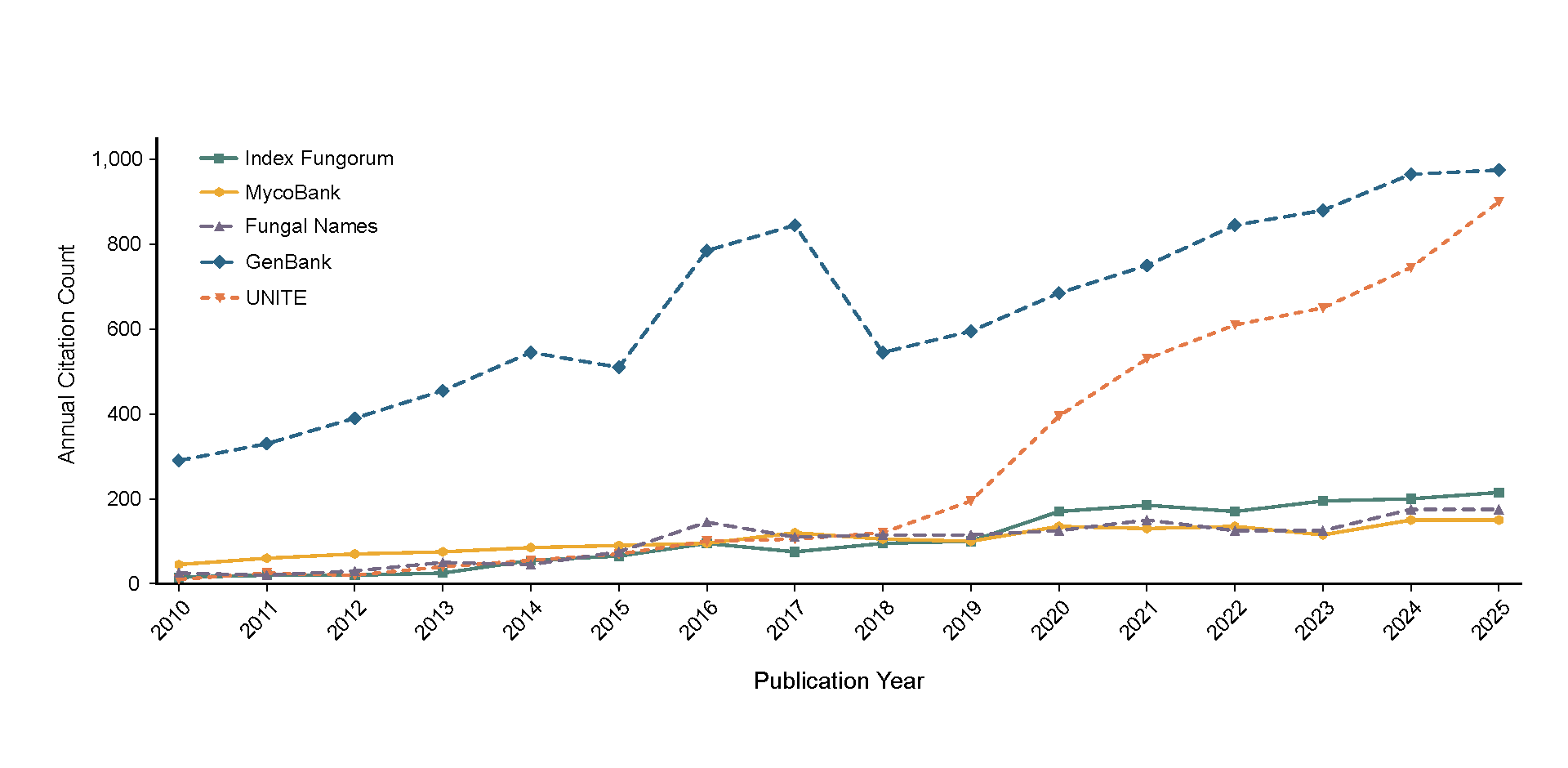
Geographic Density of Citing Publications
MycoBank, Fungal names and Index Fungorum are just choices of where to register a fungal taxon. The global citation map largely matches with the global mycological research hubs (Fig. 2). China is the predominant research cluster, yielding the highest number of unique citations with over 5000 citations. This is followed by the United States with high-density citation rates (3,796 citations). Western Europe, led by Germany, the United Kingdom, Italy, and Spain, shows a prominent regional cluster, as do South Asia (India) and South America (Brazil). Considering citations by country, we normalized the cumulative citation volumes to 100% stacked proportions, and distinct regional research paradigms and operational preferences become apparent among the top 20 nations. There is high repository diversification in the Asian region. Thailand exhibits a quantitative structural layout, which accounts for the largest proportion of fungal names in Index Fungorum. Thailand stands out as the absolute global outlier in high-intensity taxonomic work. It dedicates nearly half of its entire bibliometric footprint to taxonomic registries, specifically Fungal Names and Index Fungorum. This indicates the highest number of taxonomic and novel species descriptions by major research institutions in Thailand, reflecting their intensive regional micro-fungal exploration and academic collaborations in describing novel tropical taxa over the last decade.
China demonstrates a well-balanced profile but maintains a significantly larger share of Fungal Names and GenBank entries than other regions which aligns with the hosting of Fungal Names in China. The Netherlands stands out by displaying an exceptionally large proportional citation rate for MycoBank relative to all other top 20 nations, which aligns with the hosting of MycoBank in that country, with a major foundational culture collections and international fungal typing boards (Fig. 3). Similarly, South Africa and Brazil show strong, expanded MycoBank allocations, underscoring their active, ongoing engagement in classic isolate validation and plant-pathogenic descriptions, where isolating, naming, and registering new fungal crop pathogens requires strict taxonomic registration. Saudi Arabia, Egypt, and South Korea show a narrow proportional band for MycoBank and Index Fungorum, as their academic output is heavily shifted away from traditional species identification and classification.
In contrast to the Western/European region, the paradigm shift focuses on molecular approaches and data curation. Countries including Germany, the United Kingdom, Sweden, and France have cited the molecular databases (GenBank and UNITE), with UNITE occupying a massive footprint, reflecting the shift of the mainstream research in these regions toward environmental ecology, microbiomics, and high-throughput community sequencing (Fig. 3).
The footprints in molecular and sequence databases reflect each country's engagement with high-throughput sequencing, ecological metabarcoding, clinical mycobiome profiling, and big-data bioinformatics. The Scandinavian/Western European countries, including Sweden, Germany, the UK, and France, allocate a dominant share of their citations to UNITE. This confirms an academic infrastructure heavily focused on soil ecology, mycorrhizal networks, and climate-driven community profiling via high-throughput ITS sequencing. USA and Canada have a highly balanced, massive molecular footprint, with UNITE accounting for nearly a third of their total citation distribution. Saudi Arabia and Egypt display an intensely polarized molecular footprint. They show the highest proportional reliance on GenBank globally, while their UNITE shares remain very small. India and Japan exhibit a high reliance on GenBank (Fig. 3). Their research sectors favor functional gene identification, agricultural diagnostics, and industrial fungal biotechnology over community-level ecology.
Discussion
Case studies illustrating classification inconsistencies across major fungal groups
To complement the broad database-level comparison, we provide selected case studies from major fungal groups viz., Dothideomycetes, Eurotiomycetes, Sordariomycetes, Diaporthales, Xylariomycetidae, Agaricales, lichenized fungi, plant pathogens, yeasts, Basidiomycota and non-Dikarya. These case studies were selected to illustrate the major types of inconsistencies detected in the dataset, including family- and order-level conflicts, higher-rank disagreement, outdated classifications, inconsistent use of incertae sedis, missing or incomplete taxonomic fields, delayed incorporation of recent phylogenetic revisions, and cross-code homonymy.
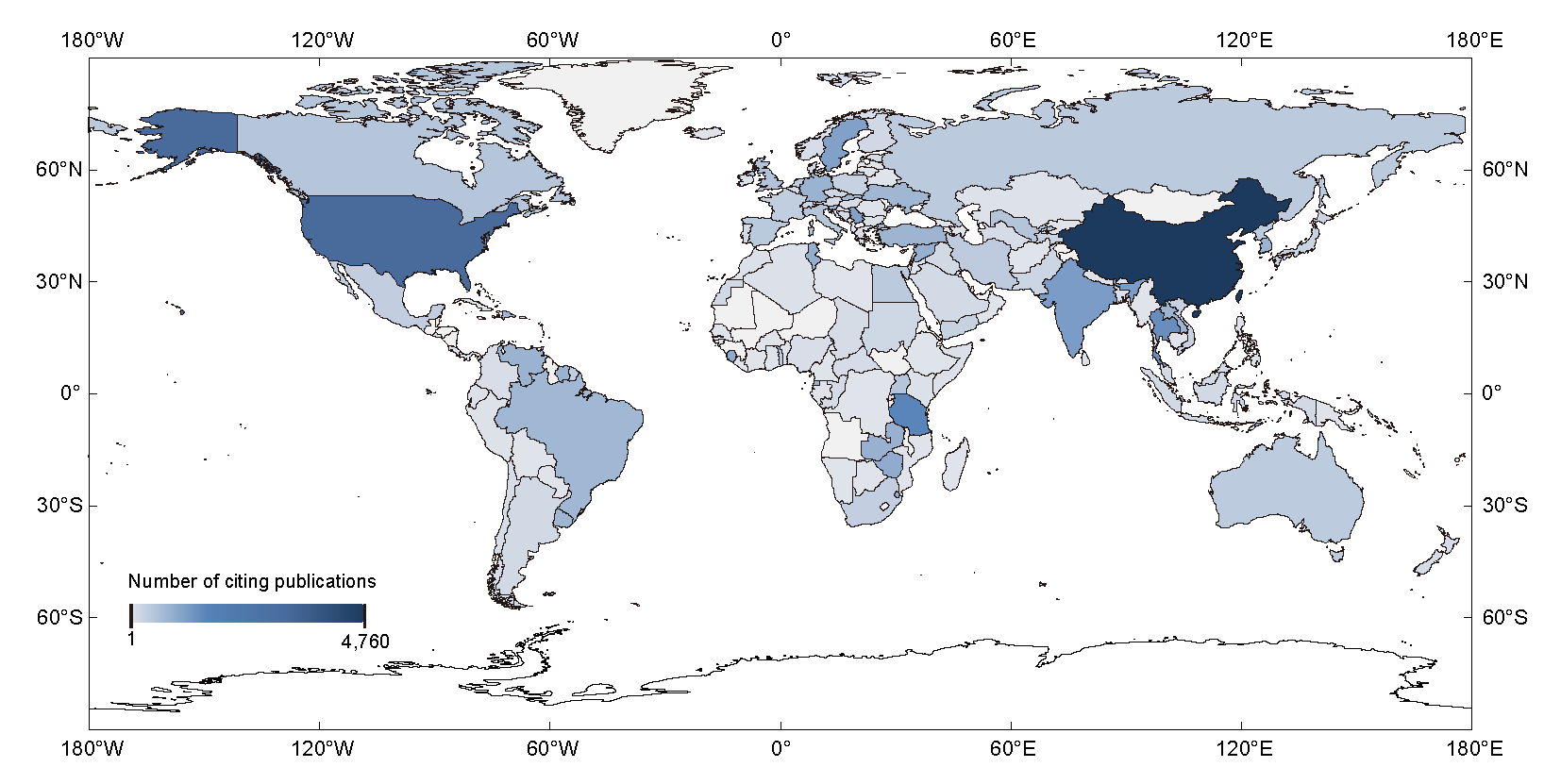
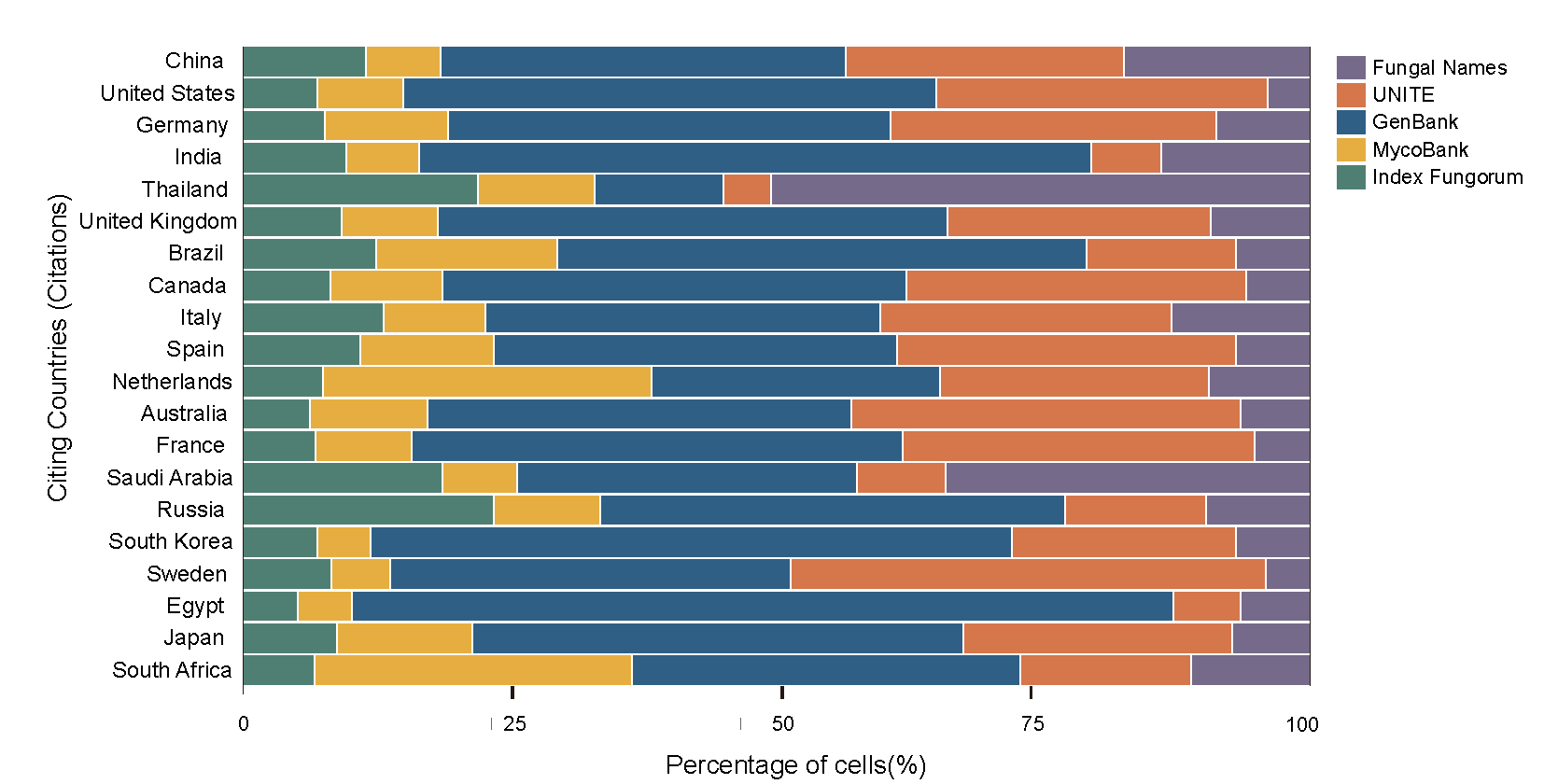
The purpose of these case studies is not to provide a complete taxonomic revision of each group, but to demonstrate how database inconsistencies occur in practice and how they affect different areas of mycology. Some examples show rapidly changing phylogenetic concepts, such as the reclassification of families in Agaricales, Eurotiomycetes and Xylariomycetidae. Others reflect database lag, where recent taxonomic revisions have been adopted by one database but not by others. Several examples also show how unresolved taxa are treated differently across databases, either as incertae sedis, placed in alternative families or omitted at some ranks.
These case studies also indicate that the causes of inconsistencies differ among fungal groups. In some groups, conflicts arise mainly from rapid phylogenomic revision and changing family boundaries. In others, they reflect historical classifications, morphology-based generic concepts, asexual morph names or insufficient sequence data. In sequence-rich groups, such as yeasts and other medically, industrially or ecologically important fungi, inconsistencies may result from the uneven updating of taxonomic backbones across databases. For example, taxonomic changes involving yeast genera such as Candida, Pichia and Saccharomyces or filamentous genera such as Aspergillus and Penicillium may be incorporated into some databases earlier than others. In contrast, in poorly sampled groups, especially genera known only from old descriptions, single collections or morphology-based records, uncertainty may arise from the absence of type-derived molecular data.
Rank-level patterns of database inconsistency
The present study demonstrates that classification inconsistencies among major fungal databases are widespread, vary among taxonomic ranks and have important biological implications. Based on the comparison of 10,693 genus-level and higher taxa records across the 2024 Outline of Fungi, Index Fungorum, MycoBank, GenBank and UNITE, disagreements were observed in 6,127 (57.29%) and at nearly all major taxonomic ranks. The highest number of conflicts occurred at the family level, followed by order, subclass, class, subphylum and phylum. In total, 4,921 genera showed conflicting family placements, 3,646 showed conflicting order placements, 3,522 showed conflicting subclass placements, 2,792 showed conflicting class placements, 1,700 showed conflicting subphylum placements and 638 showed conflicting phylum placements. These results indicate that database disagreement is a broader issue affecting fungal taxonomy, biodiversity informatics, ecological analyses and sequence-based identification.
These numerical patterns are also consistent with the representative examples discussed above, where genera such as Brunneoclavispora, Cryptophaea, Fumagospora, Neoplatysporoides and Pseudaphelidium show discrepancies at family, order, phylum or even kingdom levels. Cryptophaea is consistently treated as an Arthoniomycete lichenized fungus in the 2024 Outline of Fungi, Index Fungorum, Fungal Names, and MycoBank, while GenBank records correspond to an insect genus within Odonata (Arthropoda), reflecting a clear case of name homonymy and inadequate cross-database validation. Pseudaphelidium, is variably classified under Aphelidiaceae (Aphelidiomycota) in the 2024 Outline of Fungi, Fungal Names, and MycoBank, while UNITE lists it under Andreiomycetaceae (Ascomycota) and Index Fungorum treated it as incertae sedis (Protozoa), reflecting a significant incongruence at the phylum level.
Family- and order-level classification conflicts
The most frequent inconsistency detected in the dataset was at the family level. This is important because family placement is often used as a common taxonomic unit in fungal checklists, ecological summaries, comparative taxonomy and biodiversity databases (Tedersoo et al. 2014; Nguyen et al. 2016; Nilsson et al. 2019a). When a genus is assigned to different families in different databases, the interpretation of its evolutionary relationships, ecological function, host/substrate association and biogeographic pattern may also change. In this study, nearly half of the analysed genera showed some form of family-level disagreement in at least one of the compared databases.
Several genera provide strong examples of this problem. Petrophila is placed in Extremaceae in the 2024 Outline of Fungi, MycoBank and UNITE, whereas Index Fungorum places it in Teratosphaeriaceae. Although both placements remain within fungal classifications, this difference affects the interpretation of the genus within Mycosphaerellales. The problem becomes more serious in GenBank, where the same genus is linked to Crambidae (Lepidoptera, Insecta, Arthropoda), representing an animal classification rather than a fungal one. Similarly, Butleria is placed in Myriangiaceae in the 2024 Outline of Fungi, but in Elsinoaceae in Index Fungorum, MycoBank and UNITE, while GenBank links the same name to Hesperiidae (Lepidoptera, Arthropoda).
Heteroconium is linked to Antennulariellaceae, Capnodiaceae and Herpotrichiellaceae, while Hemimyriangium is linked to Myriangiaceae, Elsinoaceae and even Clavicipitaceae in different sources. Julella is associated with Didymosphaeriaceae, Thelenellaceae and Trypetheliaceae in different databases, indicating disagreement in family placement and in the broader interpretation of its phylogenetic affinity. Some GenBank records appear to retain outdated names. For example, Julella fallaciosa (JN887412) should be treated as Arthopyrenia fallaciosa, which belongs to a different order. Similar problems occur in several other GenBank records, where older names and outdated classifications are retained.
Similar family-level disagreement occurs in Basidiomycota, particularly within Agaricales. Recent phylogenetic studies have reorganized several waxcap genera, resulting in the recognition of Hygrocybaceae as distinct from Hygrophoraceae. However, database adoption of these changes is inconsistent. Genera such as Chromosera, Chrysomphalina, Gliophorus, Humidicutis, Hygrocybe, Neohygrocybe, Porpolomopsis and Sinohygrocybe are placed in Hygrocybaceae in the 2024 Outline of Fungi and MycoBank, whereas Index Fungorum, GenBank and UNITE often retain them in Hygrophoraceae.
Order-level conflicts were also common. For example, Bertiella is placed in Pleosporales (Dothideomycetes) in the 2024 Outline of Fungi and MycoBank, whereas Index Fungorum and UNITE place it in Coronophorales (Sordariomycetes). GenBank, however, links the same genus to Anoplocephalidae (Cyclophyllidea, Cestoda, and Platyhelminthes), representing a tapeworm lineage. This single example demonstrates three levels of conflict viz., family-level disagreement, class-level disagreement and cross-kingdom confusion. Daruvedia also shows instability between Dothideales or Pleosporales (Dothideomycetes) and Pyrenulales (Eurotiomycetes). Sirodesmium is linked to Pleosporales (Dothideomycetes) in some classifications, but to Chaetothyriales (Eurotiomycetes) in others. Such cases show how difficult it is to keep fungal classifications synchronized across databases. Because this task is too large for only a few curators, a coordinated curation system involving database curators and taxonomic specialists for different fungal groups is needed.
Higher-rank conflicts and taxonomic interpretation
Although family- and order-level conflicts were the most frequent, class- and phylum-level conflicts are more biologically significant because they may shift a genus between major evolutionary lineages. In the present dataset, 2,792 genera showed class-level conflicts and 638 genera showed phylum-level conflicts. These higher-rank discrepancies may arise from outdated classifications, limited molecular evidence, homonymous genus names, delayed incorporation of recent phylogenetic revisions or erroneous sequence annotation. Previous studies have emphasized that fungal databases are updated independently and that inconsistencies in taxonomic backbones and molecular reference datasets can affect species identification, ecological interpretation, metabarcoding analyses and reproducibility of fungal biodiversity studies (Prakash et al. 2017; Kidd et al. 2023; Rawson & Zahn 2023; de Hoog et al. 2024; Hyde et al. 2024a, b; Abarenkov et al. 2024; Gherbawy et al. 2025).
Examples such as Atrozythia and Luxuriomyces are especially useful for discussion. Atrozythia is linked to Sareaceae (Sareales, Lichinomycetes) in the 2024 Outline of Fungi, whereas other databases associate it with Zythiaceae or Xylariaceae (Xylariales, Sordariomycetes). Luxuriomyces is placed in Mollisiaceae (Helotiales, Leotiomycetes) in Index Fungorum, but in Helminthosphaeriaceae (Sordariales, Sordariomycetes) in MycoBank. When genera are placed in different classes, any downstream analysis using class-level summaries will produce different results depending on the database used.
Similar higher-rank uncertainty is observed in non-Dikarya, especially in Aphelidiomycota and Rozellomycota. These groups occupy a difficult position because some taxa have historically been treated under zoological nomenclatural frameworks, while recent fungal classifications accept them within the Kingdom Fungi (Wijayawardene et al. 2025). Contradictory comments and classifications across databases may therefore confuse users, especially when a database simultaneously provides a fungal classification while also indicating that the name may not apply to an organism within the fungal clade.
Such inconsistencies are problematic for fungal ecology and biodiversity studies. For instance, a genus is counted as a member of Dothideomycetes in one database and Sordariomycetes in another. Therefore, estimates of class-level diversity, host association, substrate preference and geographic distribution may be inaccurate. This inconsistency is especially relevant for large-scale metabarcoding and environmental sequencing studies, where thousands or millions of sequences may be assigned automatically based on reference databases. If the reference taxonomy is inconsistent, the resulting ecological interpretation will also be unstable.
Rapid phylogenetic revision, differing taxonomic opinions and database lag
A major reason for classification inconsistency is likely the delay between the publication of phylogenetic revisions and their incorporation and harmonization in online databases. Modern fungal taxonomy is highly dynamic, with new families, orders, and revised genus concepts continually being introduced through multigene phylogenies and phylogenomic studies (Maharachchikumbura et al. 2021). However, these changes are not incorporated into all databases simultaneously, and the harmonization of classifications across databases may take considerable time. As a result, one database may reflect a recent taxonomic revision, whereas another may retain an older classification. Classification inconsistency may also result from different taxonomic opinions. In some fungal groups, different researchers may accept different genus or family concepts even when using similar molecular data. For example, the treatment of Fusarium and segregated genera such as Neocosmospora has differed among taxonomic communities, with some researchers preferring a broad concept of Fusarium and others accepting narrower segregated genera. Similar differences in taxonomic interpretation occur in several fungal groups and can delay agreement among databases. Therefore, database disagreement does not always indicate an error and in some cases, it reflects active scientific debate or different classification philosophies. This problem is clearly seen in Eurotiomycetes as already mentioned in the case studies. The classification of genera such as Paecilomyces, Thermoascus and Talaromyces differs among databases because family concepts in Aspergillaceae, Thermoascaceae and Trichocomaceae have changed repeatedly following phylogenetic studies (Houbraken & Samson 2011; Steenwyk et al. 2019). In Agaricales, recent re-classification of waxcap fungi has resulted in the transfer of several genera from Hygrophoraceae to Hygrocybaceae (Vizzini et al. 2024), but this change has not been consistently adopted across all databases.
In Xylariomycetidae, database lag is particularly evident in the placement of recently introduced or revised families. Anungitiomycetaceae and Nothodactylariaceae have been placed differently in Xylariales and Amphisphaeriales across databases. Similarly, Neoarthrinium is treated as incertae sedis in some resources, placed in Apiosporaceae in others and accepted in Neoarthrineaceae in MycoBank.
Unresolved taxa and incertae sedis placements
Another major inconsistency is the different way databases handle uncertain taxonomic placement. Some databases use the term “incertae sedis”, whereas others provide rank-specific terms such as “Ascomycota fam. Incertae sedis”, “Pezizomycotina ord. incertae sedis” or “Dothideomycetes ord. incertae sedis”. Although these terms often represent genuine uncertainty, they are not standardized across databases. As a result, automated comparisons may treat these terms as different taxonomic classifications, even when they simply indicate that the taxon is unresolved.
Several genera in the dataset illustrate this issue. Dictyonella is placed in Myriangiales (Dothideomycetes) in the 2024 Outline of Fungi, while Index Fungorum treats it partly as incertae sedis, and UNITE uses classifications such as Pezizomycotina ord. incertae sedis and Pezizomycotina cls. Incertae sedis. GenBank further complicates the issue by linking the same genus to Dictyonellidae (Bubarida, Demospongiae, Porifera) representing an animal classification. Dictyonella represents both taxonomic uncertainty within fungi and cross-code homonymy.
Other genera such as Apiocarpella, Botryoderma, Exosporiella, Pleurovularia, Tretospeira and Tryssglobulus also show uncertainty-based conflicts. For example, Apiocarpella is treated as Taphrinomycetes in the 2024 Outline of Fungi, while Index Fungorum records it as incertae sedis and GenBank links it to Didymosphaeriaceae (Pleosporales, Dothideomycetes). Botryoderma shows a similar pattern, with records varying between Taphrinomycetes, incertae sedis and Chaetomiaceae (Sordariales, Sordariomycetes).
In Xylariomycetidae, Polystigmataceae is treated as part of Xylariales in the 2024 Outline of Fungi, placed in Phyllachoraceae (Phyllachorales) in other databases, and listed as incertae sedis in MycoBank. Calceomyces has been accepted as incertae sedis within Xylariomycetidae based on morpho-molecular evidence, but databases continue to assign it inconsistently to Xylariaceae, Lopadostomataceae, Xylariales incertae sedis or other placements. In Agaricales, Melanomphalia is placed in Hygrophoraceae in some databases, treated as incertae sedis in others and assigned to Cortinariaceae in MycoBank.
In biodiversity analyses, taxa assigned to incertae sedis may be excluded from downstream analyses, grouped incorrectly under broad unresolved categories, or counted as separate artificial taxonomic units. This is particularly problematic in large-scale fungal biodiversity and metabarcoding studies, where taxonomic summaries often depend on database-derived family, order, class or phylum assignments (Tedersoo et al. 2018; Nilsson et al. 2019a; Abarenkov et al. 2024). Therefore, databases should clearly distinguish among accepted placements, provisional placements, uncertain placements and missing data. The term incertae sedis should not be treated as equivalent to a formal family, order or class, but rather as an indication that the taxonomic position remains unresolved. A clear and standardized representation of unresolved taxa is necessary to improve compatibility among databases, taxonomic reproducibility and downstream biodiversity interpretation (Prakash et al. 2017; Wijayawardene et al. 2020a; Rawson & Zahn 2023; Hyde et al. 2024a, b; de Hoog et al. 2024).
Missing ranks and database incompleteness
The dataset also shows that classification inconsistency is caused by conflicting taxonomic opinions and missing or incomplete rank information. This is important because the absence of a family, order, class, subphylum or phylum assignment can create the same practical difficulty as a conflicting classification. In both cases, users cannot confidently recover a complete taxonomic hierarchy for a genus. Therefore, database inconsistency should not be evaluated only by comparing different names at the same rank, but also by assessing the completeness of classification fields across databases.
The missing pattern was not evenly distributed among the compared databases. GenBank showed the highest level of incompleteness, especially at intermediate and higher taxonomic ranks. Subclass and subphylum fields were also absent for all GenBank records in this dataset. This indicates that GenBank is highly valuable as a sequence repository, but its taxonomic hierarchy is often incomplete when compared with specialist fungal databases.
By comparison, specialist fungal databases generally provided more complete taxonomic hierarchies, although missing data were present. MycoBank showed notable missingness at several ranks, particularly at the family, order and subclass levels. The 2024 Outline of Fungi also contained missing values for some ranks, especially where genera were unresolved or where certain intermediate ranks were not consistently applied. UNITE frequently used rank-specific placeholder classifications such as “Ascomycota fam. incertae sedis”, “Pezizomycotina ord. incertae sedis” or similar uncertainty labels. Index Fungorum appeared relatively complete for many records, but some of its classifications differed from those used in the 2024 Outline of Fungi, MycoBank or UNITE.
These missing data patterns have important consequences for database comparison. When one database provides a precise family-level placement and another database leaves the family field blank, the difference is not a true taxonomic conflict, but it reduces interoperability. For example, a genus may be placed in a recognized family in the 2024 Outline of Fungi but have no family assignment in GenBank. In automated analyses, this genus may then be excluded from family-level summaries or grouped under an artificial “unclassified” category. This can distort estimates of fungal diversity, especially when large numbers of genera lack comparable rank information.
Many community-level studies summarize fungal diversity at the family, order, class or phylum levels. If one database lacks family and order assignments for many genera, community composition profiles will differ from those generated using a more complete taxonomic backbone. For example, an environmental dataset classified using a database with many missing family-level assignments may underestimate the richness of certain fungal families. Similarly, if class or phylum assignments are missing, broad ecological conclusions about the dominance of Ascomycota, Basidiomycota, Dothideomycetes, Sordariomycetes or other major groups may become less reliable.
The dataset also shows that missingness interacts with “incertae sedis” classifications. Some databases leave unresolved ranks blank, whereas others fill the same ranks with uncertainty labels. For example, one database may record a genus as having no family assignment, while another may assign it to “Ascomycota fam. incertae sedis”. Although both records may reflect uncertainty, they are represented differently and may be interpreted differently by automated tools.
Cross-code homonyms
The dataset also showed extensive incorrect kingdom placements due to cross-code homonyms, where the same genus string is linked to fungal classifications in specialist fungal databases but to animal, plant, bacterial, protist or viral classifications in GenBank. The dataset contains 144 cases where GenBank linked a fungal genus string to a non-fungal classification, including 131 animal-linked cases. Among the animal classifications, the most frequent GenBank phylum was Arthropoda, represented by 72 cases, followed by Mollusca with 16 cases, Chordata with 15 cases, and smaller numbers of Echinodermata, Platyhelminthes, Annelida, Cnidaria, Porifera, Bryozoa, Brachiopoda, Nematoda, and Acanthocephala. This clearly shows that an identical genus name can occur across fungi and animals and that automated systems may retrieve the wrong lineage if they rely only on genus names.
Petrophila is treated as a fungal genus in Extremaceae (Mycosphaerellales, Ascomycota) in fungal databases, but GenBank links the same name to Crambidae (Lepidoptera, Arthropoda). Butleria is treated as a fungus in Myriangiaceae or Elsinoaceae (Myriangiales, Ascomycota), whereas GenBank links it to Hesperiidae (Lepidoptera, Arthropoda). Pseudotrichia is treated as a fungal genus in Didymosphaeriaceae or Melanommataceae (Pleosporales, Ascomycota), but GenBank links the same string to Hygromiidae (Stylommatophora, Mollusca). Bertiella is especially notable because fungal databases place it in either Melanommataceae (Dothideomycetes) or Nitschkiaceae (Sordariomycetes), while GenBank links it to Anoplocephalidae (Cyclophyllidea, Platyhelminthes). Other important examples include Preussia, which is consistently fungal in specialist databases as Sporormiaceae (Ascomycota), but is linked in GenBank to Tettigoniidae (Arthropoda). Liua is treated as a fungal genus in Thyridariaceae (Ascomycota), but GenBank links it to Hynobiidae (Amphibia, Chordata). Asterina is a fungal genus in Asterinaceae (Ascomycota), but GenBank links the same name to Asterinidae (Asteroidea, Echinodermata). Placosoma is treated as a fungal genus in Parmulariaceae (Ascomycota), while GenBank links it to Gymnophthalmidae (Lepidosauria, Chordata).
The dataset also includes fungal genus strings linked in GenBank to plants, bacteria, algae, protists and viruses. For example, Petchia is treated as a fungal genus in Clavicipitaceae (Ascomycota), but GenBank links the same name to Apocynaceae (Magnoliopsida, Streptophyta). Romanoa is similarly treated as a fungus in Clavicipitaceae (Ascomycota), but GenBank links it to Euphorbiaceae (Streptophyta). Xizangia is treated as a fungal genus in Lasiosphaeriaceae (Ascomycota), but GenBank links it to Orobanchaceae (Magnoliopsida, Streptophyta).
Bacterial examples are also present. Bogoriella is treated as a fungal genus in Trypetheliaceae (Ascomycota), but GenBank links the same genus to Bogoriellaceae/ (Actinomycetota). Moorella is treated as a fungal genus in Tubeufiaceae (Ascomycota) or as uncertain in fungal databases, but GenBank links it to Moorellaceae (Bacillota). These examples emphasize that the genus names are not globally unique and database systems must include kingdom-aware validation.
Such misplacements can seriously affect biodiversity informatics. If a researcher searches for a fungal genus name in a broad biological database, the retrieved classification may correspond to an animal rather than a fungus. The problem is especially serious for automated pipelines, where thousands of names may be matched without manual checking. Therefore, the results strongly demonstrate that genus names alone are insufficient as global biological identifiers, but it is the addition of the author string that, in combination with a genus name, provides a unique identifier. Otherwise, a unique numerical identifier needs to be attached to all names.
Old and outdated classifications in fungal databases
Some conflicts appear to reflect older or artificial classification systems that remain embedded in certain databases. This is especially relevant for asexual morph genera historically treated under broad categories such as hyphomycetes or coelomycetes. Although modern fungal classification increasingly relies on phylogeny, morphology, type material and sequence data, some database records may preserve older taxonomic concepts.
Genera such as Anacraspedodidymum, Digicatenosporium, Neochrosporium and Sinomyces provide useful examples. In some databases, they are placed within modern ascomycetous classifications such as Ascomycota, whereas other records retain older-style classifications such as Hyphomycetes, Deuteromycotina or Deuteromycota (MycoBank). These artificial groups are historically important but no longer represent natural phylogenetic lineages. Many fungal genera were originally described based only on morphology, often from asexual states and their phylogenetic positions remain unresolved or have changed repeatedly as molecular data became available.
Outdated classifications also contribute to database inconsistency. Some records retain older names or historical classifications even after taxonomic revision. For example, GenBank uses outdated names in some cases, such as records listed under Julella fallaciosa, although this taxon should be treated as Arthopyrenia fallaciosa as discussed above. Species-rich and taxonomically complex genera such as Diaporthe further illustrate the same problem. Many Diaporthe species were originally described based on host association or morphology alone, but later studies have shown that host specificity is often unreliable and that multilocus data are needed for accurate species delimitation. Although this issue occurs mainly at the species level, it also affects database stability because changing species concepts, synonymy and genus boundaries can delay or complicate database updates.
Implications for biodiversity and sequence-based studies
The results of this study have broad implications for fungal research. Classification inconsistency directly affects fungal checklists. If different databases place the same genus in different families or orders, regional or substrate-based checklists may produce different summaries depending on the database used. This can influence estimates of fungal diversity in countries, ecosystems, host plants, animal-associated substrates, soil, freshwater, marine habitats, or extreme environments (Tedersoo et al. 2018; Hyde et al. 2024a).
Many fungal ecology papers summarize communities at family, order, class, or phylum levels and use these classifications to interpret associated metadata, such as lifestyle, host association, substrate preference, ecological guild and geographic distribution. If a genus is assigned to different higher taxa across databases, community composition analyses may change. For example, a genus treated as Dothideomycetes in one database and Sordariomycetes in another would alter class-level community profiles. This is especially important in metabarcoding studies, where taxonomic assignments are often generated automatically from reference databases (Nilsson et al. 2019a; Abarenkov et al. 2024).
Sequence annotation may also be compromised. GenBank is widely used as a sequence repository, but the dataset shows that many GenBank records have missing ranks or cross-code homonyms. This does not mean GenBank is unsuitable, but it highlights the need for careful validation when using GenBank taxonomy for fungal studies. Sequence records should be interpreted alongside specialist fungal databases and, where possible, linked to type material, voucher specimens, culture collections, and phylogenetic evidence (Nilsson et al. 2019b; Schoch et al. 2020; Abarenkov et al. 2024).
Database inconsistency also affects reproducibility. A study using Index Fungorum may produce a different classification summary from a study using MycoBank, UNITE, GenBank or the 2024 Outline of Fungi. Without clearly stating which database version was used, when it was accessed, and how conflicts were resolved, results may be difficult to reproduce. Therefore, fungal biodiversity papers should explicitly report their taxonomic backbone and provide a conflict-resolution strategy (Prakash et al. 2017; Nilsson et al. 2019b; Rawson & Zahn 2023).
In plant pathology, medical mycology, and quarantine-related research, unstable names and conflicting classifications can affect disease diagnostics, pathogen surveillance, and communication among researchers, clinicians, and regulatory agencies. For example, if a pathogen genus is treated under different names or families in different databases, searches for sequence data, host records, or distribution information may return incomplete or misleading results (Rawson & Zahn 2023; de Hoog et al. 2024; Gherbawy et al. 2025).
Recommendations for database standardization
The present study indicates that improving fungal database standardization requires a coordinated approach that addresses both taxonomic accuracy and database structure. Databases should move beyond genus-name matching and adopt stable, kingdom-aware taxon identifiers. It would be beneficial if the practice already adopted by mycologists of applying mandatory name registration (with unique identifiers) was taken up in other kingdoms, particularly for algal and plant names as covered by the same code as fungi. The occurrence of identical genus names in fungi, animals, plants, bacteria, algae and protists demonstrates that names alone are insufficient for accurate classification. Genera such as Asterina, Bertiella, Butleria, Liua, Petrophila, Preussia and Pseudotrichia show that the same genus name may refer to completely different organisms. Therefore, fungal names should be linked to unique identifiers that distinguish fungal taxa from homonymous non-fungal names.
Each database should provide clear versioning and dates of taxonomic updates. Because the dataset analysed here was completed on May 2026, some records may have changed subsequently. This highlights the importance of recording database access dates, version numbers, and update histories. Without versioning, comparisons among studies become difficult because database classifications may change between the time of data collection and publication.
The 2024 Outline of Fungi and similar curated annual classifications can function as important reference backbones for harmonization because they synthesize recent phylogenetic evidence and expert consensus. However, the goal should not be to force all databases to become identical, but to ensure that differences are transparent, traceable and clearly explained.
Databases should flag homonyms including cross-code homonyms. When a genus name occurs in more than one kingdom, this should be visible in both database interfaces and downloadable taxonomy files. Cross-code homonyms should not be treated as ordinary taxonomic disagreements because they represent confusion between entirely different biological entities.
Missing ranks and incertae sedis classifications should be standardized. Each unresolved rank should include metadata explaining whether the classification is genuinely uncertain, not evaluated, missing from the source or awaiting phylogenetic confirmation. This would reduce artificial disagreement among databases and improve the interpretation of incomplete taxonomic records.
Databases should provide complete taxonomic hierarchies wherever possible. Even when family or order placement is unresolved, higher-rank classifications should be supplied with an uncertainty flag. Incomplete hierarchies reduce the comparability of datasets and may cause taxa to be excluded or misclassified in automated analyses.
Nomenclatural status should be clearly separated from taxonomic placement. A fungal name may be effectively published or not, validly published or not, or illegitimate or legitimate, under the Code, but these nomenclatural categories are not relevant to the taxonomic placement of a name in a phylogenetic classification, except in terms of what names are available to be used for a given taxon. Databases such as Index Fungorum, MycoBank and Fungal Names are indispensable nomenclatural resources, but their nomenclatural functions should be clearly distinguished from taxonomic classification frameworks where terms such as accepted, synonymised, doubtful or uncertain are appropriate.
Each taxonomic placement should be supported by a source reference. This metadata about the classification adopted is especially important when different databases place the same genus in different families, orders or classes. Providing the literature source for each classification would allow users to determine whether a placement is based on recent molecular phylogenetic evidence, older morphology-based taxonomy, provisional interpretation or database-derived curation. Classification confidence labels such as “accepted”, “provisional”, “incertae sedis”, “historical”, “unverified” or “conflicting” would further improve the transparency.
For recent changes, the “Reference” field in MycoBank is being used to store references that include updated classifications. However, where multiple sources are cited, the exact classification adopted in the database may be a meshing together of various source classifications (none of which are exactly the same as the accepted classification). For example, one source reference may back up the placement of a species in a particular genus, while another source reference may deal with a heterotypic synonym of the accepted name (not mentioned in the first source reference). Capturing the metadata for different classifications is challenging but various options for tracking and comparing “taxon concepts” have been developed (Müller et al. 2024). One method of explicitly showing what information is in each source reference is that adopted by the Australian Fungi List (AFL: a component of the Australian National Species List), where each “instance” of a name (a given reference) is accompanied by the full synonymy provided in that reference. For example, Cortinarius, accepted in a broad sense by AFL (Australian Fungi Name Index, Accessed May 2026) inclusive of genera such as Phlegmacium, the ‘instance’ for Liimatainen et al. (2022) shows that this publication included Cortinarius in a narrow sense (exclusive of Phlegmacium), while the ‘instance’ for Gallone et al. (2024) shows that these authors treated Phlegmacium under Cortinarius. The corresponding entry for Phlegmacium (Australian Fungi Name Index, Accessed May 2026) indicates that Liimatainen et al. (2022) treats this as an independent genus, while Gallone et al. (2024) treats it under Cortinarius. The use of ‘instances’ in databases is scalable, as each new taxonomy can be added, and the database itself can include an ‘instance’ that meshes together various source synonymies and placements in higher taxa. Kõljalg et al. (2020) extend the “species hypothesis”, as applied in UNITE to a set of sequences to a “taxon hypothesis” whereby each taxon at any rank is defined by the set of individuals within and associated with a persistent identifier (PID). Taxon concepts, in terms of the constituent taxa and the chosen rank of an accepted name could also be associated with unique identifiers, thereby facilitating communication as to exactly what was the circumscription and placement of any name at any rank in a given source reference. Regular synchronization among major fungal databases is needed. The 2024 Outline of Fungi, Index Fungorum, MycoBank, Fungal Names, GenBank, and UNITE serve different purposes and complete uniformity may not always be possible. However, their differences should be transparent, and the basic use of the same fungal names should be harmonized. At minimum, the same fungal name should be linked to the same accepted name, synonymy, nomenclatural status and current taxonomic concept or any differences should be clearly explained. A cross-database reconciliation table would allow users to compare database-specific placements, identify conflicts, and select the most appropriate classification for their study. Such a system should include accepted names, synonyms, current placements, alternative placements, reasons for conflict, supporting references and dates of last update. GenBank is widely used for sequence-based fungal identification. Therefore, fungal taxonomic curation within the database requires particular attention. GenBank was not designed primarily as a fungal taxonomic authority, but its taxonomy is heavily used in molecular identification and environmental sequencing.
Comparison of the classifications adopted by major databases would be facilitated by providing both accepted names in a taxonomic hierarchy along with synonymies linked to accepted names in downloadable spreadsheet format. Tools for the comparison of classifications such as ChecklistBank (Check List Bank) are available and should be routinely used to detect incongruence between major databases. Database users should also adopt more careful taxonomic workflows. For fungal biodiversity studies, classifications should not be copied uncritically from a single database. Instead, researchers should compare multiple sources, check recent literature, verify molecular support and clearly document how final placements were selected.
The establishment of a 'Fungal Classification Harmonisation Working Group' that regularly reviews new molecular evidence and publishes a 'Recommended Classification Treatment' for accepted ranks should be encouraged. Such a working group could sit under the International Commission on the Taxonomy of Fungi (ICTF) alongside existing working groups addressing important issues for fungi globally. Furthermore, a team of global experts should be assembled to review all entries in the current databases to produce a unified, verified checklist. The output would be made available to all databases for uptake. This would address inconsistencies in a focused, expert‑driven manner and could gradually improve overall data quality. Creating an independent, third‑party platform that regularly harvests classification data from all major sources would automatically flag conflicting placements (e.g., the same genus assigned to different families in different databases) and present them in a unified, searchable interface. Researchers could quickly verify any taxon to see where discrepancies exist, reducing the risk of relying on a single database. Such a service would promote transparency and help the community identify persistent disagreements.
Conclusions
This study demonstrates that classification inconsistencies among major fungal databases are widespread and occur at multiple taxonomic ranks. Based on 10,693 genus-level records compared across the 2024 Outline of Fungi, Index Fungorum, MycoBank, GenBank and UNITE, most discrepancies occurred at the family and order levels, although conflicts were also observed at subclass, class, subphylum, and phylum levels. These inconsistencies show that fungal classification is not always represented uniformly across databases, even for the same genus name.
The results indicate that database discrepancies arise from several sources, including differential timing of database updates, different interpretations of family and order boundaries, incomplete taxonomic hierarchies, inconsistent use of incertae sedis, outdated classifications and cross-code homonyms. The latter is particularly serious, as some fungal genus names are linked to animal, plant, bacterial, algal, protist or viral classifications in broader biological databases. Such cases demonstrate that genus names alone are not sufficient as reliable biological identifiers but must be accompanied by the author string in order to be unique, or else by a unique name identifier.
These inconsistencies have important consequences for fungal taxonomy, biodiversity inventories, ecological studies, sequence-based identification, metabarcoding, plant pathology, medical mycology and conservation research. Depending on which database is used, the same genus may be assigned to different families, orders, classes or even different kingdoms. This can lead to misidentification, inconsistent taxon sampling, incorrect diversity summaries and reduced reproducibility among studies.
Improving fungal database standardization therefore requires coordinated action among database curators, taxonomists, molecular systematists, bioinformaticians and users. Future database development should prioritize stable and kingdom-aware taxon identifiers, clearer treatment of homonyms, complete hierarchical classifications, standardized representation of missing and uncertain ranks, links to supporting literature, versioned updates, and regular synchronization among major databases.
Artificial intelligence may have a supporting role in this process, for example by helping to detect inconsistent classifications, identify possible homonyms, compare database records and highlight recently published taxonomic changes. However, AI-generated outputs should not be accepted uncritically, because automated searches may produce incorrect, outdated or biologically implausible results. Therefore, AI tools should be used only as an aid to expert curation, with final decisions made by taxonomic specialists and supported by published literature, type material, voucher specimens, sequence data and phylogenetic evidence.
The aim should not necessarily be to make all databases identical, but to make their differences transparent, traceable, and scientifically interpretable.
Acknowledgments
Jian-Kui Liu thanks the National Natural Science Foundation of China (NSFC 32570014). Chitrabhanu S. Bhunjun would like to thank Thailand Science Research and Innovation and the National Science Research and Innovation Fund (Grant no. 692A01027) entitled “Exploring the biodiversity and applications of agricultural waste degrading fungi”. Mingkwan Doilom acknowledges the Foundation of Guangzhou Municipal Science and Technology Bureau (Grant No. 2023A04J1426). Wei Dong thanks the National Natural Science Foundation of China (Grant No. 32200015), the Foreign Expert Program of the Department of Science and Technology of Guangdong Province (Grant No. 252025061951000003), and the foundation of Guangzhou Municipal Science and Technology Bureau (Grant No. 2023A04J1425). Mao-Qiang He thanks the Central Guidance Local Science and Technology Development Special Project of Sichuan Province (2024ZYD0128), the Edible Fungus Innovation Team of Sichuan Province (sccxtd-2026-07). Sinang Hongsanan would like to thank Shenzhen University 2035 Program for Excellent Research (Grant No. 2024C006). Fatimah Alotibi and Kevin D. Hyde acknowledge the Ongoing Research Funding Program (ORF-2026-114), King Saud University, Saudi Arabia. Chayanard Phukhamsakda was funded by the Alexander von Humboldt (AvH) foundation for a Fellowship of Experienced Researchers stipend.
Author contributions
Conceptualization: Hyde KD, Maharachchikumbura SSN, Manawasinghe IS and Liu JK; methodology, Gomdola D, Manawasinghe IS and Dissanayake AJ; formal analysis, Gomdola D, Manawasinghe IS and Dissanayake AJ; writing—original draft preparation: Hyde KD, Kandawatte CTW, Gomdola D, Bera I, Bhunjun CS, Boekhout T, Dissanayake AJ, Doilom M, Dong W, He MQ, Hongsanan S, Khamngoen R, Madhushan A, Maharachchikumbura SSN, Manawasinghe IS, Al Otibi F, Phukhamsakda C, Samarakoon MC, Thalagala US, Wanasinghe DN, Wannasawang N, Wijayawardene NN, Zhu JT, Zhao RL, Liu JK; writing—review & editing: Hyde KD, May TW, Wanasinghe DN and Liu JK; supervision: Hyde KD; project administration: Liu JK; funding acquisition: Liu JK. All authors have read and agreed to the published version of the manuscript.
ORCID
Kevin D. Hyde: https://orcid.org/0000-0002-2191-0762
Jian-Kui Liu: https://orcid.org/0000-0002-9232-228X
Conflict of interest statement
The author list includes members of the Editorial Board of Fungal Diversity. They were not involved in the journal’s review of, or decisions related to, this manuscript. The authors declare no competing interests.
Supplementary Information
The online version contains supplemental information available at https://doi.org/10.65390/fdiv.2026.136021.
Rights and permissions
The Author(s) 2026. Published by BioAcademic Press on behalf of Kunming Institute of Botany,Chinese Academy of Sciences (CAS) and Mushroom Research Foundation. This is an open accessarticle under the Creative Commons Attribution license ( http://creativecommons.org/licenses/by/4.0), which permits use, distribution and reproduction in any medium, provided the originalwork is properly cited.
References
- Abarenkov K, Nilsson RH, Larsson KH, Taylor AFS, May TW, Frøslev TG, Pawlowska J, Lindahl B, Põldmaa K, Truong C et al (2024) The UNITE database for molecular identification and taxonomic communication of fungi and other eukaryotes: sequences, taxa and classifications reconsidered. Nucleic Acids Res 52(D1):D791–D797.
https://doi.org/10.1093/nar/gkad1039 - Abdollahzadeh J, Groenewald JZ, Coetzee MPA, Wingfield MJ, Crous PW (2020) Evolution of lifestyles in Capnodiales. Studies in Mycology 95:381–414.
https://doi.org/10.1016/j.simyco.2020.02.004 - Aime MC, McTaggart AR (2021) A higher-rank classification for rust fungi, with notes on genera. Fungal Syst Evol 7(1):21–47. https://doi.org/10.3114/fuse.2021.07.02
- Ament-Velásquez LS, Johannesson H, Giraud T, Debuchy R, Saupe SJ, Debets AJM, Bastiaans E, Malagnac F, Grognet P, Peraza-Reyes L et al (2020) The taxonomy of the model filamentous fungus Podospora anserina. MycoKeys 75:51–69.
https://doi.org/10.3897/mycokeys.75.55968 - Ariyawansa HA, Hyde KD, Jayasiri SC, Buyck B, Chethana KWT, Dai DQ, Dai YC, Daranagama DA, Jayawardena RS, Lücking R et al (2015) Fungal diversity notes 111–252—taxonomic and phylogenetic contributions to fungal taxa. Fungal Diversity 75:27–274.
https://doi.org/10.1007/s13225-015-0346-5 - Bai Y, Lin L, Pan M, Fan XL (2023) Studies of Diaporthe (Diaporthaceae, Diaporthales) species associated with plant cankers in Beijing, China, with three new species described. MycoKeys 98:59–86.
https://doi.org/10.3897/mycokeys.98.104156 - Bao DF, Hyde KD, Maharachchikumbura SSN, Perera RH, Thiyagaraja V, Hongsanan S, Wanasinghe DN, Shen HW, Tian XG, Yang LQ et al (2023) Taxonomy, phylogeny and evolution of freshwater Hypocreomycetidae (Sordariomycetes). Fungal Diversity 121:1–94.
https://doi.org/10.1007/s13225-023-00521-8 - Barreto GG, Souza-Motta CM, Silva GA, Groenewald JZ, Crous PW, Bezerra JDP (2024) Meristematic and meristematic-like fungi in Dothideomycetes. Fungal Systematics and Evolotion 14:77–88.
https://doi.org/10.3114/fuse.2024.14.05 - Begerow D, Bauer R, Boekhout T (2000) Phylogenetic placements of ustilaginomycetous anamorphs as deduced from nuclear LSU rDNA sequences. Mycological Research 104:53–60.
https://doi.org/10.1017/S0953756299001161 - Benny GL, Kimbrough JW (1980) Synopsis of the orders and families of Plectomycetes with keys to genera. Mycotaxon 12:1–91. https://doi:10.5962/p.417279
- Bhunjun CS, Chen YJ, Phukhamsakda C, Boekhout T, Groenewald JZ, McKenzi EHC, Francisco EC, Frisvad JC, Groenewald M, Hurdeal VG et al (2024) What are the 100 most cited fungal genera? Studies in Mycology 108:1–411.
https://doi.org/10.3114/sim.2024.108.01 - Bitner MA, Molodtsova TN (2020) New records of Recent brachiopods (Terebratulida) from the northern Mid-Atlantic Ridge. Mar Biol Res 16(6–7):514–520. https://doi.org/10.1080/17451000.2020.1797093
- Boekhout T (1995) Pseudozyma Bandoni emend. Boekhout, a genus for yeast-like anamorphs of Ustilaginales. J Gen Appl Microbiol 41:359–366.
https://doi.org/10.2323/jgam.41.359 - Boonmee S, Wanasinghe DN, Calabon MS, Huanraluek N, Chandrasiri SKU, Jones GEB, Rossi W, Leonardi M, Singh SK, Rana S et al (2021) Fungal diversity notes 1387–1511: taxonomic and phylogenetic contributions on genera and species of fungal taxa. Fungal Diversity 111:1–335.
https://doi.org/10.1007/s13225-021-00489-3 - Borman AM, Johnson EM (2021) Reply to Kidd et al., "new names for fungi of medical importance: can we have our cake and eat it too?" J Clin Microbiol 59:e02896-20.
https://doi.org/10.1128/JCM.02896-20 - Borman AM, Johnson EM (2023) Changes in fungal taxonomy: mycological rationale and clinical implications. Clin Microbiol Rev 36(4):e00099-22. https://doi.org/10.1128/cmr.00099-22
- Braun U, Nakashima C, Crous PW, Groenewald JZ, Moreno-Rico O, Rooney-Latham S, Blomquist CL, Haas J, Marmolejo J (2018) Phylogeny and taxonomy of the genus Tubakia s. lat. Fungal Syst Evol 1:41–99.
https://doi.org/10.3114/fuse.2018.01.04 - Cai F, Druzhinina IS (2021) In honor of John Bissett: authoritative guidelines on molecular identification of Trichoderma. Fungal Diversity 107:1–69.
https://doi.org/10.1007/s13225-020-00464-4 - Castlebury LA, Rossman AY, Jaklitsch WJ, Vasilyeva LN (2002) A phylogeny overview of the Diaporthales based on large subunit nuclear ribosomal DNA sequences. Mycologia 94:1017–1031.
https://doi.org/10.2307/3761867 - Cedeño-Sanchez M, Charria-Girón E, Lambert C, Luangsa-Ard JJ, Decock C, Franke R, Brönstrup M, Stadler M (2023) Segregation of the genus Parahypoxylon (Hypoxylaceae, Xylariales) from Hypoxylon by a polyphasic taxonomic approach. MycoKeys 95:131–162.
https://doi.org/10.3897/mycokeys.95.98125 - Chaiwan N, Gomdola D, Wang S, Monkai J (2021) https://gmsmicrofungi.org: an online database providing updated information of microfungi in the Greater Mekong Subregion. Mycosphere 12:1513–1526.
https://doi.org/10.5943/mycosphere/12/1/19 - Chen KH, Miadlikowska J, Molnár K, Arnold AE, U'Ren JM, Gaya E, Gueidan C, Lutzoni F (2015) Phylogenetic analyses of eurotiomycetous endophytes reveal their close affinities to Chaetothyriales, Eurotiales, and a new order – Phaeomoniellales. Mol Phylogenet Evol 85:117–130.
https://doi.org/10.1016/j.ympev.2015.01.008 - Chen YP, Su PW, Hyde KD, Maharachchikumbura SSN (2023) Phylogenomics and diversification of Sordariomycetes. Mycosphere 14(1):414–451.
https://doi.org/10.5943/mycosphere/14/1/5 - COGEM (2026) Update of the taxonomy of the fungal classification lists of COGEM. Onderzoeksrapport 2025-04, CGM 2025-4. RIVM, Bilthoven, The Netherlands, pp 161.
- Crous PW, Gams W, Stalpers JA, Robert V, Stegehuis G (2004) MycoBank: an online initiative to launch mycology into the 21st century. Studies in Mycology 50:19–22.
- Crous PW, Hawksworth DL, Wingfield MJ (2015) Identifying and naming plant-pathogenic fungi: past, present, and future. Annu Rev Phytopathol 53:247–267.
https://doi.org/10.1146/annurev-phyto-080614-120245 - Crous PW, Wingfield MJ, Lombard L, Roets F, Swart WJ, Alvarado P, Carnegie AJ, Moreno G, Luangsa-Ard J, Thangavel R et al (2019) Fungal planet description sheets: 951–1041. Persoonia 43:223–425.
https://doi.org/10.3767/persoonia.2019.43.06 - Daranagama DA, Hyde KD, Sir EB, Thambugala KM, Tian Q, Samarakoon MC, McKenzie EHC, Jayasiri SC, Tibpromma S, Bhat JD et al (2018) Towards a natural classification and backbone tree for Graphostromataceae, Hypoxylaceae, Lopadostomataceae and Xylariaceae. Fungal Diversity 88:1–165.
https://doi.org/10.1007/s13225-017-0388-y - de Hoog GS, Smith MT (2004) Ribosomal gene phylogeny and species delimitation in Geotrichum and its teleomorphs. Studies in Mycology 50:489–515.
- de Hoog S, Walsh TJ, Ahmed SA, Alastruey-Izquierdo A, Alexander BD, Arendrup MC, Babady E, Bai FY, Balada-Llasat JM, Borman A et al (2024) Reply to Kidd et al. “Inconsistencies within the proposed framework for stabilizing fungal nomenclature risk further confusion”. J Clin Microbiol 62:e01625-23.
https://doi.org/10.1128/jcm.01625-23 - de Long Q, Liu LL, Zhang X, Wen TC, Kang JC, Hyde KD, Shen XC, Li QR(2019) Contributions to species of Xylariales in China-1. Durotheca species. Mycological Progress 18(3):495–510.
https://doi.org/10.1007/s11557-018-1458-6 - Delgado G, Koukol O, Maciá-Vicente JG, Colbert W, Piepenbring M (2024) Redefining Ellisembia sensu stricto with a reassessment of related taxa in Sordariomycetes. Mycological Progress 23:32.
https://doi.org/10.1007/s11557-024-01967-z - Delgado-Baquerizo M, Guerra CA, Cano-Díaz C, Egidi E, Wang JT, Eisenhauer N, Singh BK, Maestre FT (2020) The proportion of soil-borne pathogens increases with warming at the global scale. Nat Clim Chang 10:550–554.
https://doi.org/10.1038/s41558-020-0759-3 - Dentinger BTM, Gaya E, O'Brien H, Suz LM, Lachlan R, Díaz-Valderrama JR, Koch RA, Aime MC (2016) Tales from the crypt: genome mining from fungarium specimens improves resolution of the mushroom tree of life. Biol J Linn Soc 117(1):11–32.
https://doi.org/10.1111/bij.12553 - Deshpande V, Wang Q, Greenfield P, Charleston M, Porras-Alfaro A, Kuske CR, Cole JR, Midgley DJ, Tran-Dinh N (2016) Fungal identification using a Bayesian classifier and the Warcup training set of internal transcribed spacer sequences. Mycologia 108(1):1–5. https://doi.org/10.3852/14-293
- Dissanayake AJ, Zhu JT, Chen YY, Maharachchikumbura SSN, Hyde KD, Liu JK (2024a) A re‐evaluation of Diaporthe: refining the boundaries of species and species complexes. Fungal Diversity 126:1–125 https://doi.org/10.1007/s13225-024-00538-7
- Dissanayake LS, Samarakoon MC, Maharachchikumbura SSN, Hyde KD, Tang X, Li Q, Mortimer PE, Faraj T, Xu J, Kang JC et al (2024b) Exploring the taxonomy and phylogeny of Sordariomycetes taxa emphasizing Xylariomycetidae in Southwestern China. Mycosphere 15:1675–1793. https://doi.org/10.5943/mycosphere/15/1/15
- Dong W, Wang B, Hyde KD, McKenzie EHC, Raja HA, Tanaka K, Abdel-Wahab MA, Abdel-Aziz FA, Doilom M, Phookamsak R et al (2020) Freshwater Dothideomycetes. Fungal Diversity 105:319–575.
https://doi.org/10.1007/s13225-020-00463-5 - Douglass AP, Offei B, Braun-Galleani S, Coughlan AY, Martos AAR, Ortiz-Merino RA, Byrne KP, Wolfe KH (2018) Population genomics shows no distinction between pathogenic Candida krusei and environmental Pichia kudriavzevii: one species, four names. PLoS Pathog 14:e1007138.
https://doi.org/10.1371/journal.ppat.1007138 - Fan XL, Bezerra JDP, Tian CM, Crous PW (2018) Families and genera of diaporthalean fungi associated with canker and dieback of tree hosts. Persoonia 40:119–134.
https://doi.org/10.3767/persoonia.2018.40.05 - Fradin EF, Thomma BPHJ (2006) Physiology and molecular aspects of Verticillium wilt diseases caused by V. dahliae and V. alboatrum. Mol Plant Pathol 7:71–86.
https://doi.org/10.1111/j.1364-3703.2006.00323.x - Gallone B, Kuyper TW, Nuytinck J (2024) The genus Cortinarius should not (yet) be split. IMA Fungus 15:24.
https://doi.org/10.1186/s43008-024-00159-4 - Gautam AK, Verma RK, Avasthi S, Sushma Bohra Y, Devadatha B, Niranjan M, Suwannarach N (2022) Current insight into traditional and modern methods in fungal diversity estimates. Journal of Fungi 8(3):226.
https://doi.org/10.3390/jof8030226 - Geiser DM (2009) Sexual structures in Aspergillus: morphology, importance and genomics. Medical mycology 47: S21–S26. https://doi.org/10.1080/13693780802139859
- Geiser DM, Aoki T, Bacon CW, Baker SE, Bhattacharyya MK, Brandt ME, Brown DW, Burgess LW, Chulze S, Coleman JJ et al (2013) One fungus, one name: defining the genus Fusarium in a scientifically robust way that preserves longstanding use. Phytopathology 103(5):400–408. https://doi.org/10.1094/phyto-07-12-0150-le
- Geiser DM, Gueidan C, Miadlikowska J, Lutzoni F, Kauff F, Hofstetter V, Fraker E, Schoch CL, Tibell L, Untereiner WA et al (2006) Eurotiomycetes: Eurotiomycetidae and Chaetothyriomycetidae. Mycologia 98:1053–1064.
https://doi.org/10.1080/15572536.2006.11832634 - Gherbawy YA, Al-Harthi H, El-Dawy E, Gaber M, Pet I, Wang L, Hu P, Hussein M (2025) The molecular revolution in fungal diagnostics: bridging gaps across clinical, agricultural, and environmental mycology. Mycology 1–28.
https://doi.org/10.1080/21501203.2025.2569931 - Gibas CFC, Sigler L, Summerbell RC, Currah RS (2002) Phylogeny of the genus Arachnomyces and the establishment of Arachnomycetales, a new eurotiomycete order in the Ascomycota. Studies in Mycology 47:131–139.
- Gomes RR, Glienke C, Videira SIR, Lombard L, Groenewald JZ, Crous PW(2013) Diaporthe: a genus of endophytic, saprobic and plant pathogenic fungi. Persoonia 31:1–41.
https://doi.org/10.3767/003158513X666844 - Gryzenhout M, Myburg H, Wingfield BD, Wingfield MJ (2006) Cryphonectriaceae (Diaporthales), a new family including Cryphonectria, Chrysoporthe, Endothia and allied genera. Mycologia 98:239–249.
https://doi.org/10.3852/mycologia.98.2.239 - Gueidan C, Aptroot A, Cáceres MES, Badali H, Stenroos S (2014) A reappraisal of orders and families within the subclass Chaetothyriomycetidae (Eurotiomycetes, Ascomycota). Mycological Progress 13:1027–1039.
https://doi.org/10.1007/s11557-014-0990-2 - Guiry MD (2024) How many species of algae are there? A reprise. Four kingdoms, 14 phyla, 63 classes and still growing. J Phycol:1–15.
https://doi.org/10.1111/jpy.13431 - Guiry MD, Guiry GM (2025) AlgaeBase. World-wide electronic publication, National University of Ireland, Galway. https://www.algaebase.org
- Gullan PJ, Cranston PS (2014) The insects: an outline of entomology. John Wiley & Sons.
- Guterres DC, dos Santos MDDM, Furlanetto C, Pinho DB, Barreto RW, Dianese JC (2022) Filling a gap in the taxonomy of phyllachoroid fungi: proposition of Neopolystigma, gen. nov., and the new family Neopolystigmataceae. Mycologia 114(5):900–913.
https://doi.org/10.1080/00275514.2022.2092365 - Hagen F, Khayhan K, Theelen B, Kolecka A, Polacheck I, Sionov E, Falk R, Parnmen S, Lumbsch HT, Boekhout T (2015) Recognition of seven species in the Cryptococcus gattii / Cryptococcus neoformans species complex. Fungal Genet Biol 78:16–48.
https://doi.org/10.1016/j.fgb.2015.02.009 - Hawksworth DL, Cooper JA, Crous PW, Hyde KD, Iturriaga T, Kirk PM, Lumbsch HT, May TW, Minter DW, Misra JK et al (2010) Proposals to make the pre-publication deposit of key nomenclatural information in a recognized repository a requirement for valid publication of organisms treated as fungi under the Code. Taxon 59:1–11 https://doi.org/10.1002/tax.592045
- Hawksworth DL, Crous PW, Redhead SA, Reynold DR (2011) The Amsterdam declaration on fungal nomenclature. IMA fungus 2(1):105–111
- He J, Li DW, Cui WL, Huang L (2024b) Seven new species of Alternaria (Pleosporales, Pleosporaceae) associated with Chinese fir, based on morphological and molecular evidence. MycoKeys 101:1–44.
https://doi.org/10.3897/mycokeys.101.115370 - He MQ, Cao B, Liu F, Boekhout T, Denchev TT, Schoutteten N, Denchev CM, Kemler M, Gorjón SP, Begerow D et al (2024a) Phylogenomics, divergence times and notes of orders in Basidiomycota. Fungal Diversity 126(1):127–406.
https://doi.org/10.1007/s13225-024-00535-w - He MQ, Yang WQ, Phurbu D, Liu F, Li JX, Cao B, Zhao RL ( 2026) Systematic study of Panaeolus (Agaricales, Galeropsidaceae) sensu lato and psilocybin-producing traits of species from China. IMA Fungus 17:e167329. https://doi.org/10.3897/imafungus.17.167329
- He MQ, Zhao RL, Hyde KD, Begerow D, Kemler M, Yurkov A, McKenzie EHC, Raspé O, Kakishima M, Sánchez-Ramírez S et al (2019) Notes, outline and divergence times of Basidiomycota. Fungal Diversity 99:105–367. https://doi.org/10.1007/s13225-019-00435-4
- Hensen N, Bonometti L, Westerberg I, Brännström IO, Guillou S, Cros-Aarteil S, Calhoun S, Haridas S, Kuo A, Mondo S et al (2023) Genome-scale phylogeny and comparative genomics of the fungal order Sordariales. Molecular Phylogenetics and Evolution 189:107938. https://doi.org/10.1016/j.ympev.2023.107938
- Hilário S, Gonçalves MFM, Alves A (2021b) Using genealogical concordance and coalescent-based species delimitation to assess species boundaries in the Diaporthe eres complex. Journal of Fungi 7:507. https://doi.org/10.3390/jof7070507
- Hilário S, Santos L, Alves A (2021a) Diaporthe amygdali, a species complex or a complex species? Fungal Biology 125:505–518. https://doi.org/10.1016/j.funbio.2021.01.006
- Hongsanan S, Hyde KD, Phookamsak R, Wanasinghe DN, McKenzie EHC, Sarma VV, Lücking R, Boonmee S, Bhat JD, Liu NG et al (2020a) Refined families of Dothideomycetes: orders and families incertae sedis in Dothideomycetes. Fungal Diversity 105:17–318.
https://doi.org/10.1007/s13225-020-00462-6 - Hongsanan S, Hyde KD, Phookamsak R, Wanasinghe DN (2020b) Refined families of Dothideomycetes: Dothideomycetidae and Pleosporomycetidae. Mycosphere 11:1553–2107.
https://doi.org/10.5943/mycosphere/11/1/13 - Hongsanan S, Maharachchikumbura SSN, Hyde KD, Samarakoon MC, Jeewon R, Zhao Q, Al-Sadi AM, Bahkali AH (2017) An updated phylogeny of Sordariomycetes based on phylogenetic and molecular clock evidence. Fungal Diversity 84:25–41.
https://doi.org/10.1007/s13225-017-0384-2 - Hou LW, Giraldo A, Groenewald JZ, Rämä T, Summerbell RC, Huang GZ, Cai L, Crous PW (2023) Redisposition of acremonium-like fungi in Hypocreales. Studies in Mycology 105:23–203 https://doi.org/10.3114/sim.2023.105.02
- Houbraken JA, Samson RA (2011) Phylogeny of Penicillium and the segregation of Trichocomaceae into three families. Studies in Mycology 70:1–51. https://doi.org/10.3114/sim.2011.70.01
- Huang SK, Hyde KD, Mapook A, Maharachchikumbura SSN, Bhat JD, McKenzie EHC, Jeewon R, Wen TC (2021) Taxonomic studies of some often-over-looked Diaporthomycetidae and Sordariomycetidae. Fungal Diversity 111:443–572.
https://doi.org/10.1007/s13225-021-00488-4 - Hubka V, Kolařík M, Kubátová A, Peterson SW (2013) Taxonomic revision of Eurotium and transfer of species to Aspergillus. Mycologia, 105(4):912–937. https://doi.org/10.3852/12-151
- Hyde KD, Abdel-Wahab MA, Abdollahzadeh J, Abeywickrama PD, Absalan S, Afshari N, Ainsworth A, Akulov O, Aleoshin V, Al-Sadi A et al (2023) Global consortium for the classification of fungi and fungus-like taxa. Mycosphere 14(1):1960–2012.
https://doi.org/10.5943/mycosphere/14/1/23 - Hyde KD, Baldrian P, Chen Y, Chethana TKW, De Hoog S, Doilom M, de Farias ARG, Gonçalves MFM, Gonkhom D, Gui H et al (2024a) Current trends, limitations and future research in the fungi. Fungal Diversity 125:1–71.
https://doi.org/10.1007/s13225-023-00532-5 - Hyde KD, Bao DF, Hongsanan S, Chethana KT, Yang J, Suwannarach N (2021) Evolution of freshwater Diaporthomycetidae (Sordariomycetes) provides evidence for five new orders and six new families. Fungal Diversity 107, 71–105.
https://doi.org/10.1007/s13225-021-00469-7 - Hyde KD, Fröhlich J, Taylor JE (1998) Fungi from palms. XXXVI. Reflections on unitunicate ascomycetes with apiospores. Sydowia 50:21–80.
- Hyde KD, Fryar S, Tian Q, Bahkali AH, Xu J (2016) Lignicolous freshwater fungi along a north–south latitudinal gradient in the Asian/Australian region; can we predict the impact of global warming on biodiversity and function? Fungal Ecol 19:190–200.
- Hyde KD, Jones EBG, Liu JK, Ariyawansa H, Boehm E, Boonmee S, Braun U, Chomnunti P, Crous PW, Dai DQ et al (2013) Families of Dothideomycetes. Fungal Diversity 63:1–313.
https://doi.org/10.1007/s13225-013-0263-4 - Hyde KD, Noorabadi MT, Thiyagaraja V, He MQ, Johnston PR, Wijesinghe SN, Armand A, Biketova AY, Chethana KWT, Erdogdu M et al (2024b) The 2024 Outline of Fungi and fungus-like taxa. Mycosphere 15(1):5146–6239.
https://doi.org/10.5943/mycosphere/15/1/25 - Hyde KD, Norphanphoun C, Maharachchikumbura SSN, Bhat DJ, Jones EBG, Bundhun D, Chen YJ, Bao DF, Boonmee S, Calabon MS et al (2020) Refined families of Sordariomycetes. Mycosphere 11(1):305–1059.
https://doi.org/10.5943/mycosphere/11/1/7 - Irinyi L, Serena C, Garcia-Hermoso D, Arabatzis M, Desnos-Ollivier M, Vu D, Cardinali G, Arthur I, Normand AC, Giraldo A et al (2015) International Society of Human and Animal Mycology (ISHAM)-ITS reference DNA barcoding database–the quality controlled standard tool for routine identification of human and animal pathogenic fungi. Med Mycol 53:313–337. https://doi.org/10.1093/mmy/myv008
- Jaklitsch WM, Gardiennet A, Voglmayr H (2016) Resolution of morphology based taxonomic delusions: Acrocordiella, Basiseptospora, Blogiascospora, Clypeosphaeria, Hymenopleella, Lepteutypa, Pseudapiospora, Requienella, Seiridium and Strickeria. Persoonia 37:82–105.
- James TY, Stajich JE, Hittinger CT, Rokas A (2020) Toward a fully resolved fungal tree of life. Annual Review of Microbiology 74(1):291–313. https://doi.org/10.1146/annurev-micro-022020-051835
- Jiang N, Fan XL, Tian CM (2021) Identification and characterization of leaf-inhabiting fungi from Castanea plantations in China. Journal of Fungi 7(1):64.
https://doi.org/10.3390/jof7010064 - Kalichman J, Kirk PM, Matheny PB (2020) A compendium of generic names of agarics and Agaricales. Taxon 1–23. DOI
https://doi.org/10.1002/tax.12240 - Khan FK, Sánchez-García M, Johannesson H, Ryberg M (2024) High rate of gene family evolution in proximity to the origin of ectomycorrhizal symbiosis in Inocybaceae. New Phytologist 244(1):219–234. https://doi.org/10.1111/nph.20007
- Kidd SE, Abdolrasouli A, Hagen F (2023) Fungal nomenclature: managing change is the name of the game. Open Forum Infect Dis 10:fac559.
https://doi.org/10.1093/ofid/ofac559 - Kidd SE, Halliday CL, McMullan B, Chen SA, Elvy J (2021) New names for fungi of medical importance: can we have our cake and eat it too? J Clin Microbiol 59:e02730-20.
https://doi.org/10.1128/JCM.02730-20 - Kirk PM, Cannon PF, Minter DW, Stalpers JA (2008) Ainsworth & Bisby’s dictionary of the fungi, 10th edn. CABI, Wallingford https://doi.org/10.1079/9780851998268.0000
- Kõljalg U, Nilsson HR, Schigel D, Tedersoo L, Larsson KH, May TW, Taylor AFS, Jeppesen TS, Frøslev TG, Lindahl BD et al (2020) The taxon hypothesis paradigm – on the unambiguous detection and communication of taxa. Microorganisms 8, 1910:1–25.
https://doi.org/10.3390/microorganisms8121910 - Kooij PW, Sulastri MP, Rodrigues A, Gaya E (2024) Disentangling the basidiomycete family Agaricaceae. Mycological Progress 23(1):pp75 https://doi.org/10.1007/s11557-024-02011-w
- Kopchinskiy A, Komon M, Kubicek CP, Druzhinina IS (2005) TrichoBLAST: a multilocus database for Trichoderma and Hypocrea identifications. Mycological Research 109:658–660. https://doi.org/10.1017/s0953756205233397
- Kowalska B (2021) Management of the soil-borne fungal pathogen Verticillium dahliae Kleb. causing vascular wilt diseases. Journal of Plant Pathology 103:1185–1194. https://doi.org/10.1007/s42161-021-00937-8
- Kruys A, Castlebury LA (2012) Molecular phylogeny of Sydowiellaceae—resolving the position of Cainiella. Mycologia 104(2):419–426. https://doi.org/10.3852/11-163
- Kurtzman CP, Boekhout T, Fell JW (2011) The Yeasts: a taxonomic study, 5th edn. Elsevier, Amsterdam, pp 1–2079.
- Kurtzman CP, Robnett CJ (2003) Phylogenetic relationships among yeasts of the “Saccharomyces complex” determined from multigene sequence analyses. FEMS Yeast Res 3:417–432.
https://doi.org/10.1016/S1567-1356(03)00012-6 - Kurtzman CP, Robnett CJ (2010) Systematics of methanol-assimilating yeasts and neighboring taxa from multigene sequence analysis and the proposal of Peterozyma gen. nov., a new member of the Saccharomycetales. FEMS Yeast Res 10:353–361.
https://doi.org/10.1111/j.1567-1364.2010.00625.x - Kurtzman CP, Robnett CJ, Basehoar-Powers E (2008) Phylogenetic relationships among species of Pichia, Issatchenkia, and Williopsis determined from multigene sequence analysis, and the proposal of Barnettozyma gen. nov., Lindnera gen. nov., and Wickerhamomyces gen. nov. FEMS Yeast Res 8:939–954.
https://doi.org/10.1111/j.1567-1364.2008.00419.x - Larsson E, Jeppson M (2008) Phylogenetic relationships among species and genera of Lycoperdaceae based on ITS and LSU sequence data from north European taxa. Mycological research 112(1):4–22. https://doi.org/10.1016/j.mycres.2007.10.018
- Leuchtmann A (1984) Über Phaeosphaeria Miyake und andere bitunicate Ascomyceten mit mehrfach querseptierten Ascosporen. Sydowia 37:75–194.
- Li JX, Zhao RL, Phurbu D, Xing R, Liu DM, He MQ, Ling ZL, Han X, Feng HY, Zhu XY et al (2025) Disentangling taxonomic chaos in Agaricaceae sl: an integrative phylogenomic framework with divergence dating reconstructs classification. Fungal Diversity 135:745–881 https://doi.org/10.1007/s13225-025-00568-9
- Li Y, Steenwyk JL, Chang Y, Wang Y, James TY, Stajich JE, Spatafora JW, Groenewald M, Dunn CW, Hittinger CT et al (2021) A genome-scale phylogeny of the kingdom Fungi. Current Biology 31(8):1653–1665. https://doi.org/10.1016/j.cub.2021.01.074
- Liimatainen K, Kim JT, Pokorny L, Kirk PM, Dentinger B, Niskanen T (2022), Taming the beast: a revised classification of Cortinariaceae based on genomic data. Fungal Diversity 112:89–170.
https://doi.org/10.1007/s13225-022-00499-9 - Liu F, Hu ZD, Yurkov A, Chen XH, Bao WJ, Ma Q, Zhao WN, Pan S, Zhao XM, Liu JH et al (2024) Saccharomycetaceae: delineation of fungal genera based on phylogenomics. Persoonia 52:1–21.
https://doi.org/10.3767/persoonia.2024.52.01 - Liu JK, Hyde KD, Jeewon R, Phillips AJL, Maharachchikumbura SSN, Ryberg M, Liu ZY, Zhao Q (2017) Ranking higher taxa using divergence times: a case study in Dothideomycetes. Fungal Diversity 84:75–99.
https://doi.org/10.1007/s13225-017-0385-1 - Liu XZ, Wang QM, Göker M, Groenewald M, Kachalkin AV, Lumbsch HT, Millanes AM, Wedin M, Yurkov AM, Boekhout T et al (2015) Towards an integrated phylogenetic classification of the Tremellomycetes. Studies in Mycology 81:85–147.
https://doi.org/10.1016/j.simyco.2015.12.001 - Lodge DJ, Padamsee M, Matheny PB, Aime MC, Cantrell SA, Boertmann D, Kovalenko A, Vizzini A, Dentinger BTM, Kirk PM et al (2014) Molecular phylogeny, morphology, pigment chemistry and ecology in Hygrophoraceae (Agaricales). Fungal Diversity 64:1–99. https://doi.org/10.1007/ s13225-013-0259-0
- López Carranza N, Carlson SJ (2019) Testing species assignments in extant terebratulide brachiopods: a three-dimensional geometric morphometric analysis of long-looped brachidia. PLoS One 14(11):e0225528. https://doi.org/10.1371/journal.pone.0225528
- Lu RX, Wang Z, Zhai YJ, Hong RY, Shen F, Jin WX, Zheng CL, Ma HQ (2021) First report of Geotrichum candidum causing sour rot of peach in China. Plant Disease 105:3298. https://doi.org/10.1094/PDIS-02-21-0279-P
- Lücking R, Aime MC, Robbertse B, Miller AN, Ariyawansa HA, Aoki T, Cardinali G, Crous PW, Druzhinina IS, Geiser DM et al (2020) Unambiguous identification of fungi: where do we stand and how accurate and precise is fungal DNA barcoding? IMA Fungus 11:14.
https://doi.org/10.1186/s43008-020-00033-z - Lumbsch HT, Huhndorf SM (2007) Whatever happened to the pyrenomycetes and loculoascomycetes? Mycological Research 111:1064–1074.
https://doi.org/10.1016/j.mycres.2007.04.004 - Lumbsch HT, Huhndorf SM (2010) Myconet volume 14. Part one. Outline of Ascomycota–2009. Part two. Notes on ascomycete systematics. Nos. 4751–5113. Fieldiana Life Earth Sci 1:1–64.
https://doi.org/10.3158/1557.1 - Luo ZL, Hyde KD, Liu JK, Maharachchikumbura SSN, Jeewon R, Bao DF, Bhat DJ, Lin CG, Li WL, Yang J et al (2019) Freshwater Sordariomycetes. Fungal Diversity 99:451–660.
https://doi.org/10.1007/s13225-019-00438-1 - Luque-Cruz C, Capote N, Marco-Noales E, Palomares-Rius JE, Romero‐Cuadrado L, Morán F, Armengol J, Agustí‐Brisach C (2026) Insights into the aetiology of almond canker diseases and decline syndromes: an emerging and complex phytopathological challenge. Plant Pathol 75:e70126.
https://doi.org/10.1111/ppa.70126 - Ma C, He SC, Cai T, Li CJY, YU FM, WANG ZY, ZHANG Y, ZHAO Q (2025) A new species of Stachylidium (Trichosphaeriaceae) from Xizang, China. Phytotaxa 694:77–85. https://doi.org/10.11646/phytotaxa.694.1.6
- Maharachchikumbura SSN, Chen Y, Ariyawansa HA, Hyde KD, Haelewaters D, Perera RH, Samarakoon MC, Wanasinghe DN, Bustamante DE, Liu JK et al (2021) Integrative approaches for species delimitation in Ascomycota. Fungal Diversity 109:155–179.
https://doi.org/10.1007/s13225-021-00486-6 - Maharachchikumbura SSN, Guo LD, Chukeatirote E, Hyde KD (2014a) Improving the backbone tree for the genus Pestalotiopsis; addition of P. steyaertii and P. magna sp. nov. Mycological Progress 13:617–624.
https://doi.org/10.1007/s11557-013-0944-0 - Maharachchikumbura SSN, Hyde KD, Groenewald JZ, Xu J, Crous PW (2014b) Pestalotiopsis revisited. Studies in Mycology 79:121–186.
- Maharachchikumbura SSN, Hyde KD, Jones EBG, McKenzie EHC, Huang SK, Abdel-Wahab MA, Daranagama DA, Dayarathne M, D'souza MJ, Goonasekara ID et al (2015) Towards a natural classification and backbone tree for Sordariomycetes. Fungal Diversity 72:199–301.
https://doi.org/ 10.1007/s13225-015-0331-z - Maharachchikumbura SSN, Hyde KD, Jones EBG, McKenzie EHC, Bhat JD, Dayarathne MC, Huang SK, Norphanphoun C, Senanayake IC, Perera RH et al (2016) Families of Sordariomycetes. Fungal Diversity 79:1–317.
https://doi.org/10.1007/s13225-016-0369-6 - Manawasinghe IS, Phillips AJL, Xu J, Balasuriya A, Hyde KD, Harischandra DL, Karunarathna A, Yan J, Weerasinghe J, Luo M et al (2021) Defining a species in fungal plant pathology: beyond the species level. Fungal Diversity 109:267–282.
https://doi.org/10.1007/s13225-021-00481-x - Marin-Felix Y, Miller AN, Cano-Lira JF, Guarro J, García D, Stadler M, Huhndorf SM, Stchigel AM (2020) Re-evaluation of the order Sordariales: delimitation of Lasiosphaeriaceae s. str., and introduction of the new families Diplogelasinosporaceae, Naviculisporaceae, and Schizotheciaceae. Microorganisms 8(9):1430. https://doi.org/10.3390/microorganisms8091430
- Matheny PB, Curtis JM, Hofstetter V, Aime MC, Moncalvo JM, Ge ZW, Yang ZL, Slot JC, Ammirati JF, Baroni TJ et al (2006) Major clades of Agaricales: a multilocus phylogenetic overview. Mycologia 98(6):982–995. https://doi.org/10.1080/15572536.2006.11832627
- Matheny PB, Hobbs AM, Esteve-Raventós F (2019) Genera of Inocybaceae: new skin for the old ceremony. Mycologia 112(1):83–120. https://doi.org/10.1080/00275514.2019.1668906
- May TW (2021) Identification of fungi: background, challenges and prospects. In P Bridge, D Smith & E Stackebrandt (eds), Trends in the Systematics of Bacteria and Fungi, pp. 21–29. https://doi.org/10.1079/9781789244984.00
- McNeill J, Barrie FR, Buck WR, Demoulin V, Greuter W, Hawksworth DL, Herendeen PS, Knapp S, Marhold K, Prado J et al (Eds) (2012) International Code of Nomenclature for algae, fungi, and plants (Melbourne Code): adopted by the Eighteenth International Botanical Congress Melbourne, Australia, July 2011. Koeltz Scientific Books, Königstein.
- Mostert L, Groenewald JZ, Summerbell RC, Gams W, Crous PW (2006) Taxonomy and pathology of Togninia (Diaporthales) and its Phaeoacremonium anamorphs. Studies in Mycology 54:1–113.
https://doi.org/10.3114/sim.54.1.1 - Mukhopadhyay S, Phukhamsakda C, Bhunjun CS, Bahkali AH, Jones EBG, Hyde KD (2025) Exploring fungi on mangrove associates: novel family Neoarthriniaceae and two novel species in Neoarthrinium and Oncopodiella. Mycological Progress 24(1):18.
https://doi.org/10.1007/s11557-025-02035-w - Müller A, von Raab-Straube E, Berendsohn WG (2024) A Taxonomic concept mapping service for taxonomic information aggregators. Biodiversity Information Science and Standards 8: e136016.
https://doi.org/10.3897/biss.8.136016 - Nannfeldt JA (1932) Studien uber die Morphologie und Systematik der nichtlichenisierten inoperculaten Discomyceten. Nova Acta Regiae Soc Sci Upsal Ser IV 8:1–368
- Nguyen NH, Song Z, Bates ST, Branco S, Tedersoo L, Menke J, Schilling JS, Kennedy PG (2016) FUNGuild: an open annotation tool for parsing fungal community datasets by ecological guild. Fungal Ecol 20:241–248.
https://doi.org/10.1016/j.funeco.2015.06.006 - Nilsson RH, Anslan S, Bahram M, Wurzbacher C, Baldrian P, Tedersoo L (2019b) Mycobiome diversity: high-throughput sequencing and identification of fungi. Nat Rev Microbiol 17:95–109.
https://doi.org/10.1038/s41579-018-0116-y - Nilsson RH, Larsson KH, Taylor AFS, Bengtsson-Palme J, Jeppesen TS, Schigel D, Kennedy P, Picard K, Glöckner FO, Tedersoo L et al (2019a) The UNITE database for molecular identification of fungi: handling dark taxa and parallel taxonomic classifications. Nucleic Acids Res 47(D1):D259–D264.
https://doi.org/10.1093/nar/gky1022 - Ninkuu V, Liu Z, Liu H, Li C, Zhou Y, Zhao Q, Qin A, Li M, Gao P, Yan L et al (2025) Genome sequencing of a novel Verticillium dahliae strain (huangweibingjun). Sci Rep 15:15143.
https://doi.org/10.1038/s41598-025-99279-z - Niskanen T, Dentinger B, Ainsworth AM, Kytövuori I, Kim JT, Griffith GW, Liimatainen K (2026) Re-shaping the family-level classification of Agaricineae (Agaricales, Basidiomycota) using a phylogenomic approach. Studies in Mycology 113:115–134. https://doi.org/10.3114/sim.2026.113.03
- O'Donnell K, Humber RA, Geiser DM, Kang S, Park B, Robert VARG, Crous PW, Johnston PR, Aoki T, Rooney AP et al (2012) Phylogenetic diversity of insecticolous fusaria inferred from multilocus DNA sequence data and their molecular identification via FUSARIUM-ID and Fusarium MLST. Mycologia 104:427–445. https://doi.org/10.3852/11-179
- O'Donnell K, Rooney AP, Proctor RH, Brown DW, McCormick SP, Ward TJ, Frandsen RJN, Lysøe E, Rehner SA, Aoki T et al (2013) Phylogenetic analyses of RPB1 and RPB2 support a middle Cretaceous origin for a clade comprising all agriculturally and medically important fusaria. Fungal Genetics and Biology 52:20–31 https://doi.org/10.1016/j.fgb.2012.12.004
- Paulin-Mahady AE, Harrington TC, McNew D (2002) Phylogenetic and taxonomic evaluation of Chalara, Chalaropsis, and Thielaviopsis anamorphs associated with Ceratocystis. Mycologia 94(1):62–72. https://doi.org/10.1080/15572536.2003.11833249
- Pem D, Hyde KD, McKenzie EHC, Hongsanan S, Wanasinghe D, Boonmee S, Darmostuk V, Bhat J, Tian Q, Htet Z et al (2024) A comprehensive overview of genera in Dothideomycetes. Mycosphere 15(1):2175–4568.
https://doi.org/10.5943/mycosphere/15/1/18 - Pem D, Jeewon R, Bhat DJ, Doilom M, Boonmee S, Hongsanan S, Promputtha I, Xu JC, Hyde KD (2019) Mycosphere notes 275-324: A morpho-taxonomic revision and typification of obscure Dothideomycetes genera (incertae sedis). Mycosphere 10:1115–1246.
https://doi.org/10.5943/mycosphere/10/1/22 - Perera RH, Hyde KD, Jones EBG, maharachchikumbura SSN, Bundhun D, Camporesi E, Akulov A, Liu JK, Liu ZY (2023) Profile of Bionectriaceae, Calcarisporiaceae, Hypocreaceae, Nectriaceae, Tilachlidiaceae, Ijuhyaceae fam. nov., Stromatonectriaceae fam. nov. and Xanthonectriaceae fam. nov. Fungal Diversity 118:95–271.
https://doi.org/10.1007/s13225-022-00512-1 - Piątek M, Lutz M, Yorou NS (2015) A molecular phylogenetic framework for Anthracocystis (Ustilaginales), including five new combinations (inter alia for the asexual Pseudozyma flocculosa), and description of Anthracocystis grodzinskae sp. nov. Mycological Progress 14:88.
https://doi.org/10.1007/s11557-015-1114-3 - Prakash PY, Irinyi L, Halliday C, Chen S, Robert V, Meyer W (2017) Online databases for taxonomy and identification of pathogenic fungi and proposal for a cloud-based dynamic data network platform. J Clin Microbiol 55(4):1011–1024.
https://doi.org/10.1128/jcm.02084-16 - Qiao M, Zheng H, Lv RL, Yu ZF (2020) Neodactylariales, Neodactylariaceae (Dothideomycetes, Ascomycota): new order and family, with a new species from China. MycoKeys 73:69–85.
https://doi.org/10.3897/mycokeys.73.54054 - Qu H, Cai Q, Redhead SA, Chen X et al (2025) Exploring criteria for constructing suprageneric classifications of fungi in the genomic era: a case study of suborders Agaricineae, Pluteineae, and Tricholomatineae (Agaricales). Fungal Diversity 132:127–150.
https://doi.org/10.1007/s13225-025-00557-y - Rawson C, Zahn G (2023) Inclusion of database outgroups reduces false positives in fungal metabarcoding taxonomic assignments. Mycologia 115(4):571–577.
https://doi.org/10.1080/00275514.2023.2206931 - Réblová M, Hubka V, Thureborn O, Lundberg J, Sallstedt T, Wedin M, Ivarsson M (2016) From the tunnels into the treetops: new lineages of black yeasts from biofilm in the Stockholm metro system and their relatives among ant-associated fungi in the Chaetothyriales. PLoS One 11:e0163396.
https://doi.org/10.1371/journal.pone.0163396 - Réblová M, Mostert L, Gams W, Crous PW (2004) New genera in the Calosphaeriales: Togniniella and its anamorph Phaeocrella, and Calosphaeriophora as anamorph of Calosphaeria. Studies in Mycology 50(2):533–550
- Réblová M, Untereiner WA, Štěpánek V, Gams W (2017) Disentangling Phialophora section Catenulatae: disposition of taxa with pigmented conidiophores and recognition of a new subclass, Sclerococcomycetidae (Eurotiomycetes). Mycological Progress 16:27–46.
https://doi.org/10.1007/s11557-016-1248-y - Regnier T, Combrinck S, Veldman W, Du Plooy W (2014) Application of essential oils as multi-target fungicides for the control of Geotrichum citriaurantii and other postharvest pathogens of citrus. Industrial Crops and Products 61:151–159. https://doi.org/10.1016/j.indcrop.2014.05.052
- Robbertse B, Strope PK, Chaverri P, Gazis R, Ciufo S, Domrachev M, Schoch CL (2017) Improving taxonomic accuracy for fungi in public sequence databases: applying 'one name one species' in well-defined genera with Trichoderma/Hypocrea as a test case. Database 2017:1–14.
https://doi.org/10.1093/database/bax072 - Rossman AY, Farr DF, Castlebury LA (2007) A review of the phylogeny and biology of the Diaporthales. Mycoscience 48:135–144.
https://doi.org/10.1007/s10267-007-0347-7 - Samarakoon MC, Hyde KD, Maharachchikumbura SSN, Stadler M, Gareth Jones EB, Promputtha I, Suwannarach N, Camporesi E, Bulgakov TS, Liu JK (2022) Taxonomy, phylogeny, molecular dating and ancestral state reconstruction of Xylariomycetidae (Sordariomycetes). Fungal Diversity 112:1–88.
https://doi.org/10.1007/s13225-021-00495-5 - Sandoval-Denis M, Lombard L, Crous PW (2019) Back to the roots: a reappraisal of Neocosmospora. Persoonia 43(1):90–185. https://doi.org/10.3767/persoonia.2019.43.04
- Schmey T, Tominello-Ramirez CS, Brune C, Stam R (2024) Alternaria diseases on potato and tomato. Molecular Plant Pathology 25:e13435.
https://doi.org/10.1111/mpp.13435 - Schoch CL, Ciufo S, Domrachev M, Hotton CL, Kannan S, Khovanskaya R, Leipe D, Mcveigh R, O'Neill K, Robbertse B et al (2020) NCBI Taxonomy: a comprehensive update on curation, resources and tools. Database 2020:baaa062.
https://doi.org/10.1093/database/baaa062 - Schoch CL, Shoemaker RA, Seifert KA, Hambleton S, Spatafora JW, Crous PW (2006) A multigene phylogeny of the Dothideomycetes using four nuclear loci. Mycologia 98:1041–1052.
https://doi.org/10.1080/15572536.2006.11832632 - Selivanova ON, Zhigadlova GG (2010) Members of the order Palmariales (Rhodophyta) at the Russian Pacific coasts. The genus Palmaria Stackhouse. Russian Journal of Marine Biology 36(7):497–506. https://doi.org/10.1134/s1063074010070035
- Senanayake IC, Jeewon R, Chomnunti P, Wanasinghe DW, Norphanphoun C, Karunarathna A, Pem D, Perera RH, Camporesi E, McKenzie EHC et al (2018) Taxonomic circumscription of Diaporthales based on multigene phylogeny and morphology. Fungal Diversity 93:241–443.
https://doi.org/10.1007/s13225-018-0410-z - Senanayake IC, Maharachchikumbura SSN, Hyde KD, Bhat JD, Jones EBG, McKenzie EHC, Dai DQ, Daranagama DA, Dayarathne MC, Goonasekara ID et al (2015) Towards unraveling relationships in Xylariomycetidae (Sordariomycetes). Fungal Diversity 73:73–144.
https://doi.org/10.1007/s13225-015-0340-y - Shenoy BD, Jeewon R, Wu WP, Bhat DJ, Hyde KD (2007) Ribosomal and rpb2 DNA sequence analyses suggest that Sporidesmium and morphologically similar genera are polyphyletic. Mycological Research 110, 916–928.
- Silva AC, Diogo E, Henriques J, Ramos AP, Sandoval-Denis M, Crous PW, Bragança H(2020) Pestalotiopsis pini sp. nov., an emerging pathogen on stone pine (Pinus pinea L.). Forests 11:805.
https://doi.org/10.3390/f11080805 - Simion P, Delsuc F, Philippe H (2020) To what extent current limits of phylogenomics can be overcome? Phylogenetics in the genomic era, 2-1.
- Skriptsova AV, Kalita TL (2020) A re-evaluation of Palmaria (Palmariaceae, Rhodophyta) in the North-West Pacific. Eur J Phycol 55(3):266–274.
https://doi.org/10.1080/09670262.2020.1714081 - Steenwyk JL, Shen XX, Lind AL, Goldman GH, Rokas A (2019) A robust phylogenomic time tree for biotechnologically and medically important fungi in the genera Aspergillus and Penicillium. mBio 10:e00925-19.
https://doi.org/10.1128/mBio.00925-19 - Strassert JF, Monaghan MT (2022) Phylogenomic insights into the early diversification of fungi. Curr Biol 32(16):3628–3635.
https://doi.org/10.1016/j.cub.2022.06.054 - Summerbell RC, Gueidan C, Schroers HJ, de Hoog GS, Starink M, Rosete YA, Guarro J, Scott JA (2011) Acremonium phylogenetic overview and revision of Gliomastix, Sarocladium, and Trichothecium. Studies in Mycology 68:139–162.
https://doi.org/10.3114/sim.2011.68.06 - Summerell BA, Leslie JF, Liew ECY, Laurence MH, Bullock S, Petrovic T, Bentley AR, Howard CG, Peterson SA, Walsh JL et al (2011) Fusarium species associated with plants in Australia. Fungal Diversity 46:1–27.
https://doi.org/10.1007/s13225-010-0075-8 - Sun JZ, Yu S, Lu YZ, Liu HW, Liu X (2022) Proposal of a new family Pseudodiploösporeaceae fam. nov. (Hypocreales) based on phylogeny of Diploöspora longispora and Paecilomyces penicillatus. Mycology 13(4):1–14.
https://doi.org/10.1080/21501203.2022.2143919 - Taylor A, Peters I, Dhand NK, Whitney J et al (2016) Evaluation of serum Aspergillus-specific immunoglobulin A by indirect ELISA for diagnosis of feline upper respiratory tract aspergillosis. Journal of veterinary internal medicine, 30(5):1708–1714. https://doi.org/10.1111/jvim.14567
- Tedersoo L, Bahram M, Põlme S, Kõljalg U, Yorou NS, Wijesundera R, Ruiz LV, Vasco-Palacios AM, Thu PQ, Suija A et al (2014) Global diversity and geography of soil fungi. Science 346:1256688.
https://doi.org/10.1126/science.1256688 - Tedersoo L, Sanchez-Ramirez S, Koljalg U, Bahram M (2018) High-level classification of the Fungi and a tool for evolutionary ecological analyses. Fungal Diversity 90:135–159.
https://doi.org/10.1007/s13225-018-0401-0 - Thakshila SAD, Bhunjun CS, Phukhamsakda C, Saichana N, Hoog SD, Manawasinghe IS (2026). A comprehensive checklist and ecological assessment of Eurotiomycetes in Thailand: Substrate and habitat associations with the discovery of a new insect-associated species and a new record. Chiang Mai Journal of Science 53(1): 1-71. https://doi.org/10.12982/cmjs.2026.016
- Thomma BPHJ (2003) Alternaria spp.: from general saprophyte to specific parasite. Mol Plant Pathol 4:225–236.
https://doi.org/10.1046/j.1364-3703.2003.00173.x - Traquair JA, Shaw LA, Jarvis WR (1988) New species of Stephanoascus with Sporothrix anamorphs. Canadian Journal of Botany 66(5):926–933. https://doi.org/10.1139/b88-134
- Turland NJ, Wiersema JH, Barrie FR, Gandhi KN, Gravendyck J, Greuter W, Hawksworth DL, Herendeen PS, Klopper RR, Knapp S et al (2025) International Code of Nomenclature for algae, fungi, and plants (Madrid Code). Regnum Vegetabile 162. The University of Chicago Press.
https://doi.org/10.7208/chicago/9780226839479.001.0001 - Udayanga D, Castlebury LA, Rossman AY, Hyde KD (2014) Species limits in Diaporthe: molecular re-assessment of D. citri, D. cytosporella, D. foeniculina and D. rudis. Persoonia 32(1):83–101. https://doi.org/10.3767/003158514X679984
- Udayanga D, Liu X, McKenzie EHC, Chukeatirote E, Bahkali AHA, Hyde KD (2011) The genus Phomopsis: biology, applications, species concepts and names of common phytopathogens. Fungal Diversity 50:189–225.
https://doi.org/10.1007/s13225-011-0126-9 - Ullah S, Rahman W, Ullah F, Jehan R (2022) FDBC: a comprehensive platform of the fungi databases collection. Journal of Biology, 11(3):1–6
- Van der Walt JP, Yarrow D (1984) The genus Arxiozyma gen. nov. (Saccharomycetaceae). South African Journal of Botany 3(5):340–342. https://doi.org/10.1016/S0022-4618(16)30022-5
- Vellinga EC (2004) Ecology and distribution of lepiotaceous fungi (Agaricaceae)-A review. Nova Hedwigia 78(3):273–299. https://doi.org/10.1127/0029-5035/2004/0078-0273
- Vellinga EC, Kuyper TW, Ammirati J, Desjardin DE, Halling RE, Justo A, Læssøe T, Lebel T, Lodge DJ, Matheny PB et al (2015) Six simple guidelines for introducing new genera of fungi. IMA Fungus, 6(2), 65–68. https://doi.org/10.1007/BF03449356
- Vellinga EC, Sysouphanthong P, Hyde KD (2011) The family Agaricaceae: phylogenies and two new white-spored genera. Mycologia 103(3):494–509 https://doi.org/10.3852/10-204
- Vizzini A, Alvarado P, Consiglio G, Marchetti M, Xu J (2024). Family matters inside the order Agaricales: systematic reorganization and classification of incertae sedis clitocyboid, pleurotoid and tricholomatoid taxa based on an updated 6-gene phylogeny. Studies in Mycology, 107(1), 67–148.
https://doi.org/10.3114/sim.2024.107.02 - Wang CQ, Zhang M, Li TH, Liang XS, Shen YH (2018) Additions to tribe Chromosereae (Basidiomycota, Hygrophoraceae) from China, including Sinohygrocybe gen. nov. and a first report of Gloioxanthomyces nitidus. MycoKeys 38:59–76.
https://doi.org/10.3897/mycokeys.38.25427 - Wang F, Wang K, Cai L, Zhao M, Kirk PM, Fan G, Sun Q, Li B, Wang S, Yu Z et al (2023a) Fungal names: a comprehensive nomenclatural repository and knowledge base for fungal taxonomy. Nucleic Acids Res 51(D1):D708–D716.
https://doi.org/10.1093/nar/gkac926 - Wang QC, Zhan ZJ, Sattar A, Wang HN, Zhou LF, Eckhardt L, Li GQ, Liu FF, Xu HC, Zhou XD (2025) Pestalotiopsis (Amphisphaeriales, Sporocadaceae) species including six new taxa inhabiting pines from different climate zones in China. IMA Fungus 16:e151614.
https://doi.org/10.3897/imafungus.16.151614 - Wang S, Ruan C, Yi L, Deng L, Yao S, Zeng K(2020) Biocontrol ability and action mechanism of Metschnikowia citriensis against Geotrichum citriaurantii causing sour rot of postharvest citrus fruit. Food Microbiology 87:103375.
https://doi.org/10.1016/j.fm.2019.103375 - Wang XW, Bai FY, Bensch K, Meijer M, Sun BD, Han YF, Crous PW, Samson RA, Yang FY, Houbraken J (2019) Phylogenetic re-evaluation of Thielavia with the introduction of a new family Podosporaceae. Studies in Mycology 93:155–252.
https://doi.org/10.1016/j.simyco.2019.08.002 - Wang Z, Kim W, Wang YW, Yakubovich E, Dong C, Trail F, Townsend JP, Yarden O (2023b) The Sordariomycetes: an expanding resource with Big Data for mining in evolutionary genomics and transcriptomics. Front Fungal Biol 4:1214537.
https://doi.org/10.3389/ffunb.2023.1214537 - Wendt L, Sir EB, Kuhnert E, Heitkämper S, Lambert C, Hladki AI, Romero AI, Luangsa-ard JJ, Srikitikulchai P, Peršoh D et al (2018) Resurrection and emendation of the Hypoxylaceae, recognised from a multigene phylogeny of the Xylariales. Mycological Progress 17:115–154.
https://doi.org/10.1007/s11557-017-1311-3 - Wijayawardene NN, Crous PW, Kirk PM, Hawksworth DL, Boonmee S, Braun U, Dai DQ, D'souza MJ, Diederich P, Dissanayake A et al (2014) Naming and outline of Dothideomycetes–2014 including proposals for the protection or suppression of generic names. Fungal Diversity 69:1–55.
https://doi.org/10.1007/s13225-014-0309-2 - Wijayawardene NN, Hyde KD, Al-Ani LK, Tedersoo L, Haelewaters D, Rajeshkumar KC, Zhao RL, Aptroot A, Leontyev DV, Saxena RK et al. (2020b) Outline of Fungi and fungus-like taxa. Mycosphere 11(1):1060–1456.
https://doi.org/10.5943/mycosphere/11/1/8 - Wijayawardene NN, Hyde KD, Dai DQ, Sánchez-García M, Goto B, Saxena R, Erdoğdu M, Selçuk F, Rajeshkumar K, Aptroot A et al (2022) Outline of Fungi and fungus-like taxa–2021. Mycosphere 13(1):53–453.
https://doi.org/10.5943/mycosphere/13/1/2 - Wijayawardene NN, Hyde KD, Dai DQ, Tang LZ, Aptroot A, Castañeda-Ruiz RF, Druzhinina IS, Cai F, Ekanayaka AH, Erdoğdu M et al. (2020a) A dynamic portal for a community-driven, continuously updated classification of Fungi and fungus-like organisms: outlineoffungi.org. Mycosphere 11(1):1514–1526.
https://doi.org/10.5943/mycosphere/11/1/11 - Wijayawardene NN, Hyde KD, Mikhailov KV, Goto BT, Santiago A, Tokarev Y, Elshahed M, Madrid H, Pires-Zottarelli C, Pawłowska J et al (2025) Families of non-Dikarya fungi. Mycosphere 16(1):4063–4454. https://doi.org/10.5943/mycosphere/16/1/32
- Wijayawardene NN, Hyde KD, Mikhailov KV, Péter G, Aptroot A, Pires-Zottarelli CLA, Goto BT, Tokarev YS, Haelewaters D, Karunarathna SC et al (2024) Classes and phyla of the kingdom Fungi. Fungal Diversity 128(1):1–65.
https://doi.org/10.1007/s13225-024-00539-6 - Wijayawardene NN, Hyde KD, Rajeshkumar KC, Hawksworth DL, Madrid H, Kirk PM, Braun U, Singh RV, Crous PW, Kukwa M et al (2017) Notes for genera: Ascomycota. Fungal Diversity 86:1–594.
https://doi.org/10.1007/s13225-017-0386-0 - Wijayawardene NN, Pawłowska J, Letcher PM, Kirk PM, Humber RA, Schüßler A, Wrzosek M, Muszewska A, Okrasińska A, Gęsiorska A et al (2018) Notes for genera: Basal clades of fungi (Including Aphelidiomycota, Basidiobolomycota, Blastocladiomycota, Calcarisporiellomycota, Caulochytriomycota, Chytridiomycota, Entomophthoromycota, Glomeromycota, Kickxellomycota, Monoblepharomycota, Mortierellomycota, Mucoromycota, Neocallimastigomycota, Olpidiomycota, Rozellomycota and Zoopagomycota). Fungal Diversity 92(1):43–129.
https://doi.org/10.1007/s13225-018-0409-5 - Xu J (2016) Fungal DNA barcoding. Genome 59:913–932. https://doi.org/10.1139/gen-2016-004
- Xu RJ, Hyde KD, Li JN, Boonmee S, Liu NG, Yang J, Li Y, Bao DF, Shen HW, Zhu XT et al (2025) Lignicolous freshwater fungi of the pan Qinghai-Xizang Plateau, China. Fungal Diversity 133:23–234.
https://doi.org/10.1007/s13225-025-00555-0 - Yaghmour MA, Bostock RM, Morgan DP, Michailides TJ (2012) Biology and sources of inoculum of Geotrichum candidum causing sour rot of peach and nectarine fruit in California. Plant Dis 96:204–210.
https://doi.org/10.1094/PDIS-05-11-0391 - Yamada Y, Maeda K, Mikata K (1994) The phylogenetic relationships of the hat-shaped ascospore-forming, nitrate-assimilating Pichia species, formerly classified in the genus Hansenula, based on partial sequences of 18S and 26S ribosomal RNAs (Saccharomycetaceae): Proposals of three new genera, Ogataea, Kuraishia, and Nakazawaea. Biosci Biotechnol Biochem 58:1245–1257.
https://doi.org/10.1271/bbb.58.1245 - Zhang Y, Schoch CL, Fournier J, Crous PW, de Gruyter J, Woudenberg JHC, Hirayama K, Tanaka K, Pointing SB, Spatafora JW et al (2009) Multi-locus phylogeny of Pleosporales: a taxonomic, ecological and evolutionary re-evaluation. Studies in Mycology 64:85–102. https://doi.org/10.3114/sim.2009.64.04
- Zhang Y, Wang X, Yang S, Chi J et al (2011) Cloning and characterization of a Verticillium wilt resistance gene from Gossypium barbadense and functional analysis in Arabidopsis thaliana. Plant Cell Reports 30(11):2085–2096. https://doi.org/10.1007/s00299-011-1115-x
- Zhang ZX, Liu XY, Tao MF, Liu XY, Xia J, Zhang X, Meng Z (2023) Taxonomy, phylogeny, divergence time estimation, and biogeography of the family Pseudoplagiostomataceae (Ascomycota, Diaporthales). Journal of Fungi 9:82.
https://doi.org/10.3390/jof9010082 - Zhang ZX, Shang YX, Liu QY, Li DH, Yin CZ, Liu XY, Tao MF, Jiang Y, Wang YX, Zhang MY et al (2025) Deciphering the evolutionary and taxonomic complexity of Diaporthales (Sordariomycetes, Ascomycota) through integrated phylogenomic and divergence time estimation. Fungal Diversity 132(1):1–125. https://doi.org/10.1007/s13225-025-00551-4
- Zhang ZX, Shang YX, Zhang MY, Zhang JJ, Geng Y, Xia JW, Zhang XG (2024) Phylogenomics, taxonomy and morphological characters of the Microdochiaceae (Xylariales, Sordariomycetes). MycoKeys 106: 303–325. https://doi.org/10.3897/mycokeys.106.127355
- Zhao L, Groenewald JZ, Hou LW, Starink-Willemse M, Beek B, Grum-Grzhimaylo OA, Summerbell RC, Crous PW (2026) New insights into acremonium-like fungi in Hypocreales: a taxonomic and phylogenetic perspective. Studies in Mycology 113:1–71.
https://doi.org/10.3114/sim.2026.113.01 - Zhao Q, Jia A, Yang H, Hu J, Gao X, Zhao W, Zhou L, Zhang M, Li Z, Zhang W (2025) Unveiling species diversity of Plectosphaerellaceae (Sordariomycetes) fungi involved in rhizome and root rots of ginger in Shandong Province, China. Microorganisms 13:2180.
https://doi.org/10.3390/microorganisms13092180 - Zhao RL, Li GJ, Sánchez-Ramírez S, Stata M, Yang ZL, Wu G, Dai YC, He SH, Cui BK, Zhou JL et al (2017) A six-gene phylogenetic overview of Basidiomycota and allied phyla with estimated divergence times of higher taxa and a phyloproteomics perspective. Fungal Diversity 84:43–74.
https://doi.org/10.1007/s13225-017-0381-5 - Zhao RL, Zhou JL, Chen J, Margaritescu S, Sánchez-Ramírez S, Hyde KD, Callac P, Parra LA, Li GJ, Moncalvo JM (2016) Towards standardizing taxonomic ranks using divergence times - a case study for reconstruction of the Agaricus taxonomic system. Fungal Diversity 78:239–292. https://doi.org/10.1007/s13225-016-0357-x
- Zhou LW, May TW (2023) Fungal taxonomy: current status and research agendas for the interdisciplinary and globalisation era. Mycology 14(1):52–59.
https://doi.org/10.1080/21501203.2022.2103194 - Zhu HY, Shang YJ, Wei XY, Groenewald M, Robert V, Zhang RP, Li AH, Han PJ, Ji F, Li JN et al (2024) Taxonomic revision of Geotrichum and Magnusiomyces, with the descriptions of five new Geotrichum species from China. Mycology 15:400–423.
https://doi.org/10.1080/21501203.2023.2294945