Abstract
Main
Macrofungi are fungi that produce fruiting bodies large enough to be observed with the unaided eye and collected by hand (Chang & Miles 1992). Although not a formal taxonomic group, macrofungi constitute a pragmatic concept encompassing most Basidiomycota, including mushrooms, puffballs, and stinkhorns, together with a smaller subset of Ascomycota, such as cup fungi, morels, and truffles (Kirk et al. 2008; He et al. 2019, 2024). Macrofungi are of major ecological and economic importance. They include most edible and medicinal fungi, key ectomycorrhizal symbionts, primary wood decomposers, and several important forest pathogens and poisonous species (Wu et al. 2019; Niego et al. 2023a,b; Wu & Yang 2026). Advances in molecular phylogenetics have substantially refined fungal classification (Hibbett et al. 2025), leading to continual refinement of comprehensive classification frameworks such as the Outline of Fungi and fungus-like taxa (Wijayawardene et al. 2020, 2022; Hyde et al. 2024). However, despite these efforts, a dedicated and integrated classification framework focusing specifically on macrofungi remains lacking. Given their ecological significance, morphological distinctiveness, and broad interest, establishing a dedicated taxonomic outline for macrofungi is both necessary and timely. To address this gap, we compiled a hierarchical classification of macrofungal genera and developed MTSEM (Macrofungal Taxonomic System and Economic Mushrooms), a continuously updated platform integrating taxonomic, genomic, and biodiversity resource data. Although genomic correlates have been identified for several fungal lifestyle transitions (Floudas et al. 2012; Miyauchi et al. 2020), attempts to identify similar patterns underlying fruiting body complexity, one of the most extensively studied characteristics of mushrooms, have remained largely inconclusive (Nagy et al. 2026). We further integrated phylogenomic reconstruction with comparative genomic analyses based on more than 800 fungal genomes from Ascomycota and Basidiomycota.
Macrofungi are distributed across both Ascomycota and Basidiomycota, with most macro-ascomycetes belonging to Pezizomycotina and nearly all macro-basidiomycetes to Agaricomycotina, although a few pathogenic taxa also occur in other subphyla. As of the current update, we recognize 1,982 macrofungal genera across two phyla, five subphyla, 15 classes, 49 orders, and 247 families (Table 1; Supplementary Table S1). Notably, 289 genera (14.6%) remain classified as incertae sedis at one or more taxonomic ranks, highlighting unresolved higher-level placements within macrofungal taxonomy. Cortinarius remains the most species-rich genus, followed by Entoloma, Russula, Mycena, and Inocybe. Cortinariaceae is the largest family, whereas Agaricales is by far the most species-rich order, followed by Polyporales and Russulales (Supplementary Table S2). Although additional taxonomic revisions are expected, the relative ranking of these major lineages is unlikely to change substantially.
| Category | Ascomycota | Basidiomycota | Total |
| Species* | 9,543 | 42,356 | 51,899 |
| Genera | 368 | 1,614 | 1,982 |
| Families | 63 | 184 | 247 |
| Orders | 17 | 32 | 49 |
| Classes | 8 | 7 | 15 |
*Species counts should be interpreted with caution because some macrofungal genera contain non-macrofungal species (e.g. yeasts or endophytes), which are retained in the database and included in the total counts to preserve taxonomic completeness.
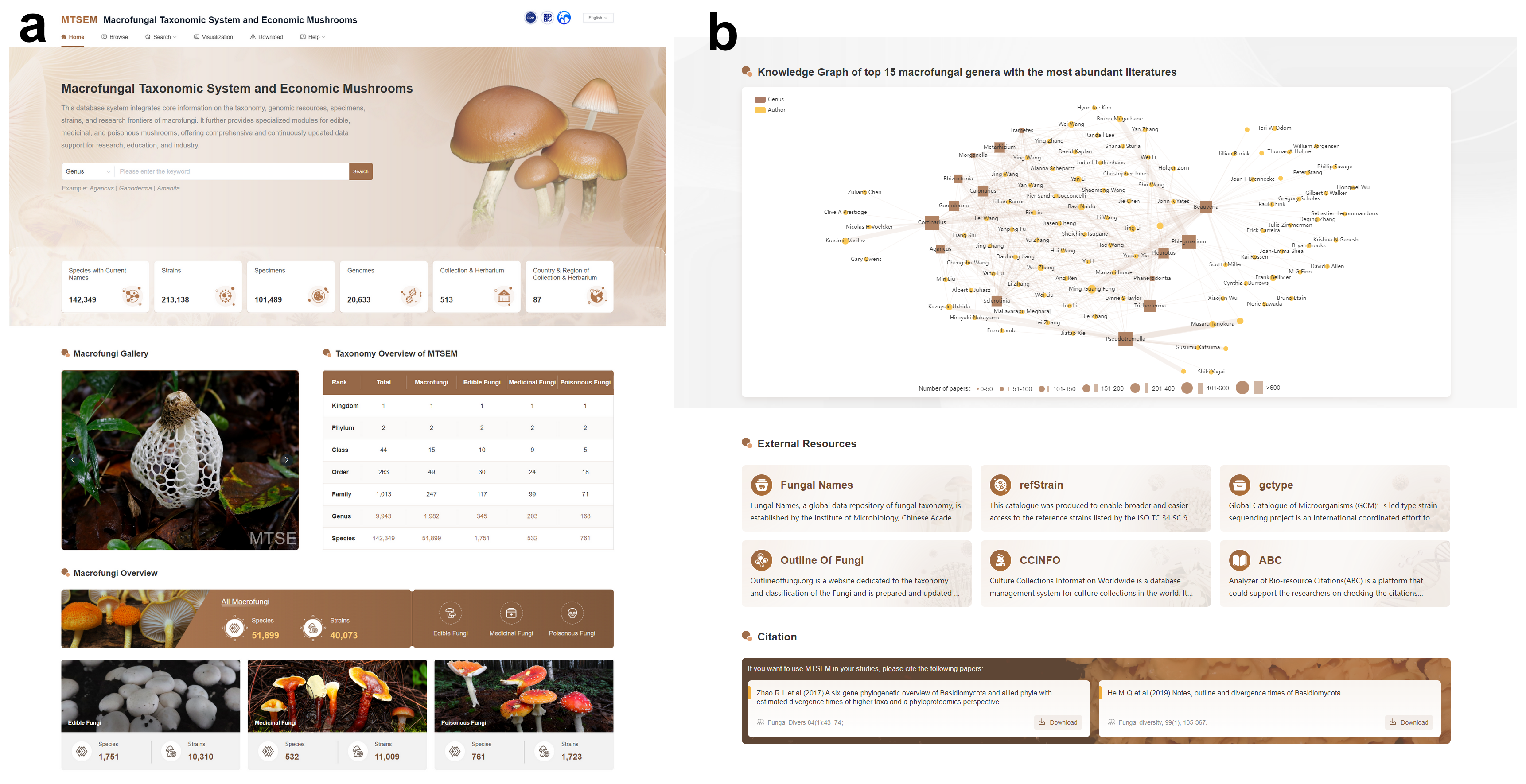
MTSEM is a macrofungi-centered database that integrates taxonomic, genomic, and economic trait data across Dikarya. It currently contains information for 9,943 fungal genera, 142,349 species, 20,633 genomes, 101,489 specimens, and 213,138 strains, including 1,982 macrofungal genera and 51,899 macrofungal species (Fig. 1; Supplementary Fig. S1). The inclusion of non-macrofungal taxa establishes a comprehensive taxonomic backbone that facilitates nomenclatural consistency and comparative analyses involving macrofungi. Despite this extensive coverage, genomic representation remains limited, with more than 96% of all species and 97% of macrofungal species lacking sequenced genomes, and several fungal classes remaining entirely unrepresented. MTSEM provides an integrated platform for accessing taxonomic hierarchies, genome data, specimen and strain records, publications, patents, culture collections, and herbaria, while regular synchronization with external resources ensures nomenclatural consistency and continuous updates. Detailed descriptions of the data sources, integration strategy, and curation procedures are provided in the Supplementary Methods, and instructions for using the MTSEM database are provided in the Supplementary User Guide. Existing fungal resources serve complementary purposes (Chaiwan et al. 2021). Fungal Names, Index Fungorum, and MycoBank primarily provide nomenclatural and taxonomic information (Robert et al. 2013; Wang et al. 2023); UNITE serves as the principal reference database for ITS-based molecular identification and species hypotheses (Nilsson et al. 2019); GBIF aggregates global biodiversity occurrence records and specimen information; and MycoCosm provides fungal genome assemblies, annotations, and comparative genomic resources (Grigoriev et al. 2014). Rather than replacing these specialized resources, MTSEM integrates hierarchical taxonomy, species-level information, genome data, specimen and strain records, economic trait annotations (edible, medicinal, and poisonous), publications, patents, and scientometric analyses within a unified macrofungi-centered framework. This enables seamless exploration of diverse data types through a consistent taxonomic backbone while maintaining links to authoritative external resources. Collectively, MTSEM provides an integrated platform for macrofungal taxonomy, systematics, biodiversity research, and resource utilization, while also highlighting substantial gaps in current genomic sampling that warrant future investigation. Future releases of MTSEM are intended to incorporate standardized functional genomics resources, including unified genome annotation, ortholog inference, and comparative functional analyses, thereby extending the platform toward a comprehensive functional genomics resource.
Beyond establishing a taxonomic framework and database resource, we explored the evolutionary characteristics of macrofungi through phylogenomic and comparative genomic analyses. Phylogenomic analyses of 829 fungal genomes produced a well-resolved tree that was largely consistent with previous genome-scale studies and supported the classification proposed here (Choi & Kim 2017, Li et al. 2021; Supplementary Fig. S2; Supplementary Table S3). Macrofungi occurred across multiple clades but were concentrated in Agaricomycetes and, to a lesser extent, Pezizomycetes. Comparative genomic analyses revealed consistent differences between macrofungi and microfungi (Supplementary Fig. S3). Compared with microfungi, macrofungi possess larger genomes with higher gene content, similar GC content, fewer horizontally transferred genes, and a greater diversity of biosynthetic gene clusters. These patterns were stable across both phyla, indicating broad evolutionary trends associated with increased morphological and ecological complexity. KEGG BRITE profiling based on eggNOG-derived KEGG Orthology
annotations further revealed clear functional differentiation between the two groups (Supplementary Fig. S4). After excluding human disease and organismal system categories, macrofungi were significantly enriched in functions related to cellular processes, environmental information processing, and genetic information processing, particularly signal transduction, cellular organization, transport and catabolism, chromosome-associated functions, and cell growth and death. In contrast, microfungi showed relatively higher representation of core metabolic functions, including nucleotide, amino acid, and energy metabolism, together with cofactor and vitamin metabolism. Together with genome expansion and expanded biosynthetic gene cluster repertoires, these functional differences suggest distinct evolutionary strategies between the two groups, with macrofungi emphasizing regulatory complexity associated with multicellular development and microfungi retaining relatively greater representation of core metabolic functions.
Acknowledgments
This work was supported by the National Key Research and Development Program of China (2025YFE0210900 and 2022YFD1200605), the National Natural Science Foundation of China (32500009), the Science and Technology Fundamental Resources Investigation Program, Ministry of Science and Technology of China (2023FY101303), and the Biological Resources Programme, Chinese Academy of Sciences.
Author contributions
The authors confirm contribution to the paper as follows: Conceptualization, Hyde KD, Wu LH, Zhao R.L.; methodology, Cao B, Wang F, Liu F, Fan GM; formal analysis, Cao B; resources, Sun QL, Wang K, Li M, Li SW, Qu XL, Wang XX, Lan Y, Ma JC; data curation, Cao B, Wang F, Liu F, Fan GM; writing—original draft preparation, Cao B, Wang F, Liu F, Fan GM; writing—review and editing, Sun QL, Wang K, Li M, Li SW, Qu XL, Wang XX, Lan Y, Ma JC, Hyde KD, Wu LH, Zhao RL; supervision, Hyde KD, Wu LH, Zhao RL, project administration, Zhao RL; funding acquisition, Cao B, Wu LH, Zhao RL. All authors have read and agreed to the published version of the manuscript.
ORCID
Bin Cao: https://orcid.org/0000-0002-5020-1551
Fang Wang: https://orcid.org/0009-0005-6087-605X
Fei Liu: https://orcid.org/0000-0003-1175-4070
Guo-Mei Fan: https://orcid.org/0009-0008-2548-2014
Kevin D. Hyde: https://orcid.org/0000-0002-2191-0762
Lin-Huan Wu: https://orcid.org/0000-0002-5255-1846
Rui-Lin Zhao: https://orcid.org/0000-0001-8129-9339
Conflict of interest statement
The author list includes members of the Editorial Board of Fungal Diversity. They were not involved in the journal’s review of, or decisions related to, this manuscript. The authors declare no competing interests.
Data availability
The MTSEM database is publicly available at (https://nmdc.cn/macrofungi/). The genome datasets used in the phylogenomic and comparative genomic analyses were obtained from publicly available repositories, and the corresponding genome accession information is provided in Supplementary Table S3. Additional data supporting the findings of this study are provided in the Supplementary Information.
Supplementary Information
The online version contains supplemental information available at https://doi.org/10.65390/fdiv.2026.136018.
Rights and permissions
The Author(s) 2026. Published by BioAcademic Press on behalf of Kunming Institute of Botany,Chinese Academy of Sciences (CAS) and Mushroom Research Foundation. This is an open accessarticle under the Creative Commons Attribution license ( http://creativecommons.org/licenses/by/4.0), which permits use, distribution and reproduction in any medium, provided the originalwork is properly cited.
References
- Chaiwan N, Gomdola D, Wang S, Monkai J, Tibpromma S, Doilom M, Wanasinghe DN, Mortimer PE, Lumyong S, Hyde KD (2021) https://gmsmicrofungi.org: an online database providing updated information of microfungi in the Greater Mekong Subregion. Mycosphere 12(1): 1513–1526. https://doi.org/10.5943/mycosphere/12/1/19
- Chang ST, Miles PG (1992) Mushroom biology - A new discipline. The Mycologist 6: 64–65.
https://doi.org/10.1016/s0269-915x(09)80449-7 - Choi J, Kim S (2017) A genome Tree of Life for the Fungi kingdom. Proceedings of the National Academy of Sciences of the United States of America 114(35): 9391–9396.
https://doi.org/10.1073/pnas.1711939114 - Floudas D, Binder M, Riley R, Barry K, Blanchette RA, Henrissat B, Martínez AT, Otillar R, Spatafora JW, Yadav JS, et al. (2012) The paleozoic origin of enzymatic lignin decomposition reconstructed from 31 fungal genomes. Science 336: 1715–1719.
https://doi.org/10.1126/science.1221748 - Grigoriev IV, Nikitin R, Haridas S, Kuo A, Ohm R, Otillar R, Riley R, Salamov A, Zhao XL, Korzeniewski F, Smirnova T, Nordberg H, Dubchak I, Shabalov I (2014) MycoCosm portal: gearing up for 1000 fungal genomes. Nucleic Acids Research 42(D1): D699–D704.
https://doi.org/10.1093/nar/gkt1183 - He MQ, Zhao RL, Hyde KD, Begerow D, Kemler M, Yurkov A, McKenzie EHC, Raspé O, Kakishima M, Sánchez-Ramírez S, Buyck B et al. (2019) Notes, outline and divergence times of Basidiomycota. Fungal Diversity 99: 105-367. https://doi.org/10.1007/s13225-019-00435-4
- He MQ, Cao B, Liu F, Boekhout T, Denchev TT, Schoutteten N, Denchev CM, Kemler M, Gorjón SP, Redhead SA et al. (2024) Phylogenomics, divergence times and notes of orders in Basidiomycota. Fungal Diversity 126: 127–406. https://doi.org/10.1007/s13225-024-00535-w
- Hibbett DS, Nagy LG, Nilsson RH (2025) Fungal diversity, evolution, and classification. Current Biology 35: R463–R469.
https://doi.org/10.1016/j.cub.2025.01.053 - Hyde KD, Noorabadi MT, Thiyagaraja V, He MQ, Johnston PR, Wijesinghe SN, Armand A, Biketova AY, Chethana KWT, Erdoğdu M, et al. (2024) The 2024 Outline of Fungi and fungus-like taxa. Mycosphere 15(1): 5146–6239.
https://doi.org/10.5943/mycosphere/15/1/25 - Kirk PM, Cannon PF, Minter DW, Stalpers JA (2008) Ainsworth & Bisby’s Dictionary of the Fungi, 10th edn. CABI, Wallingford.
https://doi.org/10.1079/9780851998268.0000 - Li Y, Steenwyk JL, Chang Y, Wang Y, James TY, Stajich JE, Spatafora JW, Groenewald M, Dunn CW, et al. (2021) A genome-scale phylogeny of the kingdom Fungi. Current Biology 31(8): 1653-1665.e5.
https://doi.org/10.1016/j.cub.2021.01.074 - Miyauchi S, Kiss E, Kuo A, Drula E, Kohler A, Sánchez-García M, Morin E, Andreopoulos B, Barry KW, Bonito G, et al. (2020) Large-scale genome sequencing of mycorrhizal fungi provides insights into the early evolution of symbiotic traits. Nature Communications 11: 5125.
https://doi.org/10.1038/s41467-020-18795-w - Nagy LG, Bálint B, Grigoriev IV (2026) Chapter 6: Mushroom genomics – the history, driving forces and current state of the genomics of mushroom-forming fungi. In: Xu JP, James TY, Bao DP (eds) Mushroomology. Brill/Wageningen Academic, Leiden. 239-277
https://doi.org/10.1163/9789004751699_7 - Niego AGT, Lambert C, Mortimer P, Thongklang N, Rapior S, Grosse M, Schrey H, Charria-Girón E, Walker A, Hyde KD, Stadler M (2023a) The contribution of fungi to the global economy. Fungal Diversity 121: 95–137.
https://doi.org/10.1007/s13225-023-00520-9 - Niego AGT, Rapior S, Thongklang N, Raspé O, Hyde KD, Mortimer P (2023b) Reviewing the contributions of macrofungi to forest ecosystem processes and services. Fungal Biology Reviews 44: 100294.
https://doi.org/10.1016/j.fbr.2022.11.002 - Nilsson RH, Larsson K-H, Taylor A, Bengtsson-Palme J, Jeppesen T, Schigel D, Kennedy P, Picard K, et al. (2019) The UNITE database for molecular identification of fungi: handling dark taxa and parallel taxonomic classifications. Nucleic Acids Research 47(D1): D259–D264.
https://doi.org/10.1093/nar/gky1022 - Robert V, Vu D, Amor ABH, van de Wiele N, Brouwer C, Jabas B, Szoke S, Dridi A, Triki M, et al. (2013) MycoBank gearing up for new horizons. IMA Fungus 4(2): 371–379.
https://doi.org/10.5598/imafungus.2013.04.02.16 - Wang F, Wang K, Cai L, Zhao M, Kirk PM, Fan G, Sun Q, Li B, Wang S, Yu Z, Han D, Ma J, Wu L, Yao Y (2023) Fungal names: a comprehensive nomenclatural repository and knowledge base for fungal taxonomy. Nucleic Acids Research 51(D1): D708–D716.
https://doi.org/10.1093/nar/gkac926 - Wijayawardene NN, Hyde KD, Dai DQ, Sánchez-García M, Goto BT, Saxena RK, Erdoğdu M, Selçuk F, Rajeshkumar KC, Aptroot A, Błaszkowski J, Boonyuen N, da Silva GA, de Souza FA, Dong W et al. (2022) Outline of Fungi and fungus-like taxa – 2021. Mycosphere 13: 53–453.
https://doi.org/10.5943/mycosphere/13/1/2 - Wijayawardene NN, Hyde KD, Al-Ani LKT, Tedersoo L, Haelewaters D, Rajeshkumar KC, Zhao RL, Aptroot A, Leontyev DV, Saxena RK, et al. (2020) Outline of Fungi and fungus-like taxa. Mycosphere 11: 1060–1456.
https://doi.org/10.5943/mycosphere/11/1/8 - Wu F, Zhou LW, Yang ZL, Bau T, Li TH, Dai YC (2019) Resource diversity of Chinese macrofungi: edible, medicinal and poisonous species. Fungal Diversity 98: 1–76.
https://doi.org/10.1007/s13225-019-00432-7 - Wu G, Yang ZL (2026) Chapter 1: Diversity and taxonomy of edible and medicinal mushrooms. In: Xu JP, James TY, Bao DP (eds) Mushroomology. Brill/Wageningen Academic, Leiden.1-57.
https://doi.org/10.1163/9789004750593_2