Abstract
Introduction
Endophytes are microorganisms, predominantly fungi and bacteria, that reside within plant tissues without causing any apparent disease symptoms (Wilson 1995; Aleynova et al. 2023). Their long-standing association with land plants is evidenced by fossil records dating back over 400 million years, suggesting that early mutualistic relationships—particularly between fungi and plant roots—played a key role in plant evolution (Krings et al. 2007; Plett & Martin 2015). Although this symbiosis is ancient, the formal recognition and scientific study of endophytes is relatively recent (De Bary 1879). Fungal endophytes, in particular, offer a wide range of ecological and practical benefits. In agriculture and forestry, they promote plant growth by enhancing nutrient uptake and increasing resistance to both biotic and abiotic stresses (García-Latorre et al. 2021; Fontana et al. 2021; Lata et al. 2018). In medicine, they are a rich source of bioactive compounds with promising applications in the development of antibiotics, anticancer agents, and other therapeutic medications (Schulz et al. 2002; Ebrahimi et al. 2025). Endophytes have been identified in a broad spectrum of plant lineages, including mosses, algae, ferns, conifers, and angiosperms (U’Ren et al. 2010), and it is estimated that each vascular plant species may host between 10 to 100 different fungal endophyte species, with a small number showing host specificity (Dreyfuss & Chapela 1994; Bhunjun et al. 2024). Fungal endophytes represent a remarkably diverse and ecologically significant group of microorganisms that inhabit nearly every plant lineage on Earth. With an approximately 300,000 known plant species worldwide, the global diversity of fungal endophytes is estimated to exceed one million species based on 1:4 or 1:5 fungi per host, emphasizing their critical roles in plant biology and ecosystem processes (Strobel & Daisy 2003; Sun & Guo 2012; Rashmi et al. 2019).
Fungal endophytes display significant diversity, encompassing several fungal phyla, such as Ascomycota, Basidiomycota, and basal fungi, including Mucoromycota, Mortierellomycota, Glomeromycota, and Chytridiomycota. By far, most identified fungal endophytes belong to the phylum Ascomycota (Massimo et al. 2015; U’Ren et al. 2019; Moghaddam et al. 2021). Within this phylum, the classes Dothideomycetes, Sordariomycetes, Leotiomycetes, Eurotiomycetes, and Pezizomycetes are particularly rich in endophytic species (U’Ren et al. 2019; Arnold & Lutzoni 2007; Botella & Diez 2011; Rashmi et al. 2019; Sanz-Ros et al. 2015). Fungal genera that are frequently associated with endophytic lifestyles are also categorized accordingly in reference databases such as FunGuild (Nguyen et al. 2016) and FungalTraits (Põlme et al. 2020). Nevertheless, endophytism frequently represents only one stage in the life cycle of many fungi, as a number of taxa that occur as endophytes can subsequently shift into saprotrophic or pathogenic lifestyles (Stengel et al. 2022). This functional plasticity highlights the limitation of genus-level assignments, since closely related species within the same genus may differ substantially in ecological role. Therefore, recognition and classification of endophytic taxa at the species level is ecologically more meaningful and provides a more accurate understanding of their potential functional contributions.
Host specificity in fungal endophytes has been reported across numerous studies, with certain fungal species consistently associating with specific plant hosts (Arnold & Lutzoni 2007; Ekanayake et al. 2012). Neotyphodium/Epichloë species are particularly well-known for forming highly specific symbioses with grasses (Saikkonen et al. 2016). Although horizontally transmitted endophytes typically exhibit less specificity than vertically transmitted ones, host preferences are frequently observed in the latter (Todd 1988; Ahlholm et al. 2002; Unterseher et al. 2013; Rajala et al. 2013; Hardoim et al. 2015). For instance, Rhabdocline parkeri is found exclusively on Pseudotsuga menziesii, demonstrating strict host specificity (Carroll 1988). Environmental variables, especially geographic location, may further influence host specificity. While some tropical endophytes have shown host-specific associations (Arnold et al. 2003), others, such as those studied in French Guiana & India, have not (Cannon & Simmons 2002; Suryanarayanan et al. 2002). Cactus endophytes from the southwestern USA showed no host specificity (Suryanarayanan et al. 2005), whereas those from Arctic and boreal regions were often limited to a single host species (Higgins et al. 2007). Collectively, these findings reveal variability in host specificity among fungal endophytes and suggest that geographic or climatic context may play a role, although further investigation is needed to clarify these patterns.
A group of fungal endophytes colonizes plants systemically, while others exhibit specificity for particular plant organs, such as roots, stems, leaves, or seeds (Rodriguez et al. 2009; Wearn et al. 2012; Kumar & Hyde 2004; Su et al. 2010; Peršoh, 2013). Fisher & Petrini (1992) observed significant organ specificity in Oryza sativa L. Sun et al. (2008) indicated distinct fungal endophyte communities between the branches and leaves of six medicinal plant species. Fungal endophytes associated with Ageratina adenophora exhibited notable tissue specificity and rarely showed systemic growth (Fang et al. 2019). In contrast, Bayman et al. (1997) reported the same endophyte species in foliar and root tissues of Lepanthes orchids, whereas Blodgett et al. (2000) found this pattern in Amaranthus hybridus. Mishra et al. (2012) reported that Chaetomium globosum was isolated as an endophyte from all tissues of the medicinal plant Tinospora cordifolia. These findings emphasize the diverse colonization strategies employed by fungal endophytes and highlight the crucial role of organ specificity in shaping endophytic community structure and function within plant hosts.
Fungal endophytes are closely associated with plants and occur across all terrestrial biomes, from tropical to arctic ecosystems (Bacon & White 2000; Oita et al. 2021; Zhang & Yao 2015). However, some fungal species may exhibit preferences for particular climatic conditions. The taxonomic composition of fungal endophytes differs among tropical, temperate, and boreal forests (Arnold & Lutzoni 2007). The community of fungal endophytes associated with photosynthetic tissues of cupressaceous trees in xeric deserts differs from those in mesic forests (Hoffman & Arnold 2008). In the Himalayas, the intensity of dark septate endophyte (DSE) colonization in the roots of Poa attenuata significantly increased with elevation, although the opposite pattern occurred for arbuscular mycorrhizal fungi (Kotilínek et al. 2017). Overall, climatic factors like temperature, moisture, seasonality, and altitude play a significant role in shaping the distribution and diversity of fungal endophytes, with various species showing preferences for particular environmental conditions.
Fungal endophytes are commonly categorized into ecological guilds and functional groups using curated resources such as FunGuild and FungalTraits (Nguyen et al. 2016; Põlme et al. 2020). An analysis of more than 500 studies identified over 800 fungal genera reported as endophytes and compiled corresponding information on host plant organs, host species, and geographic origins (Rashmi et al. 2019). Large-scale investigations over the past two decades have significantly advanced the field by characterizing the taxonomic and functional diversity of endophytes, elucidating their ecological roles in host–microbe interactions, and uncovering evolutionary patterns that link endophytism to broader processes in fungal ecology and symbiosis (Arnold & Lutzoni 2007; Hoffman & Arnold 2008; Vega et al. 2010; U’Ren et al. 2012; Higginbotham et al. 2013; U’Ren et al. 2019; Oita et al. 2021). These foundational efforts have provided critical baselines for identifying dominant endophytic taxa and for understanding how they shape, and are shaped by, plant-associated microbial communities.
This study consolidates both published and unpublished data on fungal endophytes that were originally isolated using diverse methodologies across a wide range of plant species, organs, and geographic regions. By integrating these heterogeneous datasets, we provide a comprehensive framework for examining global patterns of endophyte diversity and ecology. Our approach is guided by the hypothesis that variation in host and organ identity shapes fungal community composition, with specific fungal taxa expected to exhibit specialization for particular organs due to differences in nutrient availability, tissue structure, or defense chemistry. Specifically, our objectives are: (1) to generate the first global-scale database of fungal species reported as endophytes, consolidating scattered records into a unified reference, and (2) to perform a detailed analysis of host- and organ-specificity among fungal endophytes, while evaluating the influence of climatic variables and spatial context on these patterns. By linking explicit ecological expectations to our sampling framework, we aim to identify fungal taxa with predictable patterns of host or organ specialization, thereby providing mechanistic insights into plant–microbe interactions across ecosystems.
Material and Methods
Data Collection
As of January 2022, data were compiled from three major bibliographic databases—Web of Science, Scopus, and PubMed—using the search terms endophyte OR endophytic applied to titles, abstracts, and keywords. The GenBank repository was also searched using the same keywords to capture sequence-based records, and both published and unpublished studies were included. In addition, fungal endophyte-related records were extracted from the FungalTraits database (Põlme et al. 2020).
Records retrieved from all sources were merged, and duplicate entries were removed prior to screening. Titles and abstracts were screened to exclude conference papers, review articles, methodological studies lacking primary data, and studies investigating non-fungal (e.g., bacterial) endophytes. Full-text articles were then assessed for eligibility. Studies were excluded if they lacked primary data, had incomplete or non-extractable metadata, focused on non-endophytic fungi or non-living plant material, or were duplicate datasets. Studies without accessible full text were also excluded. Application of these criteria reduced the initial pool of approximately 30,000 publications to ~4,500 studies that met all inclusion requirements (Fig. S1). Because FunEndo was developed as a global synthesis of published and unpublished fungal endophyte records, methodological protocols were not standardized across the original studies. Procedures used to define and isolate endophytes—including surface sterilization methods, culture conditions, sequencing platforms, primer sets, and sequence-processing pipelines—varied among sources. Consequently, no retrospective filtering based on specific sterilization protocols or sequence clustering thresholds was applied. Instead, inclusion was restricted to studies that explicitly reported fungal taxa as endophytes.
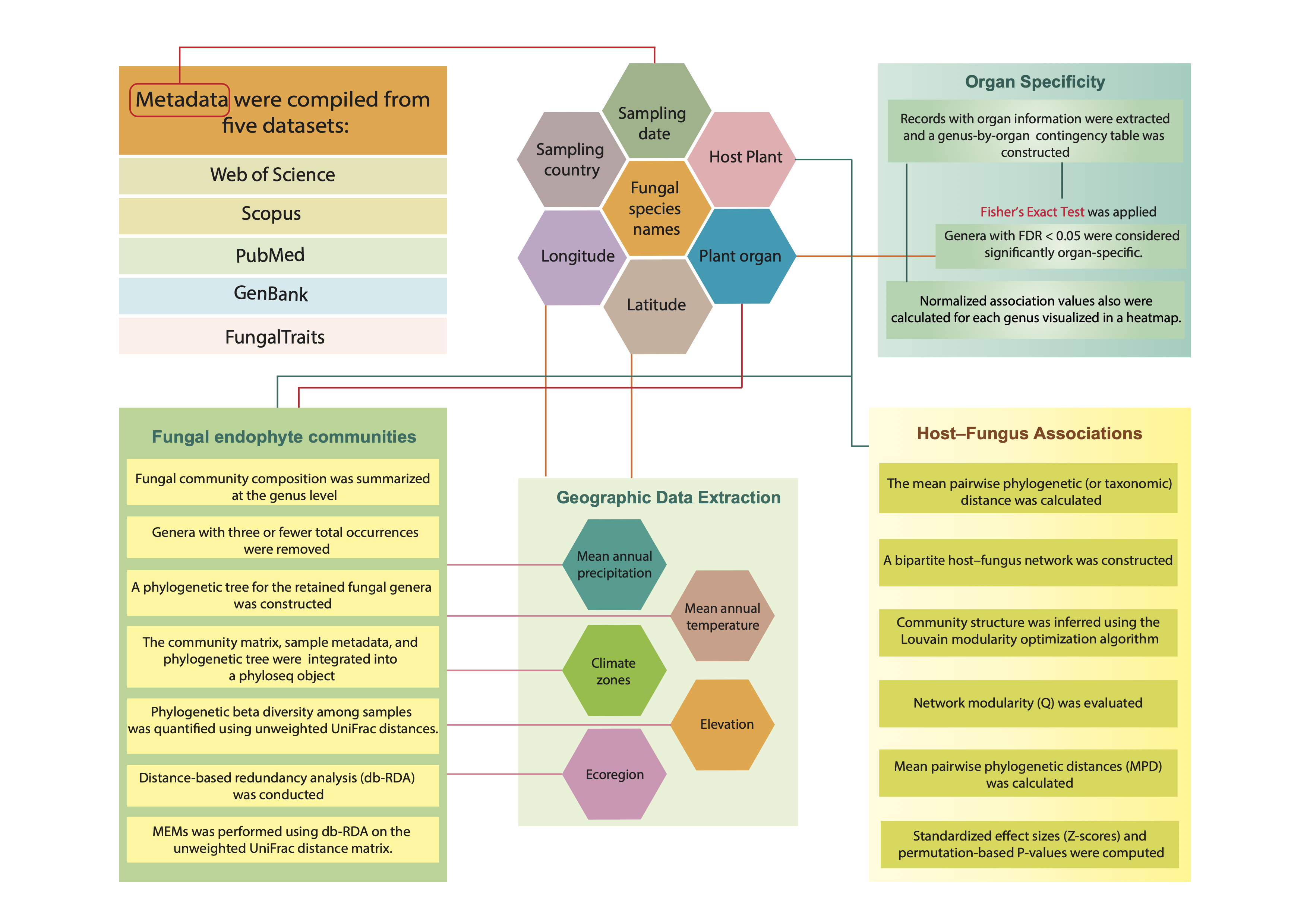
For each retained study, taxonomic and associated metadata were extracted, including fungal species names, host plant species, plant organ sampled, geographic location, latitude and longitude, country, sampling date, and season. Host plant species were further classified into broad growth-form categories (Grass/Graminoid, Herb/Forb, Shrub, Tree, and Vine/Liana) using growth habit information obtained from World Flora Online (https://www.worldfloraonline.org), Plants of the World Online (https://powo.science.kew.org), and, where available, the USDA PLANTS Database (https://plants.sc.egov.usda.gov). Classifications were cross-checked among sources when necessary to ensure consistency. To ensure taxonomic consistency across datasets, both fungal and host plant names were standardized prior to analysis using the Global Biodiversity Information Facility (GBIF) backbone taxonomy. All scientific names were processed using the GBIF Species Lookup tool (https://www.gbif.org/tools/species-lookup), which matches input names against the GBIF backbone—a curated and synthetic taxonomy integrating multiple authoritative sources (e.g., Catalogue of Life, International Plant Names Index, and Index Fungorum). For both fungi and host plants, this procedure was used to (i) correct typographical errors, (ii) resolve synonyms to their currently accepted names, and (iii) harmonize taxonomic nomenclature across all datasets. Only accepted names returned by GBIF were retained for downstream analyses. This approach ensured a consistent and up-to-date taxonomic framework for both fungal taxa and their associated host plants. All data mining procedures and subsequent analyses are presented in Figure 1, offering a concise overview of the study’s workflow and its key methodological steps.
Organ Specificity
To assess organ specificity of fungal genera, we first curated a comprehensive dataset of fungal occurrences across plant organs from the FunEndo database. Only records with organ information were retained. Organ names were standardized to correct typographical inconsistencies and ensure consistent nomenclature, and rare or ambiguous organs such as “bark”, “stolon”, “tuber”, “gall”, and “other” were removed to focus the analysis on well-represented organs. A genus-by-organ contingency table was constructed, summarizing the frequency of each genus across the remaining organs. For each genus, Fisher’s Exact Test was applied to the contingency table to evaluate whether the distribution of occurrences across organs deviated from random expectation. P-values were computed using 9,999 simulated replicates to account for sparse or unbalanced contingency tables, and multiple testing was controlled using the Benjamini–Hochberg false discovery rate (FDR) correction. Genera with FDR < 0.05 were considered significantly organ-specific. Normalized association values were calculated for each genus by dividing the number of reports in a given organ by the total number of reports for that genus across all organs, providing an occurrence-based measure of organ enrichment. These values were visualized in a heatmap to highlight patterns of organ specialization across significant genera.
To account for variation in reporting intensity among species and reduce bias associated with uneven literature representation, we employed a normalization approach based on species-level reporting frequency. For each species, we calculated the number of distinct references in which it was reported for each organ and then normalized this value by the total number of references in which the species appeared across all organs. This yielded a proportion reflecting the strength of association between each species and organ, relative to its overall reporting frequency. Species were retained for comparison if their normalized score exceeded 0.3 in at least one organ.
Phylogenetic and Network Analysis of Host–Fungus Associations
To comprehensively evaluate the phylogenetic structure of host–fungus associations, we combined an association-based permutation framework with a network-based modularity analysis, allowing assessment of both pairwise phylogenetic non-randomness and emergent community-level structure within the interaction network. We first tested whether closely related fungi preferentially associate with closely related hosts by calculating the mean pairwise phylogenetic distance among host taxa associated with each fungal taxon. Null expectations were generated by randomly shuffling host–fungus associations while preserving interaction frequencies, recalculating the distance metric for each permuted dataset, and performing 999 permutations; statistical significance was determined as the proportion of permuted values less than or equal to the observed statistic, with the null hypothesis assuming random associations and the alternative hypothesis predicting phylogenetically structured interactions. To capture higher-order structure beyond individual associations, we constructed a bipartite host–fungus network from the curated presence–absence matrix after matching taxa to phylogenies and removing rare nodes with fewer than two interactions (i.e., host or fungal taxa connected to fewer than two partner taxa within the interaction network) to reduce stochastic noise. Community structure was inferred using the Louvain modularity optimization algorithm implemented in igraph, and network modularity (Q) was evaluated against 999 permutation-based null models generated by randomizing the interaction matrix. To assess phylogenetic signal within detected modules, we calculated mean pairwise phylogenetic distances (MPD) among host taxa within each module using cophenetic distances derived from the host phylogeny and compared observed values to null distributions generated by permuting module assignments (999 permutations). Standardized effect sizes (Z-scores) and permutation-based P-values were computed to quantify phylogenetic clustering or overdispersion, enabling integration of pairwise specialization patterns with emergent modular organization across the full interaction network.
Geographic and Environmental Data Extraction
Latitude and longitude coordinates for each fungal endophyte record were carefully cleaned and standardized to ensure accuracy, and records lacking geographic information were excluded from subsequent analyses. Climate zones were assigned to each record based on latitude, with tropical zones spanning −23.5° to 23.5°, temperate zones from 23.5° to 66.5° in both hemispheres, and boreal zones beyond 66.5° or below −66.5°. To quantify climatic conditions at each sampling location, raster datasets from WorldClim version 2.1 (2.5 arc-minute resolution) were used to extract mean annual temperature (MAT, BIO1) and mean annual precipitation (MAP, BIO12) values at the exact coordinates of each sample. Elevation values were obtained for all sampling points using the elevatr R package, which accesses the high-resolution AWS terrain dataset to provide accurate altitude measurements. In addition, ecoregion identifiers were assigned to each sample through spatial mapping in QGIS Desktop v.3.36.2, using the superecoregion framework provided by Tedersoo et al. (2022) to provide ecological and biogeographic context, linking each fungal occurrence to established terrestrial ecoregions.
db-RDA–based variance partitioning of fungal endophyte communities
We used the FunEndo database, which initially included 104,411 records from multiple studies. The dataset was filtered to retain only fungal taxa, and records without geographic coordinates (latitude or longitude) were removed. Coordinates were standardized to numeric format, and records with missing or invalid spatial information were excluded. Each record was assigned to one of three broad climatic zones (tropical, temperate, or boreal) based on latitude following standard latitudinal thresholds (±23.5° and ±66.5°). Analyses were restricted to leaf and root tissues to ensure sufficient replication and ecological comparability. To reduce spatial uncertainty, samples were intersected with a global super-ecoregion layer, and records lacking ecoregion assignments were excluded. Following all filtering steps, 7,331 records representing 640 unique samples were retained. Each sample was defined as a unique combination of study reference, geographic coordinates, and host organ.
Fungal community composition was summarized at the genus level. Occurrence counts of fungal genera were aggregated per sample to generate a sample × genus matrix. Genera with three or fewer total occurrences across the dataset were removed to reduce sparsity, resulting in a final community matrix comprising 607 samples and 191 fungal genera. Phylogenetic relationships among fungal taxa were inferred using a taxonomy-based backbone approach implemented in the taxonomy_to_tree.pl script (Tedersoo et al. 2018). Fungal genera were assigned to a curated hierarchical classification reflecting current phylogenetic knowledge, and this nested taxonomy was subsequently converted into a phylogenetic tree in Newick format. Tip labels were matched to genus names, and taxa absent from the community matrix were pruned. The community matrix, sample metadata, and phylogenetic tree were integrated into a phyloseq object. Phylogenetic beta diversity among samples was quantified using unweighted UniFrac distances. Environmental predictors included scaled continuous variables (MAT, MAP, elevation) and a categorical climate zone factor. Host effects were represented by organ identity (leaf or root) and growth form. Spatial structure was modeled using Moran’s eigenvector maps (MEMs), derived from geographic coordinates using distance-based eigenvector mapping (dbMEM). MEMs capture spatial patterns across multiple scales and allow explicit control of spatial autocorrelation. To ensure consistency between spatial predictors and the phylogenetic response variable, forward selection of MEMs was performed using distance-based redundancy analysis (db-RDA) on the unweighted UniFrac distance matrix. Selection was implemented with adjusted R² stopping criteria to prevent overfitting. A subset of broad-scale MEMs explaining the majority of spatial structure was retained for subsequent analyses.
Distance-based redundancy analysis (db-RDA) was conducted using the capscale function in the vegan package, with unweighted UniFrac distances as the response. The full model included environmental variables (MAT, MAP, elevation, climate zone), host organ identity and growth form, and the selected MEMs as explanatory variables. Model significance was assessed using permutation tests (999 permutations) under a reduced model framework. Collinearity among predictors was evaluated using variance inflation factors (VIF), and no predictors exceeded accepted thresholds. To evaluate the contribution of individual predictors, term-wise permutation tests were performed with predictors added sequentially. This framework allowed assessment of the relative influence of climate, host, and spatial structure on fungal endophyte community composition while accounting for shared variance among predictor sets.
Results
Taxonomic Distribution of Fungal Endophytes
A total of approximately 105,000 records of fungal endophytes were compiled from ~4,500 studies, encompassing both published and unpublished sources. Data were aggregated from major repositories and databases, including Web of Science, Scopus, PubMed, GenBank, and FungalTraits. Records originated from both high-throughput sequencing of environmental samples and sequencing of pure fungal cultures, and were taxonomically resolved into 11 phyla, 46 classes, 164 orders, 520 families, 1,756 genera, and 4,321 species. Examination of dataset-specific contributions revealed that the scientific literature, GenBank, and FungalTraits accounted for 1,180, 1,244, and 108 unique species of fungal endophytes, respectively (Fig. S2). Of these, 1,607 species were shared between the scientific literature and GenBank, while 216 species were represented across all three datasets (Fig. S2). Taxonomic composition was strongly dominated by the phylum Ascomycota in each dataset, comprising 91% of records in the scientific literature, 92% in GenBank, and 95% in FungalTraits (Figs. S3–S5). Basidiomycota represented a smaller but consistent fraction (~7%), followed by Mucoromycota (~1%). Collectively, Ascomycota and Basidiomycota accounted for 99% of all endophyte records. The remaining 1% was distributed across other fungal phyla, including Mortierellomycota, Zoopagomycota, Glomeromycota, Chytridiomycota, Blastocladiomycota, Entomophthoromycota, Zygomycota s.l., and Sanchytriomycota (Fig. 2A).
Across all three datasets, the class Sordariomycetes was the most frequently recorded, accounting for 45–50% of entries, followed by Dothideomycetes (25–30%), Leotiomycetes (5–15%), and Eurotiomycetes (5–10%) (Figs. S3–S5). More than 95% of fungal endophyte records identified to the class level were assigned to six dominant classes: Sordariomycetes (46%), Dothideomycetes (27%), Eurotiomycetes (10%), Leotiomycetes (6%), Agaricomycetes (5%), and Tremellomycetes (2%) (Fig. 2B).
The dominant fungal orders varied across the different datasets. In the scientific literature, Pleosporales represented the highest proportion of records (21%), followed by Hypocreales (17%) and Eurotiales (9%) (Fig. S3). In the GenBank dataset, Hypocreales was most prevalent, comprising 22% of records, followed by Pleosporales (20%) and Glomerellales (12%) (Fig. S4). In the FungalTraits dataset, Xylariales was the most frequently recorded order (18%), followed by Pleosporales (17%) and Hypocreales (13%) (Fig. S5). Within the FunEndo database, more than 95% of fungal endophyte records identified to the order level belonged to eight orders: Pleosporales, Hypocreales, Eurotiales, Glomerellales, Xylariales, Diaporthales, Helotiales, and Botryosphaeriales (Fig. 2C). Among these, Pleosporales was the most taxonomically diverse, encompassing 243 endophytic fungal genera, followed by Helotiales (137), Hypocreales (131), Agaricales (95), Polyporales (80), Xylariales (78), and Sordariales (60).
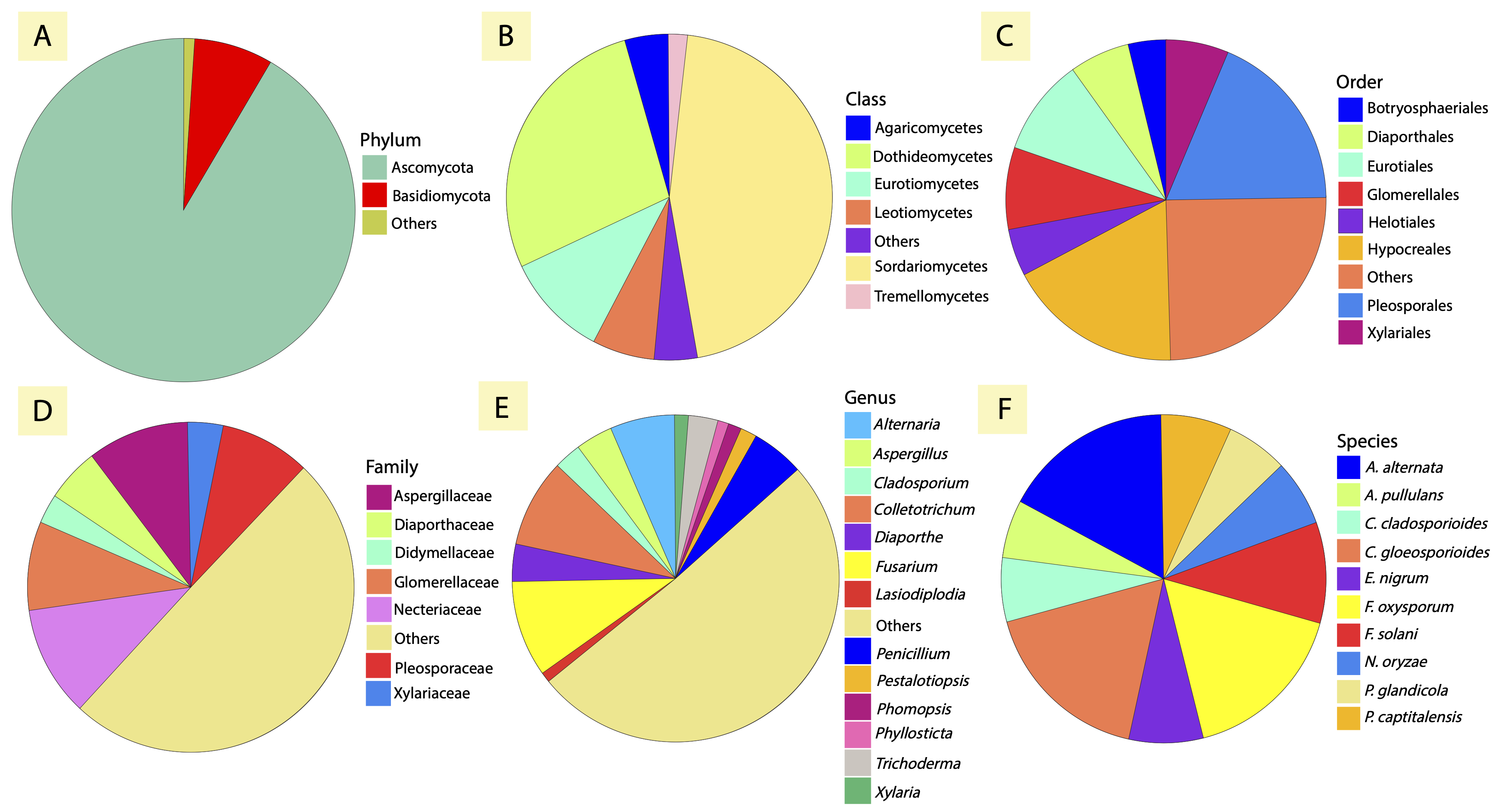
In the GenBank dataset, the majority of fungal endophyte records were attributed to three primary families: Nectriaceae, Glomerellaceae, and Aspergillaceae (Fig. S4). Similarly, the scientific literature dataset classified approximately 50% of all records within the families Nectriaceae, Pleosporaceae, and Aspergillaceae (Fig. S3). In the FungalTraits database, Xylariaceae, Nectriaceae, and Pleosporaceae emerged as the most frequently represented families (Fig. S5). In the FunEndo database, the majority of fungal endophyte records were associated with the families Nectriaceae, Aspergillaceae, Pleosporaceae, Glomerellaceae, and Diaporthaceae (Fig. 2D).
Across all three datasets and the FunEndo database, Alternaria, Fusarium, and Colletotrichum were the most frequently recorded fungal endophyte genera (Figs. 2E, S3–S5). The genus Fusarium included 95 species, with F. oxysporum, F. solani, and F. fujikuroi being the most commonly reported (Figs. S3F, S4F, and S5F). Fusarium oxysporum was recorded as an endophyte in 345 studies, exhibiting associations with a wide range of plant organs—including leaves, stems, roots, rhizomes, flowers, seeds, and fruits—across more than 230 plant species in over 40 countries. F. solani and F. fujikuroi were associated with 160 and 30 plant species, respectively. The genus Alternaria comprised 115 species, with A. alternata being the most prevalent. Alternaria alternata was found colonizing both above- and below-ground tissues of more than 250 plant species. Among the 125 Colletotrichum species documented in the datasets, C. gloeosporioides stood out as the dominant species, recorded in over 300 studies and linked to more than 200 plant species.
Geographic distribution of fungal endophytes
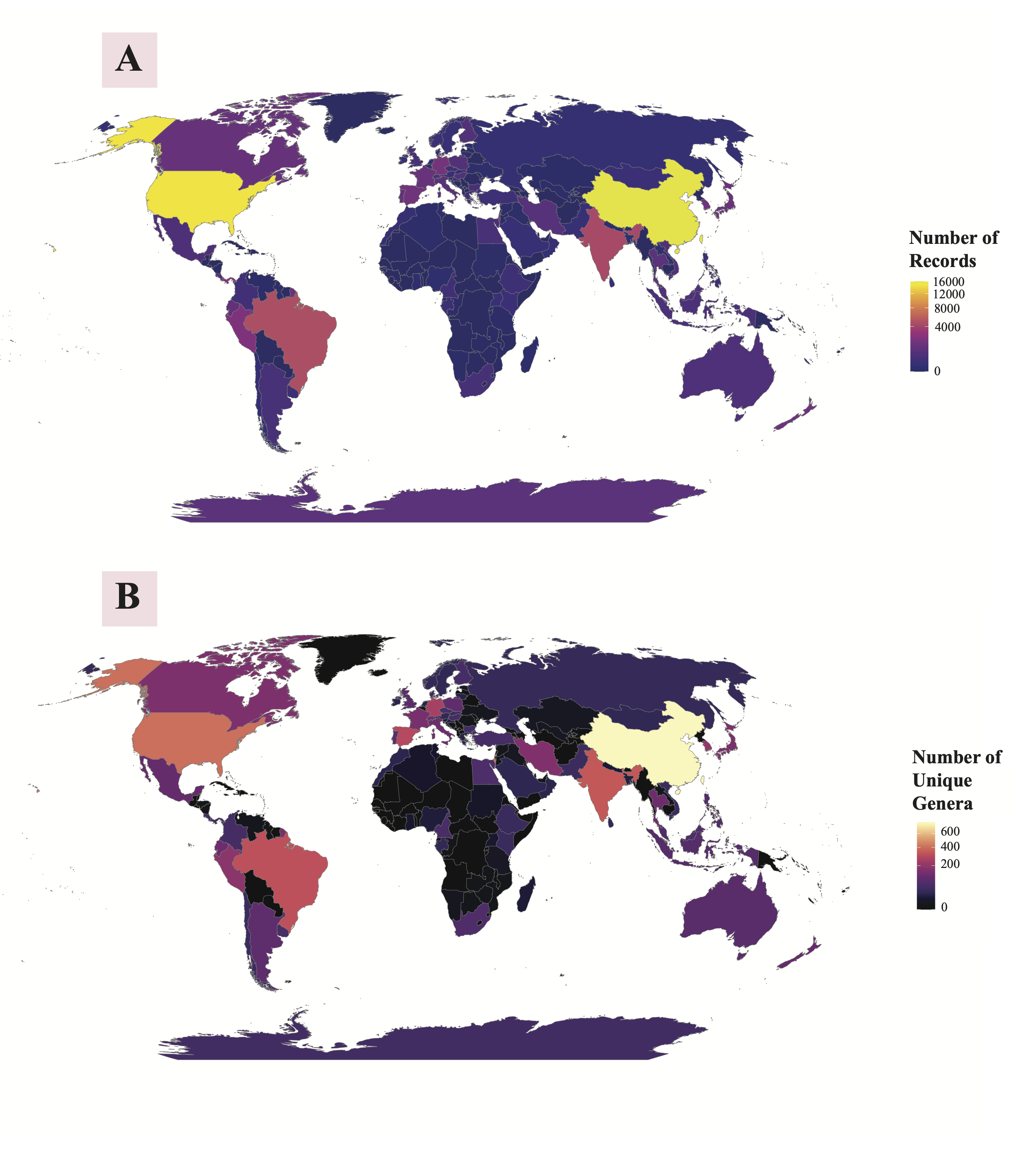
Current fungal endophyte records are geographically biased toward the United States, Europe, and China, leaving large regions underrepresented (Fig. S6). The United States and China contributed over 10,000 records each, followed by Brazil, Papua New Guinea, and India (>5,000 records; Fig. 3A). Among 114 countries, 29 contained unique species, with China reporting the highest number, followed by India, Brazil, and Israel (Fig. 3B). Notably, New Zealand showed a high proportion of unique taxa despite fewer total records. Across ecoregions, 75 contained unique species, with China Eastern forests, Western European broadleaf forests, and China Central forests showing the highest numbers (Fig. S7).
The frequency of fungal endophyte genera was examined across three various climate zones (Boreal, Temperate, and Tropical), revealing marked variation in the distribution of the ten most dominant genera (Fig. S8). Fusarium was the most dominant genus overall, accounting for 1,163 records (~30% of all reports among the top ten genera), with the majority originating from temperate regions. Alternaria ranked second with 750 records (~19%), again primarily concentrated in the temperate zone. Cladosporium (~11%) and Colletotrichum (~10%) also showed substantial representation, though Colletotrichum was comparatively more frequent in tropical and boreal climates than Cladosporium. Genera such as Penicillium, Diaporthe, and Darksidia exhibited moderate frequencies. The least represented genera were Phomopsis, Cadophora, and Aspergillus, each contributing less than 5% of the total. Across all genera, the temperate zone accounted for the highest proportion of records. In contrast, the boreal and tropical zones contributed substantially fewer records, with their relative representation varying by genus. Overall, these results indicate that fungal endophyte diversity, at least in terms of reported frequency, is strongly skewed toward temperate regions, with a smaller but notable contribution from boreal and tropical zones.
Fungal endophytes and organ type
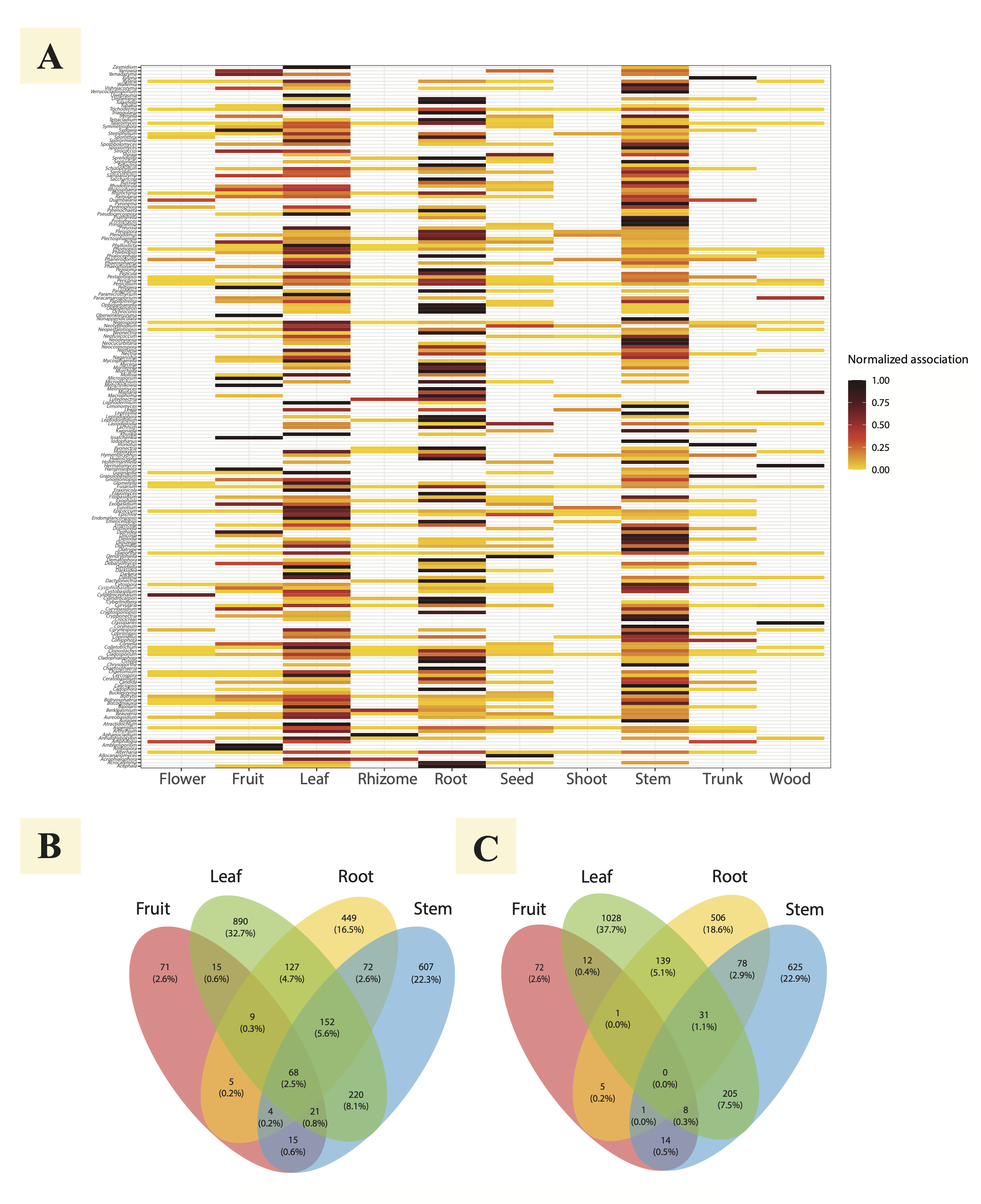
Across 1,359 fungal genera evaluated for organ specificity using Fisher’s Exact Test, 201 (14.8%) genera were identified as significantly enriched in at least one of the 14 plant organs after FDR correction (FDR < 0.05; Fig. S9). This substantial number of significant taxa demonstrates that fungal distributions across plant organs are strongly non-random. The imbalance between significant and non-significant genera indicates that organ-level filtering is a dominant structuring force in plant-associated fungal communities rather than a marginal effect driven by a small subset of taxa.
The relative representation of plant organs associated with fungal endophyte records differs across data sources, highlighting biases in tissue sampling (Fig. S10). Normalized association profiles of the significant genera revealed clear and biologically interpretable patterns of organ specialization (Fig. 4A). A number of genera exhibited strong, narrowly focused enrichment in specific tissues. For example, Mortierella, Umbelopsis, Oidiodendron, and Phialocephala showed high normalized associations with roots and rhizomes, with little to no enrichment in aboveground organs, consistent with their known prevalence in belowground environments. In contrast, genera such as Cladosporium, Alternaria, Ramularia, and Zasmidium were predominantly enriched in leaves and shoots, showing strong associations with aerial tissues and minimal representation in roots. Woody organs also supported distinct fungal assemblages, with genera including Xylaria, Hypoxylon, and Annulohypoxylon displaying pronounced enrichment in trunk and wood. While many taxa showed sharp organ specificity, others such as Fusarium, Penicillium, and Trichoderma exhibited broader distributions across multiple organs, indicating more generalist colonization strategies.
To highlight the primary organ associations of fungal species rather than incidental co-occurrences, a normalization step was applied to the dataset. In raw data, even a single detection in an alternative organ classifies a species as "shared," which can artificially reduce the perceived uniqueness of a species to a specific habitat. To correct this, species occurrences were weighted by the proportion of references across organs; only those contributing at least 30% of their total references to a given organ were retained. Consequently, the normalized Venn diagram revealed a higher number of unique species per organ by reassigning species with minor, incidental detections to their dominant organ (Figs. 4 B,C). Of the 1,756 reported fungal endophyte genera, 698 (based on 66,012 records) have been isolated from multiple plant organs, whereas 727 genera (from 2,746 records) have been documented exclusively from a single organ. Results from the Fisher exact test indicate that 201 genera exhibit significant organ specificity. For example, Tulasnella has been consistently isolated only from root tissues of 20 plant species across more than 10 studies conducted in Italy, Thailand, Australia, China, South Korea, and the United States. Similarly, Meliniomyces has been found exclusively in the roots of nine plant species in six studies from China, Canada, and Slovenia. Fraxinicola has been reported as an endophyte in the leaves of Fraxinus excelsior and Fraxinus ornus in Italy, Slovakia, and Switzerland. Triangularia has been identified in root tissues of Changnienia amoena, Oryza sativa, and Vochysia divergens in China, Kenya, and Brazil. Additionally, Paramicrothyrium has been reported as a leaf endophyte in nine plant species from Costa Rica and Panama.
Variation in Fungal Endophytes Assemblages
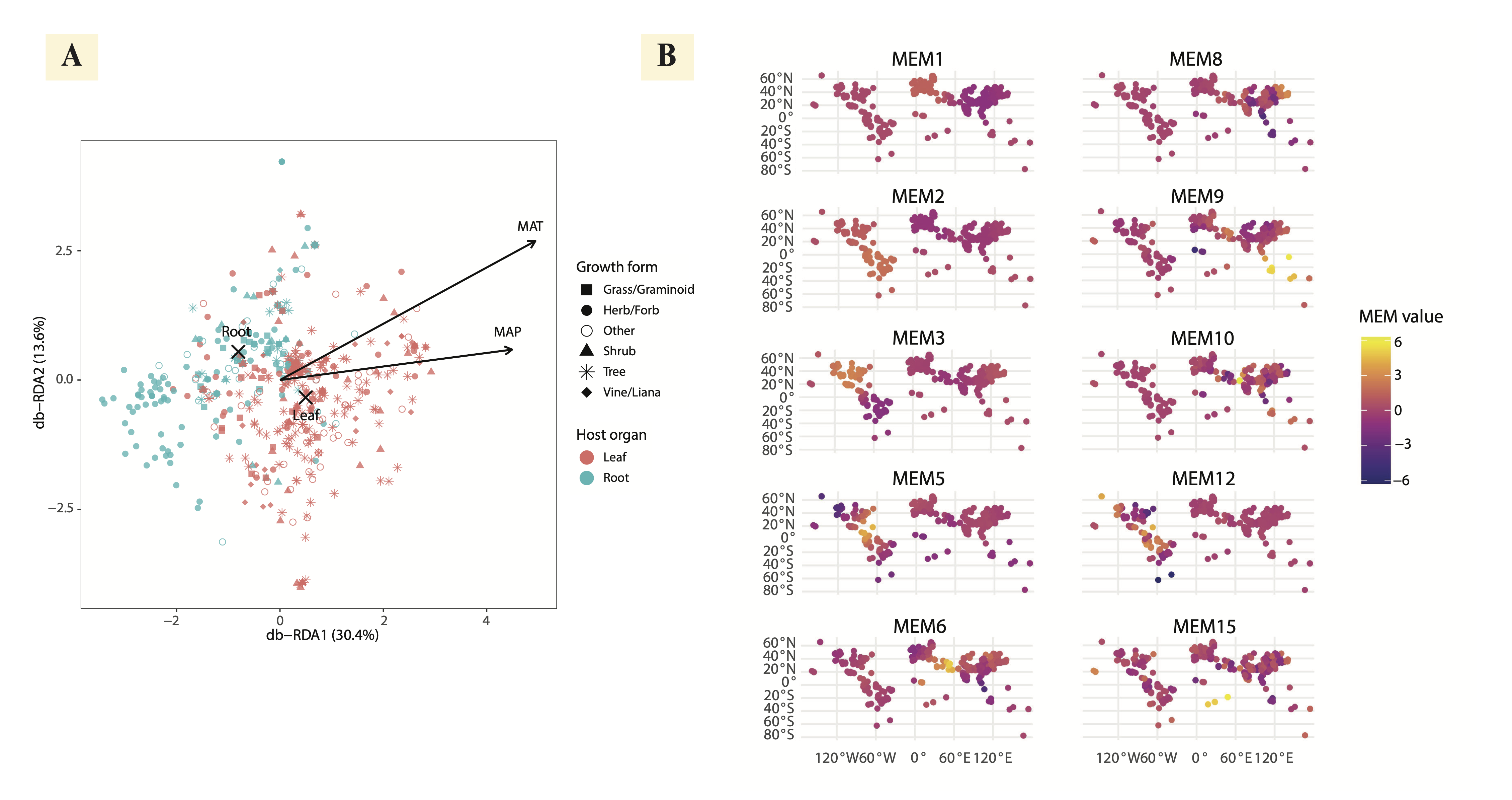
Distance-based redundancy analysis (db-RDA) of unweighted UniFrac distances indicated that fungal endophyte community composition is structured by a combination of host traits, environmental gradients, and spatial processes (Fig. 5A; Table 1). Term-wise permutation tests revealed that host growth form explained a significant proportion of compositional variation (Df = 5, F = 3.91, p = 0.001) after sequentially accounting for climatic variables, host organ, and spatial eigenvectors. Although samples representing different growth forms overlapped substantially in ordination space, growth form nonetheless contributed consistent and statistically independent explanatory power, indicating subtle but repeatable shifts in community composition rather than discrete clustering. Host organ emerged as one of the strongest predictors (Df = 1, F = 7.53, p = 0.001) with leaf- and root-associated fungal communities forming clearly separated clusters in ordination space (Fig. 5A), indicating strong tissue-specific structuring of endophyte assemblages across hosts. Climatic variables also contributed significantly, with mean annual temperature (F = 6.01, p = 0.001) and precipitation (F = 3.38, p = 0.001) exerting stronger effects than elevation (F = 1.60, p = 0.011), suggesting broad-scale environmental filtering of endophyte communities. Climate zone explained additional variation beyond continuous climatic predictors, indicating regional structuring not fully captured by temperature and precipitation alone (Fig. 5B). Multiple Moran’s eigenvector maps (MEMs) were significant (all p ≤ 0.002), collectively accounting for a substantial fraction of explained variance and highlighting strong spatial autocorrelation consistent with dispersal limitation and historical contingency. Despite the cumulative significance of these predictors, a large residual component remained (Residual SS = 258.65), reflecting high unexplained heterogeneity typical of fungal microbiome datasets and suggesting additional contributions from unmeasured host traits, microenvironmental variation, and stochastic assembly processes.
Fungal endophyte and host species
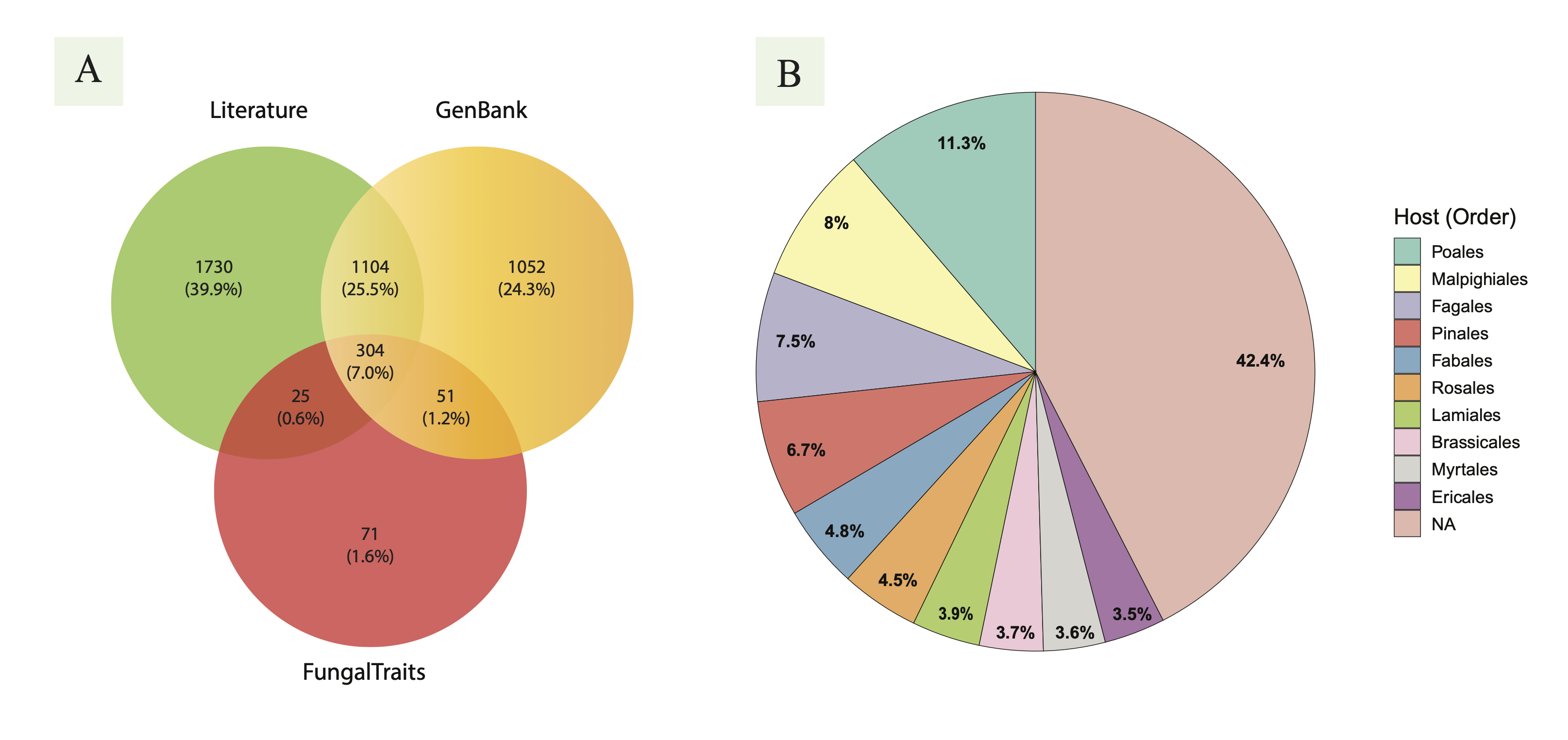
Fungal endophytes reported across the three datasets were associated with approximately 4,100 plant species. The number of unique host species recorded in the Scientific Literature, GenBank, and FungalTraits datasets was 1,730, 1,052, and 71, respectively, with 304 species common to all three sources (Fig. 6A). The distinct sets of host species represented in each dataset underscore the value of integrating multiple sources to capture broader host diversity. Among plant species linked to the highest number of reported fungal endophytes, the Scientific Literature dataset highlighted Microthlaspi perfoliatum, Pinus ponderosa, and Zea mays; GenBank featured Fritillaria cirrhosa, Quercus semecarpifolia, and M. perfoliatum; and FungalTraits included Quercus hypoleucoides, Nothofagus menziesii, and Juniperus deppeana (Fig. S11). In the FunEndo database, the plant orders Poales, Malpighiales, Fagales, Pinales, Fabales, Rosales, Lamiales, Brassicales, Myrtales, Ericales were associated with more than 50% of reported fungal
endophytes (Fig. 6B). At the species level, F. cirrhosa, Q. semecarpifolia, M. perfoliatum, Z. mays, P. ponderosa, and Hevea brasiliensis were linked with the largest number of fungal endophytes. Notably, Anemone rivularis, Phragmites australis, Campeostachys nutans, H. brasiliensis, Vitis vinifera, and Dendrobium officinale each hosted over 100 distinct fungal genera.
A total of 965 fungal genera—comprising 67,921 reports—have been isolated from multiple host species. Among these, Fusarium, Penicillium, Alternaria, Aspergillus, and Coll-etotrichum each have been isolated from more than 600
different plant species. For example, Fusarium has been identified as an endophyte in nearly 900 plant species, sampled across 70 countries and documented in over 800 studies. Similarly, Penicillium has been reported from around 630 plant species, across 69 countries in over 850 studies. Of the 599 genera associated with only one host plant species, 20 have been documented in more than one study. For instance, Sphaceloma has been exclusively reported from Pteroceltis tatarinowii, a plant native to China, in three independent studies. Scolecosporiella, Praetumpfia, and Linodochium have each been isolated only from a single host species—Chamaecyparis lawsoniana (in Oregon and
| Term | Df | Sum of Squares | F value | p-value |
| Host growth form | 5 | 8.638 | 3.907 | < 0.001 |
| MAT | 1 | 2.655 | 6.006 | < 0.001 |
| MAP | 1 | 1.493 | 3.376 | < 0.001 |
| Elevation | 1 | 0.707 | 1.600 | 0.012 |
| Climate Zone | 2 | 1.878 | 2.123 | < 0.001 |
| Organ | 1 | 3.330 | 7.531 | < 0.001 |
| MEM1 | 1 | 2.072 | 4.686 | < 0.001 |
| MEM2 | 1 | 1.114 | 2.520 | < 0.001 |
| MEM3 | 1 | 1.168 | 2.642 | < 0.001 |
| MEM8 | 1 | 1.064 | 2.406 | < 0.001 |
| MEM5 | 1 | 1.292 | 2.923 | < 0.001 |
| MEM15 | 1 | 1.326 | 2.999 | < 0.001 |
| MEM12 | 1 | 1.215 | 2.749 | < 0.001 |
| MEM6 | 1 | 0.894 | 2.021 | < 0.001 |
| MEM9 | 1 | 1.148 | 2.597 | < 0.001 |
| MEM51 | 1 | 0.875 | 1.980 | < 0.001 |
F values and p-values were obtained using a permutation test with 999 permutations.
northwestern California), Fraxinus excelsior (in Germany and Slovakia), and Calocedrus decurrens (in western North America), respectively—across multiple studies.
The association-based permutation test and bipartite network analysis together provide a multi-scale assessment of phylogenetic structure in host–fungus interactions, revealing consistent patterns across both pairwise and community-level perspectives. The permutation test indicated no significant phylogenetic structuring of fungal–host associations, as the observed mean pairwise taxonomic distance among host plants associated with individual fungal taxa did not differ from randomized expectations (p = 0.99), supporting the null hypothesis that associations occur independently of host evolutionary relatedness. This result suggests that, at the level of individual fungal associations, host phylogeny does not impose strong constraints on fungal host range. However, because pairwise analyses do not capture emergent organization across the full interaction network, we complemented this approach with a bipartite modularity framework to evaluate higher-order community structure. Across the nine modules characterized, Mean Pairwise Distance (MPD) values ranged from 352.0 to 466.7, reflecting variation in phylogenetic diversity among modules (Table S1). Standardized effect sizes (Z) varied widely, with some modules showing apparent clustering (negative Z) or overdispersion (positive Z), but none of these deviations were statistically significant (all p > 0.25). Several small modules (Modules 7, 8, and 9) contained too few taxa to permit reliable estimation of the null distribution variance, leading to an undefined standardized effect size (Z), and their P-values indicated no deviation from random expectations. Collectively, these results demonstrate that while host–fungus interactions form distinct ecological assemblages, their organization is not primarily driven by host evolutionary history (Fig. S12). Instead, the convergence of both analytical approaches supports the interpretation that ecological filtering, environmental context, geographic overlap, and functional trait matching likely play more prominent roles than phylogenetic conservatism in shaping global fungal endophyte association patterns.
Discussion
This study provides valuable insights into the global taxonomic diversity and geographic distribution of fungal endophytes, revealing a wide range of species present in various plant hosts across different regions. It is based on an extensive dataset of approximately 105,000 endophyte records collected from over 4,500 published and unpublished studies, integrating three key data sources: scientific literature, GenBank, and FungalTraits. The 1,180 unique species collected from scientific literature, 1,244 from GenBank, and 108 from FungalTraits highlight the diversity within each source, with a minimal overlap of only 216 species shared among all three datasets. This limited intersection emphasizes the complementary nature of these datasets, as each provides unique species that enrich the taxonomic breadth of the overall collection. An inherent limitation of FunEndo is that the compiled studies employed diverse protocols for endophyte isolation and identification, including differences in surface sterilization procedures, culture methods, sequencing approaches, and bioinformatic pipelines. Although such methodological variation may influence the detection of individual taxa, it is unlikely to generate consistent large-scale ecological patterns and more likely contributes to unexplained variation in the dataset.
The taxonomic composition of fungal endophyte communities is shaped by both methodological and ecological factors, with a consistent global pattern of Ascomycota dominance over Basidiomycota. This trend has been widely reported and is commonly attributed to fundamental differences in evolutionary adaptations, ecological niches, and environmental tolerances in the two phyla (Massimo et al. 2015; U’Ren et al. 2019; Moghaddam et al. 2021). Our analysis reinforces this pattern, revealing a strong predominance of Ascomycota in fungal endophyte communities across all three datasets: Scientific Literature (91%), GenBank (92%), and FungalTraits (95%). In contrast, Basidiomycota represented only a small fraction (ca. 7%) of recorded endophytes—a proportion that aligns with findings from earlier studies.
Our findings indicate a clear and consistent dominance of Sordariomycetes across all three datasets, followed by Dothideomycetes, Leotiomycetes, and Eurotiomycetes. This pattern aligns with previous studies and underscores the central role of Sordariomycetes and Dothideomycetes in shaping fungal endophyte communities. In a dataset compiled by Rashmi et al. (2019), Sordariomycetes accounted for 36% of all recorded endophytic fungal species, followed by Dothideomycetes, Eurotiomycetes, Agaricomycetes, and Leotiomycetes. Similarly, Arnold & Lutzoni (2007) noted that Sordariomycetes are especially prevalent in temperate and tropical forests, while Dothideomycetes dominate in boreal forest ecosystems. Our database reveals that Sordariomycetes and Dothideomycetes are associated with over 2,400 and 1,600 plant species, respectively, highlighting their broad host range and adaptive potential.
The fungal endophyte records in our database belong to 164 fungal orders, with Pleosporales being the most dominant and diverse, followed by Hypocreales, Helotiales, Eurotiales, Glomerellales, and Xylariales. Pleosporales, the largest order of Dothideomycetes (Schoch et al. 2009; Zhang et al. 2012), has been identified as the most dominant order in fungal endophyte communities associated with plant species thriving in arid and semi-arid environments (Zuo et al. 2021; Dastogeer et al. 2018; Sun et al. 2012; Wenndt et al. 2021; González-Menéndez et al. 2018; Loro et al. 2012; Knapp et al. 2015). It can be hypothesized that fungal endophytes belonging to this order play a crucial role in enhancing their host plant's tolerance to abiotic stresses. Xylariales is another dominant order, particularly within fungal communities associated with trees and woody plants (Arnold & Lutzoni 2007; Sieber 2007). The ability of xylarialean fungi to produce cellulases and xylanases allows them to efficiently degrade lignocellulosic substrates, giving them a competitive advantage over other fungi. This capability likely explains their dominance as endophytes in association with woody plants. Xylariales is also the most prevalent taxon in tropical grasses (Higgins et al. 2014), whereas Hypocreales and Pleosporales are dominant in temperate grasses (Porras-Alfaro et al. 2008).
Among the 1,756 genera recorded, Fusarium, Colletotri-chum, Alternaria, Penicillium, and Aspergillus were the most frequently identified, collectively accounting for over 30% of fungal endophytes classified at the genus level. These genera are not only dominant endophytes but also include many well-known plant pathogens, suggesting an evolutionary connection between endophytism and pathogenicity (Salvatore et al. 2020). Several biological, ecological, and methodological factors contribute to their prevalence as endophytes: Cosmopolitan distribution – these genera are globally distributed, inhabiting diverse ecosystems from tropical forests to arid landscapes, which enables frequent interactions with a wide range of plant hosts. Efficient dispersal – their prolific spore production and effective dispersal mechanisms (via wind, water, or animals) enhance their capacity to colonize a broad spectrum of plant species across varied environments. Rapid growth – in culture-based studies, their fast-growing nature often allows them to outcompete slow-growing taxa on culture media, skewing community composition toward these genera. Methodological bias – the common isolation methods and general plant-based media used for endophytes isolation may inadvertently favor these fungi. For example, Aspergillus, Penicillium, and Alternaria are commonly recognized as multitrophic fungi. Due to their ubiquitous presence in soil, air, and on plant surfaces, they are frequently encountered as environmental contaminants. Consequently, if surface sterilization procedures are not sufficiently rigorous during the isolation of endophytic fungi, these fungi may be introduced into culture and mistakenly identified as true endophytes.
The global distribution of fungal endophytes, as depicted in our geographic analyses, highlights substantial disparities in reporting frequency across countries. The dataset is dominated by records from the United States and China, followed by Brazil, Papua New Guinea, and India. This pattern aligns with Rashmi et al. (2019) study. Such dominance likely reflects both differences in sampling intensity and the ecological diversity of the regions studied. Across all studied countries, 29 were found to have unique fungal species, with China contributing the highest number. However, the number of unique species does not consistently correspond with dataset size. This geographic imbalance should also be considered when interpreting the broader ecological patterns identified in this study. Because a large proportion of records originate from temperate regions, particularly the United States, China, and several European countries, the observed patterns of organ specificity and host range may not fully represent global fungal endophyte diversity. Tropical ecosystems harbor exceptionally high plant and fungal diversity and often exhibit distinct ecological interactions, yet many tropical regions remain comparatively under-sampled in the current database. As a result, some fungal taxa identified as host generalists may prove more specialized when additional data become available, while currently observed organ-specific associations may not fully capture the diversity of tissue colonization strategies present in these regions. Therefore, our findings should be viewed as a global synthesis of currently available data rather than a definitive characterization of worldwide endophyte ecology, highlighting the need for increased sampling effort in underrepresented tropical ecosystems.
Our db-RDA analysis reveals that fungal endophyte community composition is shaped by interacting host traits, environmental gradients, and spatial processes, underscoring the multifactorial nature of endophyte assembly. Host growth form exerted a consistent, albeit subtle, influence on community composition, consistent with studies demonstrating that plant architecture and life-history traits modulate endophyte colonization patterns. For example, Christian et al. (2016) showed that differences in host stature and growth form influenced foliar endophyte assemblages across temperate grassland species, while Kembel and Mueller (2014) reported that leaf functional traits, including lifespan and specific leaf area, structured phyllosphere fungal communities in tropical forests. Although growth form did not result in discrete clustering in our analysis (Fig. 5A), its independent explanatory power suggests repeatable shifts in community structure, potentially reflecting differences in leaf longevity, tissue chemistry, or vascular connectivity among plant types.
The host organ emerged as one of the strongest predictors of community composition, with leaf- and root-associated fungal assemblages forming clearly distinct clusters. This pronounced tissue specificity is consistent with numerous case studies demonstrating compartmentalization of fungal endophytes within plant hosts. Higgins et al. (2014) documented strong divergence between leaf and root endophyte communities in tropical grasses, while Peršoh (2013) reported organ-specific assemblages in Pinus species, with limited taxonomic overlap between needles, bark, and roots. Similarly, Hardoim et al. (2015) synthesized evidence across multiple systems showing that contrasting nutrient availability, microclimatic exposure, and host defense chemistry between above- and belowground tissues act as strong selective filters shaping endophyte persistence.
Our results provide strong evidence that plant organ identity is a dominant and non-random structuring force shaping fungal endophyte communities across hosts. Across 1,359 fungal genera, nearly 15% exhibited statistically significant enrichment in specific organs after controlling for multiple testing, indicating that organ-level filtering is pervasive rather than driven by a limited subset of highly specialized taxa. This pattern aligns with and substantially extends prior work documenting organ specificity in endophyte assemblages (Peršoh, 2013; Del Olmo-Ruiz & Arnold, 2014; Gomes et al., 2018), demonstrating that tissue-associated niche differentiation operates broadly across the fungal tree of life.
Normalized association profiles revealed clear and biologically coherent patterns of organ specialization. Root-associated enrichment of genera such as Mortierella, Umbelopsis, Oidiodendron, and Phialocephala is consistent with their known ecological roles in belowground environments, including saprotrophy, mycorrhiza-like associations, and tolerance to soil-derived physicochemical constraints. Conversely, foliar specialization by genera such as Cladosporium, Alternaria, Ramularia, and Zasmidium reflects adaptation to aerial tissues characterized by fluctuating humidity, UV exposure, and host defense chemistry. Woody tissues supported distinct assemblages dominated by xylariaceous fungi (Xylaria, Hypoxylon, Annulohypoxylon), whose lignocellulose-degrading capacities likely confer a competitive advantage in structurally complex, carbon-rich substrates. In contrast, broadly distributed genera such as Fusarium, Penicillium, and Trichoderma exhibited generalist colonization strategies, consistent with their ecological plasticity, rapid growth, and wide physiological tolerance. Our dataset integrates both culture-dependent and culture-independent (amplicon sequencing) approaches, which capture different aspects of fungal communities and may influence the observed patterns. Culture-based methods tend to favor fast-growing, readily culturable taxa (e.g., Fusarium and Alternaria), while underrepresenting slow-growing or host-specialized fungi. In contrast, amplicon sequencing detects a broader range of taxa, including unculturable and low-abundance fungi, but may also capture dormant or non-active DNA. Differences in detection sensitivity and taxonomic resolution between these approaches can therefore affect inferred community composition and host ranges. While their integration improves overall taxonomic coverage, it also introduces heterogeneity that should be considered when interpreting patterns of host generalism and taxonomic dominance.
Climatic variables, particularly mean annual temperature and precipitation, further structured endophyte communities, highlighting the role of broad-scale environmental filtering in fungal endophyte assembly. Empirical studies have demonstrated that moisture availability is a key driver of endophyte community composition; for example, Giauque and Hawkes (2013) showed that historical and contemporary precipitation gradients strongly predicted fungal endophyte assemblages in grasses, with endophytes from drier regions conferring functional benefits related to host water relations. Harrison and Griffin (2020) emphasize climate as a major determinant of endophyte diversity and distribution across biomes, with variation in precipitation regimes and seasonality emerging as recurrent drivers of community turnover. Integrative studies further reveal that climatic effects often interact with spatial structure; for instance, Zimmerman and Vitousek (2012) found that precipitation and elevation together explained more than 50% of the variation in leaf endophyte communities of Metrosideros polymorpha across the Hawaiian Islands.
Spatial eigenvector analysis revealed significant spatial autocorrelation, indicating that dispersal limitation and historical contingency contribute substantially to fungal endophyte assembly. Comparable spatial structuring has been observed in continental-scale studies of fungal communities, where dispersal limitation constrained endophyte turnover even among climatically similar regions (Peay et al., 2016). Despite the cumulative influence of host, environmental, and spatial predictors, a large proportion of unexplained variation remained, reflecting the high heterogeneity characteristic of fungal microbiomes and suggesting additional contributions from unmeasured host traits, fine-scale environmental variation, and stochastic assembly processes, as widely reported in global fungal diversity studies (Tedersoo et al., 2014; Dini-Andreote et al., 2015). It is important to note that phylogenetic community analyses in this study were based on a taxonomy-derived backbone tree rather than a fully resolved sequence-based phylogeny. Given the taxonomic breadth of the FunEndo database and the lack of comparable molecular data for many genera, this approach provided a practical and standardized framework for incorporating phylogenetic information. Although unresolved relationships at deeper taxonomic levels may reduce the sensitivity of UniFrac distances to detect fine-scale phylogenetic turnover, the backbone tree reliably captures major evolutionary groupings and is therefore appropriate for evaluating broad-scale patterns of fungal endophyte community structure.
Our synthesis of host–fungal endophyte associations across the FunEndo database reveals a highly uneven but ecologically informative distribution of fungal diversity among plant hosts. Although fungal endophytes were collectively associated with more than 4,100 plant species, a relatively small subset of hosts supported exceptionally high numbers of reported endophytes. Plant species such as Fritillaria cirrhosa, Quercus semecarpifolia, Microthlaspi perfoliatum, Zea mays, Pinus ponderosa, and Hevea brasiliensis emerged as major hubs of endophytic diversity. These patterns may reflect genuine biological hotspots driven by host longevity, tissue complexity, or ecological breadth, but they are also likely influenced by strong research biases toward agriculturally, economically, or ecologically important taxa. Crops and forest trees, in particular, have been disproportionately sampled due to their relevance for plant health, productivity, and microbiome-mediated trait enhancement.
At the fungal level, the dominance of host-generalist taxa was striking. Nearly 1,000 fungal genera were isolated from multiple host species, with cosmopolitan genera such as Fusarium, Penicillium, Alternaria, Aspergillus, and Colletotrichum occurring across hundreds of plant hosts and dozens of countries. This widespread host sharing reinforces a consensus that ecological generalism is a prevalent strategy among fungal endophytes, enabling broad host colonization through flexible life-history traits, effective dispersal, and tolerance of diverse host environments. Similar patterns of low host specificity have been documented in tropical forest trees (Arnold et al. 2003) and across continental-scale surveys of endophytic fungi (U’Ren et al. 2012), suggesting that many endophytes function as opportunistic symbionts rather than tightly coevolved specialists. The host-range patterns in this study were evaluated primarily at the genus level, which may not fully capture ecological specialization at the species level. Genera that are broadly distributed across hosts comprise numerous species that can differ markedly in host preference, tissue colonization, and ecological function. Consequently, apparent genus-level generalism may partly reflect the cumulative distribution of multiple species occupying distinct host niches rather than uniformly broad host ranges of individual species. Nevertheless, the repeated occurrence of these genera across hundreds of host species, diverse plant lineages, and broad geographic regions indicates substantial ecological breadth at the lineage level. Nevertheless, the presence of hundreds of genera reported from only a single host species indicates that host restriction also plays an important role in shaping endophyte diversity. Some of these narrowly distributed taxa—such as Sphaceloma, Scolecosporiella, Praetumpfia, and Linodochium—have been recovered repeatedly from the same host species across independent studies and geographic regions, lending support to the existence of genuine host specialization in at least a subset of endophytic fungi. At the same time, rarity, slow growth, and methodological biases associated with culture-based isolation likely contribute to the apparent exclusivity of many taxa.
Recent pan-genomic studies provide a mechanistic basis for the widespread host generalism and ecological flexibility observed in dominant fungal taxa. For example, Genomic evolution and diversity in Botryosphaeriales (Deng et al. 2025) showed that gene family expansions, horizontal gene transfer, and effector diversification drive host adaptation in Botryosphaeriales. These patterns are consistent with the concept of “two-speed” genomes, in which rapidly evolving, repeat-rich regions—often including accessory or mobile chromosomes—harbor genes involved in host interaction and pathogenicity. Notably, mobile pathogenicity chromosomes described in Comparative genomics reveals mobile pathogenicity chromosomes in Fusarium (Ma et al. 2010) can be horizontally transferred between strains, enabling rapid acquisition of host-specific virulence traits. Together, such genomic plasticity facilitates colonization of diverse hosts and transitions along the endophyte–pathogen–saprotroph continuum, providing an evolutionary explanation for the broad host ranges and taxonomic dominance observed in our dataset.
Analyses of phylogenetic structure in host–fungus associations clarify the underlying patterns. Association-based permutation tests revealed no evidence that fungal host ranges are constrained by host evolutionary relatedness, indicating that, at the level of individual fungal taxa, associations arise largely independently of host phylogeny. Bipartite network analyses nevertheless revealed modular organization of host–fungus interactions, suggesting non-random ecological structuring at the community level. The absence of significant phylogenetic structuring does not imply that host–fungus associations are randomly assembled. Instead, the modular organization of the interaction network likely reflects ecological filtering and trait-based assembly processes. Host characteristics, including tissue chemistry, secondary metabolite profiles, and organ-specific structural barriers, together with fungal traits such as dispersal capacity, stress tolerance, and resource-acquisition strategies, may shape colonization success and persistence.
Conclusion
Our global fungal endophyte database reveals these fungi are highly diverse yet unevenly documented components of plant-associated microbiomes, structured by the interplay of host traits, plant organ identity, climate, and spatial processes rather than host evolutionary history. Across more than 100,000 records, endophyte communities were dominated by Ascomycota and characterized by the coexistence of widespread host-generalist taxa and a substantial subset of persistent specialists exhibiting strong organ-level and, in some cases, host-level restriction. Plant organ identity emerged as a fundamental axis of endophyte ecology, driving non-random taxonomic differentiation and likely underpinning functional specialization within plant tissues, while climatic gradients and spatial autocorrelation highlighted the importance of environmental filtering and dispersal limitation at broader scales. At the same time, pronounced geographic and taxonomic biases—particularly the underrepresentation of biodiversity-rich regions—underscore critical gaps in current knowledge. By consolidating fragmented data into the FunEndo database and integrating multiple analytical frameworks, this study provides a foundational resource for advancing understanding of plant–fungus interactions.
Acknowledgments
This research was supported by the University of Tartu, Estonia, with additional funding from the Danish National Research Foundation (DNRF183), the Novo Nordisk Foundation (NNF24OC0089849), and the Swedish Research Council (Vetenskapsrådet; grant 2025–08382).
Author contributions
Moghaddam MSH and Tedersoo L designed the study. All authors contributed to data collection. Material preparation and analysis were carried out by Moghaddam MSH and Rahimlou S. The first draft of the manuscript was written by Moghaddam MSH and Rahimlou S, while Tedersoo L and Bahram M provided valuable comments on earlier versions of the manuscript. All authors read and approved the final version of the manuscript.
ORCID
Mahdieh S. Hosseyni Moghaddam: https://orcid.org/0000-0003-0406-5541
Saleh Rahimlou: https://orcid.org/0000-0003-0427-1329
Mohammad Bahram: https://orcid.org/0000-0002-9539-3307
Conflict of interest statement
The authors declare no other competing interests.
Data availability
The first version of the FunEndo database has been deposited in the PlutoF repository and is publicly available at the following link (https://s3.hpc.ut.ee/plutof-public/original/bf0e5fe6-a63b-4bb4-9dd2-0d26c5c816f9.xlsx.) The dataset includes a comprehensive metadata schema detailing taxonomic information, host organ associations, reference sources, and geographic origin when available. A data dictionary is also provided to define all variables and fields in the dataset. The database will be updated periodically to incorporate newly published studies, and each release will be archived as a new version in PlutoF with documented version control and a changelog to ensure transparency and long-term sustainability. All R scripts used in this study are available on GitHub at: https://github.com/Rahimlou/Fungal-Endophyte-Database
Supplementary Information
The online version contains supplemental information available at https://doi.org/10.65390/fdiv.2026.136016
Rights and permissions
The Author(s) 2026. Published by BioAcademic Press on behalf of Kunming Institute of Botany,Chinese Academy of Sciences (CAS) and Mushroom Research Foundation. This is an open accessarticle under the Creative Commons Attribution license ( http://creativecommons.org/licenses/by/4.0), which permits use, distribution and reproduction in any medium, provided the originalwork is properly cited.
References
- Ahlholm JU, Helander M, Henriksson J, Metzler M, Saikkonen K (2002) Environmental conditions and host genotype direct genetic diversity of Venturia ditricha, a fungal endophyte of birch trees. Evolution 56 (8):1566–1573.
https://doi.org/10.1111/j.0014-3820.2002.tb01468.x - Aleynova OA, Nityagovsky NN, Ananev AA, Suprun AR, Ogneva ZV, Dneprovskaya AA, Beresh AA, Dubrovina AS, Chebukin PA, Kiselev KV (2023) Bacterial and fungal endophytes of grapevine cultivars growing in Primorsky Krai of Russia. Horticulturae 9 (12):1257.
https://doi.org/10.3390/horticulturae9121257 - Arnold AE, Herre EA (2003) Canopy cover and leaf age affect colonization by tropical fungal endophytes: ecological pattern and process in Theobroma cacao (Malvaceae). Mycologia 95 (3):388–398.
https://doi.org/10.1080/15572536.2004.11833083 - Arnold AE, Lutzoni F (2007) Diversity and host range of foliar fungal endophytes: are tropical leaves biodiversity hotspots? Ecology 88 (3):541–549.
https://doi.org/10.1890/05-1459 - Bacon CW, White Jr JF (2000) Physiological adaptations in the evolution of endophytism in the Clavicipitaceae. In: Microbial endophytes. CRC Press, pp 251–276
- Bayman P, Lebron LL, Tremblay RL, Lodge DJ (1997) Variation in endophytic fungi from roots and leaves of Lepanthes (Orchidaceae). The New Phytologist 135 (1):143–149.
https://doi.org/10.1046/j.1469-8137.1997.00618.x - Bhunjun CS, Phukhamsakda C, Hyde KD, McKenzie EH, Saxena RK, Li QR (2024) Do all fungi have ancestors with endophytic lifestyles? Fungal Diversity 125 (1):73–98.
https://doi.org/10.1007/s13225-023-00516-5 - Blodgett JT, Swart WJ, Louw Sv, Weeks WJ (2000) Species composition of endophytic fungi in Amaranthus hybridus leaves, petioles, stems, and roots. Mycologia 92 (5):853–859.
https://doi.org/10.1080/00275514.2000.12061230 - Botella L, Diez JJ (2011) Phylogenetic diversity of fungal endophytes in Spanish stands of Pinus halepensis. Fungal Diversity 47 (1):9–18.
https://doi.org/10.1007/s13225-010-0061-1 - Cannon PF, Simmons CM (2002) Diversity and host preference of leaf endophytic fungi in the Iwokrama Forest Reserve, Guyana. Mycologia 94 (2):210–220.
https://doi.org/10.1080/15572536.2003.11833226 - Carroll G (1988) Fungal endophytes in stems and leaves: from latent pathogen to mutualistic symbiont. Ecology 69 (1):2–9.
https://doi.org/10.2307/1943154 - Christian N, Sullivan C, Visser ND, Clay K (2016) Plant host and geographic location drive endophyte community composition in the face of perturbation. Microbial ecology 72 (3):621–632.
https://doi.org/10.1007/s00248-016-0804-y - Dastogeer KM, Li H, Sivasithamparam K, Jones MG, Wylie SJ (2018) Host specificity of endophytic mycobiota of wild Nicotiana plants from arid regions of Northern Australia. Microbial ecology 75 (1):74–87.
https://doi.org/10.1007/s00248-017-1020-0 - De Bary A (1879) Die erscheinung der symbiose: Vortrag gehalten auf der versammlung deutscher naturforscher und aerzte zu cassel. Trübner.
- Del Olmo-Ruiz M, Arnold AE (2014) Interannual variation and host affiliations of endophytic fungi associated with ferns at La Selva, Costa Rica. Mycologia 106 (1):8–21.
https://doi.org/10.3852/13-098 - Deng Z-L, Dissanayake AJ, Zhu J-T, Wu N, Deng J, Du H-Z, Li W-L, Lu Y-H, Tang X, Xu J, Zhang Y, Liu J-K (2025) Genomic evolution and diversity in Botryosphaeriales: insights from pan-genomic and population genetic analyses of representative species. Fungal Diversity 134:1–18.
https://doi.org/10.1007/s13225-025-00565-y - Dini-Andreote F, Stegen JC, Van Elsas JD, Salles JF (2015) Disentangling mechanisms that mediate the balance between stochastic and deterministic processes in microbial succession. Proceedings of the National Academy of Sciences 112 (11):E1326–E1332.
https://doi.org/10.1073/pnas.1414261112 - Dreyfuss M, Chapela IH (1994). Potential of fungi in the discovery of novel, low-molecular-weight pharmaceuticals. Discovery of novel natural products with therapeutic potential:49–80.
https://doi.org/10.1016/B978-0-7506-9003-4.50009-5 - Ebrahimi KS, Hosseyni Moghaddam MS, Ansari M, Nowroozi A, Shahlaei M, Moradi S (2025) Proposing of fungal endophyte secondary metabolites as a potential inhibitors of 2019-novel coronavirus main protease using docking and molecular dynamics. Journal of Biomolecular Structure and Dynamics 43 (11):5343–5355.
https://doi.org/10.1080/07391102.2024.2308777 - Ekanayake PN, Hand ML, Spangenberg GC, Forster JW, Guthridge KM (2012) Genetic diversity and host specificity of fungal endophyte taxa in fescue pasture grasses. Crop Science 52 (5):2243–2252.
https://doi.org/10.2135/cropsci2011.12.0664 - Fang K, Miao Y-F, Chen L, Zhou J, Yang Z-P, Dong X-F, Zhang H-B (2019) Tissue-specific and geographical variation in endophytic fungi of Ageratina adenophora and fungal associations with the environment. Frontiers in microbiology 10:2919.
https://doi.org/10.3389/fmicb.2019.02919 - Fisher P, Petrini O (1992) Fungal saprobes and pathogens as endophytes of rice (Oryza sativa L.). New Phytologist 120 (1):137–143.
https://doi.org/10.1111/j.1469-8137.1992.tb01066.x - Fontana DC, de Paula S, Torres AG, de Souza VHM, Pascholati SF, Schmidt D, Dourado Neto D (2021) Endophytic fungi: Biological control and induced resistance to phytopathogens and abiotic stresses. Pathogens 10 (5):570.
https://doi.org/10.3390/pathogens10050570 - García-Latorre C, Rodrigo S, Santamaría O (2021) Endophytes as plant nutrient uptake-promoter in plants. In: Endophytes: Mineral Nutrient Management, Volume 3. Springer, pp 247–265.
https://doi.org/10.1007/978-3-030-65447-4_11 - Giauque H, Hawkes CV (2013) Climate affects symbiotic fungal endophyte diversity and performance. American journal of botany 100 (7):1435–1444.
https://doi.org/10.3732/ajb.1200568 - Gomes T, Pereira JA, Benhadi J, Lino-Neto T, Baptista P (2018) Endophytic and epiphytic phyllosphere fungal communities are shaped by different environmental factors in a Mediterranean ecosystem. Microbial ecology 76 (3):668–679.
https://doi.org/10.1007/s00248-018-1161-9 - González-Menéndez V, Crespo G, De Pedro N, Diaz C, Martín J, Serrano R, Mackenzie TA, Justicia C, González-Tejero MR, Casares M (2018) Fungal endophytes from arid areas of Andalusia: high potential sources for antifungal and antitumoral agents. Scientific reports 8 (1):9729.
https://doi.org/10.1038/s41598-018-28192-5 - Hardoim PR, Van Overbeek LS, Berg G, Pirttilä AM, Compant S, Campisano A, Döring M, Sessitsch A (2015) The hidden world within plants: ecological and evolutionary considerations for defining functioning of microbial endophytes. Microbiology and molecular biology reviews 79 (3):293–320.
https://doi.org/10.1128/mmbr.00050-14 - Harrison JG, Griffin EA (2020) The diversity and distribution of endophytes across biomes, plant phylogeny and host tissues: how far have we come and where do we go from here? Environmental Microbiology 22:2107–2123.
https://doi.org/10.1111/1462-2920.14968 - Higginbotham SJ, Arnold AE, Ibañez A, Spadafora C, Coley PD, Kursar TA (2013) Bioactivity of fungal endophytes as a function of endophyte taxonomy and the taxonomy and distribution of their host plants. PloS one 8 (9):e73192.
https://doi.org/10.1371/journal.pone.0073192 - Higgins KL, Arnold AE, Coley PD, Kursar TA (2014) Communities of fungal endophytes in tropical forest grasses: highly diverse host-and habitat generalists characterized by strong spatial structure. Fungal Ecology 8:1–11.
https://doi.org/10.1016/j.funeco.2013.12.005 - Higgins KL, Arnold AE, Miadlikowska J, Sarvate SD, Lutzoni F (2007) Phylogenetic relationships, host affinity, and geographic structure of boreal and arctic endophytes from three major plant lineages. Molecular phylogenetics and evolution 42 (2):543–555.
https://doi.org/10.1016/j.ympev.2006.07.012 - Hoffman MT, Arnold AE (2008) Geographic locality and host identity shape fungal endophyte communities in cupressaceous trees. Mycological research 112 (3):331–344.
https://doi.org/10.1016/j.mycres.2007.10.014 - Kembel SW, Mueller RC (2014) Plant traits and taxonomy drive host associations in tropical phyllosphere fungal communities. Botany 92 (4):303–311.
https://doi.org/10.1139/cjb-2013-0194 - Knapp DG, Kovács GM, Zajta E, Groenewald JZ, Crous PW (2015) Dark septate endophytic pleosporalean genera from semiarid areas. Persoonia-Molecular Phylogeny and Evolution of Fungi 35 (1):87–100.
https://doi.org/10.3767/003158515X687669 - Kotilínek M, Hiiesalu I, Košnar J, Šmilauerová M, Šmilauer P, Altman J, Dvorský M, Kopecký M, Doležal J (2017) Fungal root symbionts of high-altitude vascular plants in the Himalayas. Scientific reports 7 (1):6562.
https://doi.org/10.1038/s41598-017-06938-x - Krings M, Taylor TN, Hass H, Kerp H, Dotzler N, Hermsen EJ (2007) Fungal endophytes in a 400‐million‐yr‐old land plant: infection pathways, spatial distribution, and host responses. New Phytologist 174 (3):648–657.
https://doi.org/10.1111/j.1469-8137.2007.02008.x - Kumar DSS, Hyde KD (2004) Biodiversity and tissue-recurrence of endophytic fungi in Tripterygium wilfordii. Fungal diversity
- Lata R, Chowdhury S, Gond SK, White Jr JF (2018) Induction of abiotic stress tolerance in plants by endophytic microbes. Letters in applied microbiology 66 (4):268–276.
https://doi.org/10.1111/lam.12855 - Loro M, Valero-Jiménez C, Nozawa S, Márquez L (2012) Diversity and composition of fungal endophytes in semiarid Northwest Venezuela. Journal of Arid Environments 85:46–55.
https://doi.org/10.1016/j.jaridenv.2012.04.009 - Ma L-J, Van Der Does HC, Borkovich KA, et al (2010) Comparative genomics reveals mobile pathogenicity chromosomes in Fusarium. Nature 464:367–373.
https://doi.org/10.1038/nature08850 - Massimo NC, Nandi Devan M, Arendt KR, Wilch MH, Riddle JM, Furr SH, Steen C, U’Ren JM, Sandberg DC, Arnold AE (2015) Fungal endophytes in aboveground tissues of desert plants: infrequent in culture, but highly diverse and distinctive symbionts. Microbial ecology 70 (1):61–76.
https://doi.org/10.1007/s00248-014-0563-6 - Mishra A, Gond SK, Kumar A, Sharma VK, Verma SK, Kharwar RN, Sieber TN (2012) Season and tissue type affect fungal endophyte communities of the Indian medicinal plant Tinospora cordifolia more strongly than geographic location. Microbial ecology 64 (2):388–398.
https://doi.org/10.1007/s00248-012-0029-7 - Moghaddam MSH, Safaie N, Soltani J, Hagh-Doust N (2021) Desert-adapted fungal endophytes induce salinity and drought stress resistance in model crops. Plant Physiology and Biochemistry 160:225–238.
https://doi.org/10.1016/j.plaphy.2021.01.022 - Moghaddam MSH, Safaie N, Tedersoo L, Hagh-Doust N (2021) Diversity, community composition, and bioactivity of cultivable fungal endophytes in saline and dry soils in deserts. Fungal Ecology 49:101019.
https://doi.org/10.1016/j.funeco.2020.101019 - Nguyen NH, Song Z, Bates ST, Branco S, Tedersoo L, Menke J, Schilling JS, Kennedy PG (2016) FUNGuild: an open annotation tool for parsing fungal community datasets by ecological guild. Fungal ecology 20:241–248.
https://doi.org/10.1016/j.funeco.2015.06.006 - Oita S, Ibáñez A, Lutzoni F, Miadlikowska J, Geml J, Lewis LA, Hom EF, Carbone I, U’Ren JM, Arnold AE (2021) Climate and seasonality drive the richness and composition of tropical fungal endophytes at a landscape scale. Communications Biology 4 (1):313.
https://doi.org/10.1038/s42003-021-01826-7 - Peay KG, Kennedy PG, Talbot JM (2016) Dimensions of biodiversity in the Earth mycobiome. Nat Rev Microbiol 14:434–447.
https://doi.org/10.1038/nrmicro.2016.59 - Peršoh D (2013) Factors shaping community structure of endophytic fungi–evidence from the Pinus-Viscum-system. Fungal Diversity 60 (1):55–69Petrini O, Carroll G (1981) Endophytic fungi in foliage of some Cupressaceae in Oregon. Can J Bot 59:629–636.
https://doi.org/10.1007/s13225-013-0225-x - Plett JM, Martin F (2015) Reconsidering mutualistic plant–fungal interactions through the lens of effector biology. Current Opinion in Plant Biology 26:45–50.
https://doi.org/10.1016/j.pbi.2015.06.001 - Põlme S, Abarenkov K, Henrik Nilsson R, Lindahl BD, Clemmensen KE, Kauserud H, Nguyen N, Kjøller R, Bates ST, Baldrian P (2020) FungalTraits: a user-friendly traits database of fungi and fungus-like stramenopiles. Fungal diversity 105 (1):1–16.
https://doi.org/10.1007/s13225-020-00466-2 - Porras-Alfaro A, Herrera J, Sinsabaugh RL, Odenbach KJ, Lowrey T, Natvig DO (2008) Novel root fungal consortium associated with a dominant desert grass. Applied and environmental microbiology 74 (9):2805–2813.
https://doi.org/10.1128/AEM.02769-07 - Rajala T, Velmala SM, Tuomivirta T, Haapanen M, Müller M, Pennanen T (2013) Endophyte communities vary in the needles of Norway spruce clones. Fungal biology 117 (3):182–190.
https://doi.org/10.1016/j.funbio.2013.01.006 - Rashmi M, Kushveer J, Sarma V (2019) A worldwide list of endophytic fungi with notes on ecology and diversity. Mycosphere 10 (1):798–1079.
https://doi.org/10.5943/mycosphere/10/1/19 - Rodriguez R, White Jr J, Arnold AE, Redman aRa (2009) Fungal endophytes: diversity and functional roles. New phytologist 182 (2):314–330.
https://doi.org/10.1111/j.1469-8137.2009.02773.x - Saikkonen K, Young CA, Helander M, Schardl CL (2016) Endophytic Epichloë species and their grass hosts: from evolution to applications. Plant Molecular Biology 90 (6):665–675.
https://doi.org/10.1007/s11103-015-0399-6 - Salvatore MM, Andolfi A, Nicoletti R (2020) The thin line between pathogenicity and endophytism: The case of Lasiodiplodia theobromae. Agriculture 10 (10):488.
https://doi.org/10.3390/agriculture10100488 - Sanz-Ros AV, Müller MM, San Martín R, Diez JJ (2015) Fungal endophytic communities on twigs of fast and slow growing Scots pine (Pinus sylvestris L.) in northern Spain. Fungal biology 119 (10):870–883.
https://doi.org/10.1016/j.funbio.2015.06.008 - Schoch C, Crous PW, Groenewald JZ, Boehm E, Burgess TI, De Gruyter J, De Hoog GS, Dixon L, Grube M, Gueidan C (2009) A class-wide phylogenetic assessment of Dothideomycetes. Studies in mycology 64 (1):1–15.
https://doi.org/10.3114/sim.2009.64.01 - Schulz B, Boyle C, Draeger S, Römmert A-K, Krohn K (2002) Endophytic fungi: a source of novel biologically active secondary metabolites. Mycological research 106 (9):996–1004.
https://doi.org/10.1017/S0953756202006342 - Sieber TN (2007) Endophytic fungi in forest trees: are they mutualists? Fungal biology reviews 21 (2-3):75–89.
https://doi.org/10.1016/j.fbr.2007.05.004 - Stengel A, Drijber RA, Carr E, Egreja T, Hillman E, Krause T, Reese S, Herr JR (2022) Rethinking the roles of pathogens and mutualists: exploring the continuum of symbiosis in the context of microbial ecology and evolution. Phytobiomes Journal 6 (2):108–117.
https://doi.org/10.1094/PBIOMES-05-21-0031-P - Strobel G, Daisy B (2003) Bioprospecting for microbial endophytes and their natural products. Microbiology and molecular biology reviews 67 (4):491–502.
https://doi.org/10.1128/mmbr.67.4.491-502.2003 - Su Y-Y, Guo L-D, Hyde KD (2010) Response of endophytic fungi of Stipa grandis to experimental plant function group removal in Inner Mongolia steppe, China. Fungal Diversity 43 (1):93–101.
https://doi.org/10.1007/s13225-010-0040-6 - Sun J, Guo L, Zang W, Ping W, Chi D (2008) Diversity and ecological distribution of endophytic fungi associated with medicinal plants. Science in China Series C: Life Sciences 51 (8):751–759.
https://doi.org/10.1007/s11427-008-0091-z - Sun X, Guo L-D (2012) Endophytic fungal diversity: review of traditional and molecular techniques. Mycology 3 (1):65–76.
https://doi.org/10.1080/21501203.2012.656724 - Sun Y, Wang Q, Lu X, Okane I, Kakishima M (2012) Endophytic fungal community in stems and leaves of plants from desert areas in China. Mycological Progress 11 (3):781–790.
https://doi.org/10.1007/s11557-011-0790-x - Suryanarayanan T, Murali T, Venkatesan G (2002) Occurrence and distribution of fungal endophytes in tropical forests across a rainfall gradient. Canadian Journal of Botany 80 (8):818–826.
https://doi.org/10.1139/b02-069 - Suryanarayanan TS, Wittlinger SK, Faeth SH (2005) Endophytic fungi associated with cacti in Arizona. Mycological Research 109 (5):635–639.
https://doi.org/10.1017/S0953756205002753 - Tedersoo L, Bahram M, Põlme S, et al (2014) Global diversity and geography of soil fungi. Science 346:1256688.
https://doi.org/10.1126/science.1256688 - Tedersoo L, Mikryukov V, Zizka A, Bahram M, Hagh‐Doust N, Anslan S, Prylutskyi O, Delgado‐Baquerizo M, Maestre FT, Pärn J (2022) Global patterns in endemicity and vulnerability of soil fungi. Global change biology 28 (22):6696–6710. https://doi.org/10.1111/gcb.16398
- Tedersoo L, Sánchez-Ramírez S, Kõljalg U, et al (2018) High-level classification of the Fungi and a tool for evolutionary ecological analyses. Fungal Diversity 90:135–159.
https://doi.org/10.1007/s13225-018-0401-0 - Todd D (1988) The effects of host genotype, growth rate, and needle age on the distribution of a mutualistic, endophytic fungus in Douglas-fir plantations. Canadian Journal of Forest Research 18 (5):601–605.
https://doi.org/10.1139/x88-087 - Unterseher M, Gazis R, Chaverri P, Guarniz CFG, Tenorio DHZ (2013) Endophytic fungi from Peruvian highland and lowland habitats form distinctive and host plant-specific assemblages. Biodiversity and conservation 22 (4):999–1016.
https://doi.org/10.1007/s10531-013-0464-x - U'ren JM, Lutzoni F, Miadlikowska J, Laetsch AD, Arnold AE (2012) Host and geographic structure of endophytic and endolichenic fungi at a continental scale. American journal of botany 99 (5):898–914.
https://doi.org/10.3732/ajb.1100459 - U’Ren JM, Lutzoni F, Miadlikowska J, Arnold AE (2010) Community analysis reveals close affinities between endophytic and endolichenic fungi in mosses and lichens. Microbial ecology 60 (2):340–353.
https://doi.org/10.1007/s00248-010-9698-2 - U’Ren JM, Lutzoni F, Miadlikowska J, Zimmerman NB, Carbone I, May G, Arnold AE (2019) Host availability drives distributions of fungal endophytes in the imperilled boreal realm. Nature Ecology & Evolution 3 (10):1430–1437.
https://doi.org/10.1038/s41559-019-0975-2 - Vega FE, Simpkins A, Aime MC, Posada F, Peterson SW, Rehner SA, Infante F, Castillo A, Arnold AE (2010) Fungal endophyte diversity in coffee plants from Colombia, Hawai'i, Mexico and Puerto Rico. fungal ecology 3 (3):122–138.
https://doi.org/10.1016/j.funeco.2009.07.002 - Wearn JA, Sutton BC, Morley NJ, Gange AC (2012) Species and organ specificity of fungal endophytes in herbaceous grassland plants. Journal of Ecology 100 (5):1085–1092.
https://doi.org/10.1111/j.1365-2745.2012.01997.x - Wenndt AJ, Evans SE, Van Diepeningen AD, Logan JR, Jacobson PJ, Seely MK, Jacobson KM (2021) Why Plants harbor complex endophytic fungal communities: Insights from perennial bunchgrass Stipagrostis sabulicola in the namib sand sea. Frontiers in microbiology 12:691584.
https://doi.org/10.3389/fmicb.2021.691584 - Wilson D (1995) Endophyte: the evolution of a term, and clarification of its use and definition. Oikos:274–276.
https://doi.org/10.2307/3545919 - Zhang T, Yao Y-F (2015) Endophytic fungal communities associated with vascular plants in the high arctic zone are highly diverse and host-plant specific. PLoS One 10 (6):e0130051.
https://doi.org/10.1371/journal.pone.0130051 - Zhang Y, Crous PW, Schoch CL, Hyde KD (2012) Pleosporales. Fungal diversity 53 (1):1–221.
https://doi.org/10.1007/s13225-011-0117-x - Zimmerman NB, Vitousek PM (2012) Fungal endophyte communities reflect environmental structuring across a Hawaiian landscape. Proceedings of the National Academy of Sciences 109 (32):13022–13027.
https://doi.org/10.1073/pnas.1209872109 - Zuo Y, Li X, Yang J, Liu J, Zhao L, He X (2021) Fungal endophytic community and diversity associated with desert shrubs driven by plant identity and organ differentiation in extremely arid desert ecosystem. Journal of Fungi 7 (7):578.
https://doi.org/10.3390/jof7070578