Abstract
Introduction
Fungi are among the most diverse groups of organisms on Earth, playing a crucial role in ecosystem processes and func-tioning (Han et al. 2023; Wang et al. 2023a; Zhao et al. 2023a; Abrego et al. 2024; Dong et al. 2024, 2025; He et al. 2024a; Hyde et al. 2024a; Bao et al. 2025; Hibbett et al. 2025; Hongsanan et al. 2025; Lin et al. 2025; Samaradiwakara et al. 2025), and their economic values to society are estimated at 54.57 trillion USD (Niego et al. 2023). Various studies have explored the earth’s fungal species diversity, and a conserva-tive estimate suggested that the number of fungal species ranged from 2.2 to 3.8 million, and revised estimate of 2 to 3 million fungal species with a “best estimate” at 2.5 million (Hawksworth & Lücking 2017; Baldrian et al. 2022; Bhunjun et al. 2022; Niskanen et al. 2023; Hyde et al. 2024a), while high-throughput sequencing indicated 11.7 to 13.2 million species (Wu et al. 2019a; Baldrian et al. 2022). However, only 202,799 fungal species have been recorded in the Fungal Names database to date (Wang et al. 2023b, https://nmdc.cn/fungalnames, accessed on 8 November 2025), accounting for 5.34–9.22 % of the conservative estimate. In recent times, with approximately 1,000–3,000 new fungal species being described annually, it suggests that many spe-cies are yet to be discovered (Bhunjun et al. 2022; Dis-sanayake et al. 2025; Hibbett et al. 2025).
Among these diverse groups, polypores are one of the most important wood-inhabiting fungi with complex morphology and ecology (Fig. 1), playing an important role in forest regenera-tion and energy cycling. The majority of polypores are sapro-trophs, breaking down key components of plant cell walls, such as lignin, cellulose, hemicellulose, and pectin by various car-bohydrate-active enzymes (Berglund et al. 2011; Krah et al. 2018; Wu et al. 2022a, 2022b). Some polypore species, such as Heterobasidion spp. and Phaeolus spp., are pathogenic or facultative parasites of living trees, causing tree mortality and consequent significant economic losses for commercial for-estry (Yuan et al. 2021, 2023; Wu et al. 2022b; Garcia et al. 2024; Cui et al. 2025a). A few polypores, such as Albatrellus spp., are known to form ectomycorrhizal relationships (Teder-soo et al. 2007; Zhou et al. 2024a). Notably, certain polypore species, such as Sanghuangporus spp. and Ganoderma spp., are used in traditional Chinese medicine, and modern studies have shown that they have anticancer, anti-inflammatory, antioxidant, cytotoxic, antiallergic, hepatoprotective, hypoten-sive, antiviral, and neuroprotective properties (Wang et al. 2022, 2023c; Blundell et al. 2023; Sułkowska-Ziaja et al. 2023; Ghobad-Nejhad et al. 2024) and are a potential source of pharmaceutical products. Additionally, a few polypore species, like Albatrellus spp. and Grifola albicans f. huishuhua X.J. Xie, are edible mushrooms (Wu et al. 2019b; Xie et al. 2024; Zhou et al. 2024a). Linnaeus (1753) introduced the binomial nomenclature for naming organisms and described several polypores, such as Coltricia perennis (L.) Murrill, Daedalea quercina (L.) Pers., Lenzites betulinus (L.) F., and Phellinus igniarius (L.) Quél. (Wang et al. 2023b, https://nmdc.cn/fungalnames/, accessed on 17 April 2024). Subsequently, the species descriptions of polypores became more systematic, with morphological traits consistently remaining a key factor in the taxonomy of these fungi. The species diversity of polypores has attracted wide-spread attention, particularly since the early 21st century, when molecular biology was widely applied in fungal taxonomy. In recent decades, the number of recognized polypore species has increased significantly through the efforts of numerous mycologists. In China, many studies have focused on pol-ypores, contributing to the description of new taxa, understanding distribution patterns, reconstructing phylogenetic relationships, estimating diver-gence times, and exploring historical biogeography (Dai 2010, 2012; Cui et al. 2019, 2024; Wu et al. 2021, 2022a, 2022b; Zhao et al. 2022, 2023b, 2024; Liu et al. 2023a, 2023b; Wang et al. 2023a, 2024a, 2024b; Zhou et al. 2023; Xu et al. 2025). Ryvarden and his colleagues have described numerous pol-ypore species globally and published a series of influential monographs, such as the North American polypores, poroid fungi of Europe, and poroid fungi of Africa (Ryvarden & Jo-hansen 1980; Ryvarden & Gilbertson 1986, 1987; Ryvarden 1991, 2000, 2004, 2015, 2016, 2018a, 2018b, 2020, 2023, 2024a, 2024b; Ryvarden & Melo 2014, 2017; Ryvarden et al. 2022; Spirin & Ryvarden 2024). In addition, the biodiversity and distribution patterns of polypores from North America and South America have been studied, with a large number of new taxa proposed, and new distributions of existing taxa (Ryvarden & Gilbertson 1986, 1987; Gilbertson 1991; Gibertoni et al. 2004, 2016; Gibertoni & Ryvarden 2014; Gilbertson & Hemmes 2004; Oliveira & Gib-ertoni 2023; Oliveira et al. 2023, 2025).
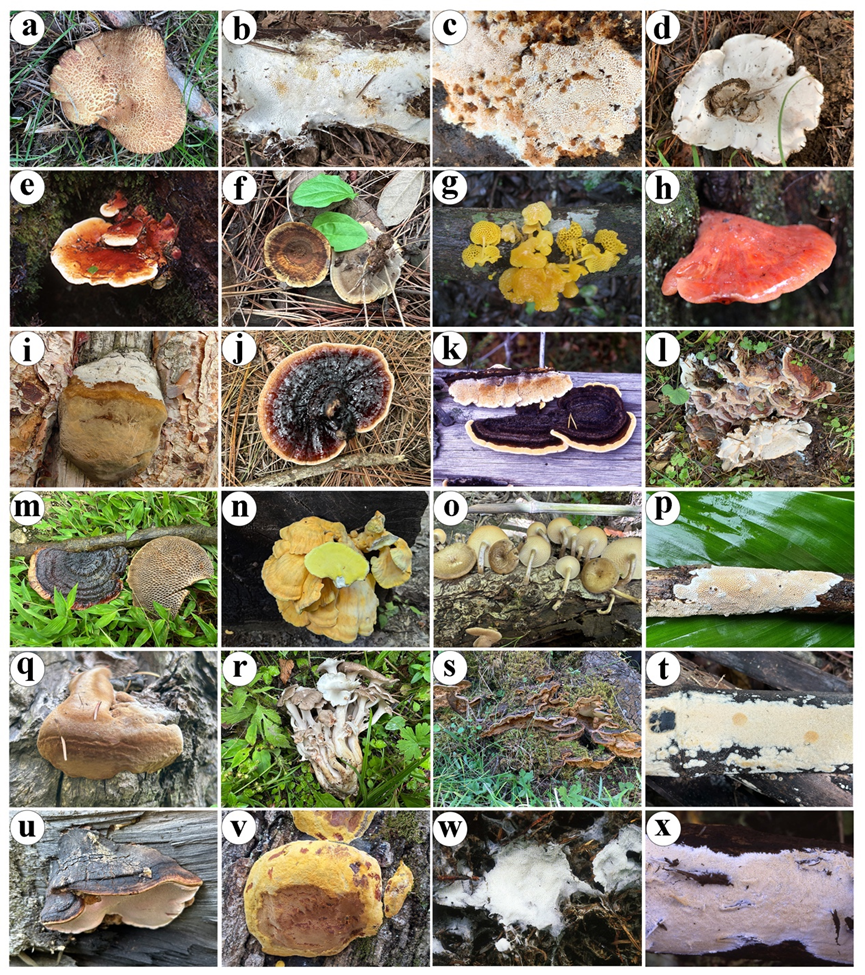
With the advancement of scientific investigations, mycolo-gists are not only describing new taxa of polypores but also focusing on polypore diversity and species composition. In-vestigations have been done in certain mountains, provinces, or countries on the species richness and composition of pol-ypores (Nunez & Ryvarden 1999; Nikitsky & Schigel 2004; Hottola & Siitonen 2008; Kotiranta 2009; Dai 2012; Ryvarden 2018b; Alem et al. 2021; Korhonen et al. 2021; Ma et al. 2022; Wu et al. 2022c; Cui et al. 2025b). Some studies were con-ducted in countries or continents, such as China, Africa, Eu-rope, and North America (Zhou et al. 2016; Ryvarden et al. 2022; Ryvarden & Melo 2014, 2017; Xu et al. 2025). Only a small number of studies have analyzed the species richness and composition of polypores across different continents. Wu et al. (2022a) compiled a total of 1,337 polypores from China, Europe, and North America. Later, Zhao et al. (2024) collated 1,902 polypore species from tropical Africa, Asia, and America. Combining these two studies, a total of 2,670 polypore species was reported, belonging to 282 genera, 53 families, and eleven orders, of Agaricomycetes within Basidiomycota. These taxa were recorded from six zones, including tropical Africa, tropical Asia, tropical America, China, Europe, and North America (Zhao et al. 2024).
Although Zhao et al. (2024) have analyzed the species composition and distribution of polypores in six zones, includ-ing three in temperate zones (China, Europe, and North America), and three in tropical zones (Africa, Asia, and Amer-ica), there were still many areas that were not considered, such as Australia, New Zealand, central and south Asia, Japan, Korea, and central America. In addition, with the advancement of scientific investigations and phylogenetic relationships, many new taxa of polypores have been described based on morphology, phylogeny, and divergence time analyses (Liu et al. 2023b; Zhou et al. 2023; Fryssouli et al. 2024; Hussain et al. 2024a, 2024b; Spirin et al. 2024; Viner et al. 2024; Wang et al. 2024b). For instance, Zhou et al. (2023) proposed two new families, Hirschioporaceae and Trichaptaceae, ten new spe-cies, and 28 new combinations based on 625 specimens from 19 countries. Spirin et al. (2024) re-examined the genus Fom-itopsis, and accepted 128 species according to ITS, ITS + TEF1, ITS + TEF1 + RPB1, and ITS + TEF1 + RPB2 datasets. Wang et al. (2024b) accepted 37 taxa of the genus Phy-sisporinus, consisting of 12 new species based on the phylo-genetic and morphological analyses. Therefore, an updated global checklist of polypores is needed.
Here, the checklist of polypores was obtained from the Fungal Names database (Wang et al. 2023b) and published articles. Then, systematic analyses of the global species richness and distribution patterns of polypores were performed, including species composition, Sørensen similarity index (SS) among different continents, nutritional modes, year published, and scholars' contribution of polypore names. The bibliometric analyses were performed using the Web of Science of Core Collection database.
| Orders (The number of families are in brackets) |
Families (The number of genera are in brackets) |
Genera | Number of species |
| Agaricales (8) | Cystostereaceae (1) | Crustomyces | 1 |
| Fistulinaceae (2) | Fistulina | 10 | |
| Pseudofistulina | 2 | ||
| Mycenaceae (3) | Favolaschia | 109 | |
| Filoboletus | 17 | ||
| Panellus | 10 | ||
| Pleurotaceae (1) | Resupinatus | 8 | |
| Porotheleaceae (1) | Porotheleum | 1 | |
| Radulomycetaceae (1) | Radulotubus | 1 | |
| Schizophyllaceae (1) | Porodisculus | 1 | |
| Stephanosporaceae (1) | Lindtneria | 9 | |
| Amylocorticiales (1) | Amylocorticiaceae (2) | Anomoloma | 8 |
| Anomoporia | 7 | ||
| Auriculariales (1) | Auriculariaceae (1) | Elmerina | 12 |
| Incertae sedis (3) | Aporpium | 3 | |
| Heteroradulum | 2 | ||
| Protomerulius | 7 | ||
| Boletales (1) | Tapinellaceae (1) | Bondarcevomyces | 1 |
| Cantharellales (1) | Hydnaceae (1) | Sistotrema | 9 |
| Gloeophyllales (1) | Gloeophyllaceae (4) | Gloeophyllum | 13 |
| Griseoporia | 1 | ||
| Hispidaedalea | 1 | ||
| Osmoporus | 2 | ||
| Hymenochaetales (13) | Chaetoporellaceae (2) | Echinoporia | 3 |
| Kneiffiella | 5 | ||
| Coltriciaceae (1) | Coltricia | 71 | |
| Hirschioporaceae (4) | Hirschioporus | 8 | |
| Nigrohirschioporus | 11 | ||
| Pallidohirschioporus | 8 | ||
| Perennihirschioporus | 5 | ||
| Hymenochaetaceae (40) | Arambarria | 1 | |
| Aurificaria | 1 | ||
| Coniferiporia | 4 | ||
| Cyanotrama | 1 | ||
| Cylindrosporus | 1 | ||
| Flaviporellus | 1 | ||
| Fomitiporella | 26 | ||
| Fomitiporia | 73 | ||
| Fulvifomes | 77 | ||
| Fulvoderma | 4 | ||
| Fuscoporia | 106 | ||
| Hydnoporia | 1 | ||
| Hymenochaete | 7 | ||
| Inocutis | 11 | ||
| Inonotopsis | 1 | ||
| Inonotus | 100 | ||
| Meganotus | 1 | ||
| Mensularia | 5 | ||
| Neomensularia | 7 | ||
| Neophellinus | 1 | ||
| Nothonotus | 1 | ||
| Nothophellinus | 1 | ||
| Ochroporus | 2 | ||
| Ochrosporellus | 11 | ||
| Onnia | 10 | ||
| Pachynotus | 1 | ||
| Perenninotus | 1 | ||
| Phellinidium | 5 | ||
| Phellinopsis | 10 | ||
| Phellinus | 37 | ||
| Phellopilus | 1 | ||
| Phylloporia | 96 | ||
| Polystictus | 4 | ||
| Porodaedalea | 20 | ||
| Pseudoinonotus | 8 | ||
| Pseudophylloporia | 1 | ||
| Pyrrhoderma | 8 | ||
| Rigidonotus | 2 | ||
| Sanghuangporus | 20 | ||
| Tropicoporus | 57 | ||
| Hyphodontiaceae (1) | Hyphodontia | 2 | |
| Neoantrodiellaceae (1) | Neoantrodiella | 2 | |
| Nigrofomitaceae (1) | Nigrofomes | 3 | |
| Rigidoporaceae (4) | Bridgeoporus | 2 | |
| Laetifomes | 1 | ||
| Leucophellinus | 2 | ||
| Rigidoporus | 52 | ||
| Schizoporaceae (3) | Paratrichaptum | 1 | |
| Poriodontia | 1 | ||
| Xylodon | 17 | ||
| Sideraceae (1) | Sidera | 19 | |
| Trichaptaceae (1) | Trichaptum | 8 | |
| Tubulicrinaceae (1) | Tubulicrinis | 8 | |
| Umbellaceae (1) | Umbellus | 2 | |
| Incertae sedis (3) | Hastodontia | 2 | |
| Podocarpioporus | 2 | ||
| Pseudotrichaptum | 1 | ||
| Polyporales (26) | Adustoporiaceae (6) | Adustoporia | 1 |
| Amyloporia | 5 | ||
| Austroporia | 1 | ||
| Lentoporia | 2 | ||
| Resinoporia | 12 | ||
| Rhodonia | 6 | ||
| Auriporiaceae (1) | Auriporia | 4 | |
| Cerrenaceae (5) | Cerrena | 11 | |
| Irpiciporus | 7 | ||
| Lividopora | 4 | ||
| Pseudospongipellis | 4 | ||
| Raduliporus | 1 | ||
| Fibroporiaceae (3) | Fibroporia | 9 | |
| Microporellopsis | 1 | ||
| Pseudofibroporia | 1 | ||
| Fomitopsidaceae (16) | Anthoporia | 1 | |
| Antrodia | 35 | ||
| Buglossoporus | 4 | ||
| Daedalea | 15 | ||
| Eucalyptoporia | 1 | ||
| Fomitopsis | 141 | ||
| Melanoporia | 1 | ||
| Neolentiporus | 1 | ||
| Niveoporofomes | 1 | ||
| Parmastomyces | 3 | ||
| Phaeodaedalea | 1 | ||
| Piptoporus | 2 | ||
| Rhodoantrodia | 2 | ||
| Rubellofomes | 2 | ||
| Spelaeomyces | 1 | ||
| Subantrodia | 1 | ||
| Fragiliporiaceae (1) | Fragiliporia | 1 | |
| Ganodermataceae (14) | Amauroderma | 60 | |
| Amaurodermellus | 1 | ||
| Cristataspora | 2 | ||
| Foraminispora | 5 | ||
| Furtadoella | 3 | ||
| Ganoderma | 214 | ||
| Haddowia | 2 | ||
| Humphreya | 3 | ||
| Magoderna | 2 | ||
| Neoganoderma | 1 | ||
| Sanguinoderma | 21 | ||
| Sinoganoderma | 1 | ||
| Tomophagus | 2 | ||
| Trachydermella | 1 | ||
| Gelatoporiaceae (3) | Cinereomyces | 4 | |
| Obba | 3 | ||
| Sebipora | 1 | ||
| Grifolaceae (2) | Aegis | 2 | |
| Grifola | 10 | ||
| Incrustoporiaceae (3) | Gloeoporellus | 1 | |
| Skeletocutis | 94 | ||
| Tyromyces | 127 | ||
| Irpicaceae (11) | Ceriporia | 70 | |
| Crystallicutis | 4 | ||
| Flavodon | 1 | ||
| Gloeoporus | 27 | ||
| Hydnopolyporus | 1 | ||
| Irpex | 42 | ||
| Leptoporus | 4 | ||
| Meruliopsis | 16 | ||
| Meruliporia | 2 | ||
| Resiniporus | 2 | ||
| Trametopsis | 5 | ||
| Ischnodermataceae (2) | Ischnoderma | 7 | |
| Lasiochlaena | 1 | ||
| Laetiporaceae (6) | Kusaghiporia | 1 | |
| Laetiporus | 23 | ||
| Macrohyporia | 3 | ||
| Pseudophaeolus | 2 | ||
| Wolfiporiella | 4 | ||
| Wolfiporiopsis | 1 | ||
| Laricifomitaceae (3) | Gilbertsonia | 1 | |
| Laricifomes | 1 | ||
| Ryvardenia | 2 | ||
| Meripilaceae (1) | Meripilus | 4 | |
| Meruliaceae (18) | Aurantiopileus | 4 | |
| Aurantiporus | 6 | ||
| Ceriporiopsis | 43 | ||
| Ceriporiopsoides | 2 | ||
| Geesterania | 2 | ||
| Luteoporia | 3 | ||
| Merulius | 1 | ||
| Mycoacia | 1 | ||
| Pappia | 2 | ||
| Phlebia | 1 | ||
| Phlebicolorata | 2 | ||
| Phlebiporia | 1 | ||
| Physisporinus | 37 | ||
| Porpomyces | 2 | ||
| Pseudonadsoniella | 1 | ||
| Pseudophlebia | 2 | ||
| Spongipellis | 6 | ||
| Phaeolaceae (3) | Melanoporella | 1 | |
| Phaeolus | 6 | ||
| Wolfiporia | 4 | ||
| Phanerochaetaceae (9) | Bjerkandera | 14 | |
| Geliporus | 1 | ||
| Hapalopilus | 14 | ||
| Oxychaete | 1 | ||
| Phanerina | 1 | ||
| Phanerochaete | 1 | ||
| Phlebiopsis | 1 | ||
| Pseudohyphodermella | 1 | ||
| Riopa | 2 | ||
| Piptoporellaceae (1) | Piptoporellus | 5 | |
| Podoscyphaceae (2) | Abortiporus | 5 | |
| Heteroporus | 1 | ||
| Polyporaceae (103) | Abundisporus | 7 | |
| Amylosporia | 1 | ||
| Atroporus | 3 | ||
| Aurantioporia | 2 | ||
| Australoporus | 1 | ||
| Cerarioporia | 1 | ||
| Cerioporus | 3 | ||
| Cinereomycetella | 1 | ||
| Citrinoporia | 2 | ||
| Colospora | 2 | ||
| Coriolopsis | 22 | ||
| Coriolus | 6 | ||
| Crassisporus | 6 | ||
| Cryptoporus | 3 | ||
| Cubamyces | 3 | ||
| Cyanoporus | 2 | ||
| Cystidioporia | 1 | ||
| Cystostiptoporus | 1 | ||
| Daedaleopsis | 10 | ||
| Datronia | 7 | ||
| Datroniella | 6 | ||
| Dendroporia | 1 | ||
| Dextrinoporus | 1 | ||
| Dichomitus | 15 | ||
| Donkioporia | 2 | ||
| Donkioporiella | 1 | ||
| Earliella | 1 | ||
| Echinochaete | 5 | ||
| Elfvingia | 2 | ||
| Favolus | 33 | ||
| Flammeopellis | 1 | ||
| Fomes | 20 | ||
| Fomitella | 1 | ||
| Funalia | 10 | ||
| Fuscocerrena | 1 | ||
| Globifomes | 1 | ||
| Grammothele | 18 | ||
| Grammothelopsis | 7 | ||
| Haploporus | 29 | ||
| Hexagonia | 24 | ||
| Hirticrusta | 2 | ||
| Hornodermoporus | 1 | ||
| Jorgewrightia | 15 | ||
| Laccocephalum | 2 | ||
| Leifiporia | 2 | ||
| Lentinus | 7 | ||
| Lenzites | 18 | ||
| Lignosus | 7 | ||
| Loweporus | 4 | ||
| Luteoperenniporia | 4 | ||
| Macroporia | 4 | ||
| Macrosporia | 1 | ||
| Mariorajchenbergia | 7 | ||
| Megasporia | 10 | ||
| Megasporoporia | 7 | ||
| Megasporoporiella | 1 | ||
| Melanoderma | 3 | ||
| Microporellus | 20 | ||
| Microporus | 13 | ||
| Minoporus | 1 | ||
| Mycobonia | 1 | ||
| Navisporus | 10 | ||
| Neodatronia | 2 | ||
| Neodictyopus | 3 | ||
| Neofavolus | 9 | ||
| Neofomitella | 4 | ||
| Neoporia | 3 | ||
| Niveoporia | 3 | ||
| Perenniporia | 85 | ||
| Perenniporiella | 5 | ||
| Perenniporiopsis | 3 | ||
| Phaeotrametes | 1 | ||
| Physisporus | 2 | ||
| Picipes | 32 | ||
| Podofomes | 5 | ||
| Polyporellus | 1 | ||
| Polyporopsis | 1 | ||
| Polyporus | 207 | ||
| Poria | 22 | ||
| Poriella | 4 | ||
| Porogramme | 18 | ||
| Poronidulus | 2 | ||
| Pseudofavolus | 4 | ||
| Pseudogrammothele | 1 | ||
| Pseudomegasporoporia | 2 | ||
| Pseudopiptoporus | 2 | ||
| Pyrofomes | 7 | ||
| Rhizoperenniporia | 1 | ||
| Royoporus | 1 | ||
| Rubroporus | 2 | ||
| Sparsitubus | 1 | ||
| Szczepkamyces | 2 | ||
| Theleporus | 10 | ||
| Thermophymatospora | 1 | ||
| Tinctoporellus | 1 | ||
| Trametes | 145 | ||
| Tropicoporia | 4 | ||
| Truncatoporia | 2 | ||
| Truncospora | 12 | ||
| Vanderbylia | 10 | ||
| Vanderbyliella | 1 | ||
| Xanthoperenniporia | 5 | ||
| Yuchengia | 2 | ||
| Postiaceae (17) | Amaropostia | 4 | |
| Amylocystis | 2 | ||
| Aurantipostia | 1 | ||
| Austropostia | 6 | ||
| Calcipostia | 1 | ||
| Cyanosporus | 42 | ||
| Cystidiopostia | 5 | ||
| Fuscopostia | 7 | ||
| Jahnoporus | 4 | ||
| Nothofagiporus | 1 | ||
| Oligoporus | 15 | ||
| Osteina | 5 | ||
| Postia | 24 | ||
| Ptychogaster | 8 | ||
| Resupinopostia | 2 | ||
| Spongiporus | 11 | ||
| Tenuipostia | 1 | ||
| Pycnoporellaceae (1) | Pycnoporellus | 2 | |
| Sarcoporiaceae (1) | Sarcoporia | 4 | |
| Steccherinaceae (23) | Antella | 4 | |
| Antrodiella | 62 | ||
| Atraporiella | 2 | ||
| Austeria | 1 | ||
| Butyrea | 2 | ||
| Caudicicola | 1 | ||
| Citripora | 2 | ||
| Elaphroporia | 1 | ||
| Flabellophora | 9 | ||
| Flaviporus | 14 | ||
| Frantisekia | 3 | ||
| Junghuhnia | 26 | ||
| Lamelloporus | 1 | ||
| Laschia | 2 | ||
| Loweomyces | 4 | ||
| Metuloidea | 3 | ||
| Mycorrhaphium | 1 | ||
| Niemelaea | 3 | ||
| Nigroporus | 7 | ||
| Rhomboidia | 1 | ||
| Steccherinum | 20 | ||
| Trullella | 8 | ||
| Xanthoporus | 2 | ||
| Taiwanofungaceae (1) | Taiwanofungus | 2 | |
| Incertae sedis (6) | Climacocystis | 3 | |
| Diacanthodes | 6 | ||
| Diplomitoporus | 32 | ||
| Erastia | 3 | ||
| Fabisporus | 1 | ||
| Henningsia | 5 | ||
| Russulales (5) | Albatrellaceae (4) | Albatrellopsis | 3 |
| Albatrellus | 35 | ||
| Byssoporia | 1 | ||
| Polyporoletus | 3 | ||
| Bondarzewiaceae (6) | Amylonotus | 6 | |
| Amylosporus | 12 | ||
| Bondarzewia | 15 | ||
| Heterobasidion | 16 | ||
| Rigidoporopsis | 3 | ||
| Wrightoporia | 30 | ||
| Echinodontiaceae (2) | Echinodontium | 1 | |
| Larssoniporia | 2 | ||
| Hericiaceae (2) | Pseudowrightoporia | 11 | |
| Wrightoporiopsis | 6 | ||
| Terrestriporiaceae (1) | Terrestriporia | 1 | |
| Thelephorales (2) | Bankeraceae (1) | Boletopsis | 11 |
| Thelephoraceae (1) | Lenzitopsis | 2 | |
| Trechisporales (1) | Hydnodontaceae (2) | Cristelloporia | 4 |
| Trechispora | 20 |
Materials and methods
Checklist collection of polypores
In this study, the polypore species were downloaded from the Fungal Names database (Wang et al. 2023b, https://nmdc.cn/fungalnames/, accessed on 1 November 2024), and then verified by consulting scientific literature and other databases, including MycoBank (https://www.mycobank.org), Index Fungorum (https://www.indexfungorum.org), and Global Biodiversity Information Facility (GBIF, https://www.gbif.org). In addition, new taxa were drawn from publications in May 2025 (Bashir et al. 2024; Bittencourt et al. 2024a, 2024b; Cui et al. 2024; de Targino et al. 2024; Dong et al. 2024; Fryssouli et al. 2024; Gunaseelan et al. 2024; He et al. 2024b; Hussain et al. 2024a, 2024b, 2025; Ji et al. 2024; Luo et al. 2024a; Liu et al. 2024a, 2024b, 2025a; Niu et al. 2024; Saha et al. 2024a, 2024b; Salvador-Montoya et al. 2024; Suh et al. 2024; Spirin et al. 2024; Tang et al. 2024; Umar et al. 2024; Viner et al. 2024; Wang et al. 2024a, 2024b, 2024c, 2024d; Wei et al. 2024a, 2024b; Wu et al. 2024a; Xu et al. 2024; Yuan & Zhao 2024; Zabin et al. 2024; Zhang et al. 2024a, 2024b, 2024c, 2024d, 2025; Zheng et al. 2024; Zhou et al. 2024a, 2024b; Zhu et al. 2024; Choudhary & Uniyal 2025; Jérusalem et al. 2025; Li et al. 2025; Oliveira et al. 2025; Shao et al. 2025; Tian et al. 2025; Yayoro et al. 2025; Zhang & Luo 2025). The checklists of polypores consisted of taxonomic ranks, current name and basionym name of each species, type of rot, reference se-quences (mainly ITS or LSU), distribution, type locality (coun-try), year of publication of current name and basionym name, and references (File S1).
Classification of polypores
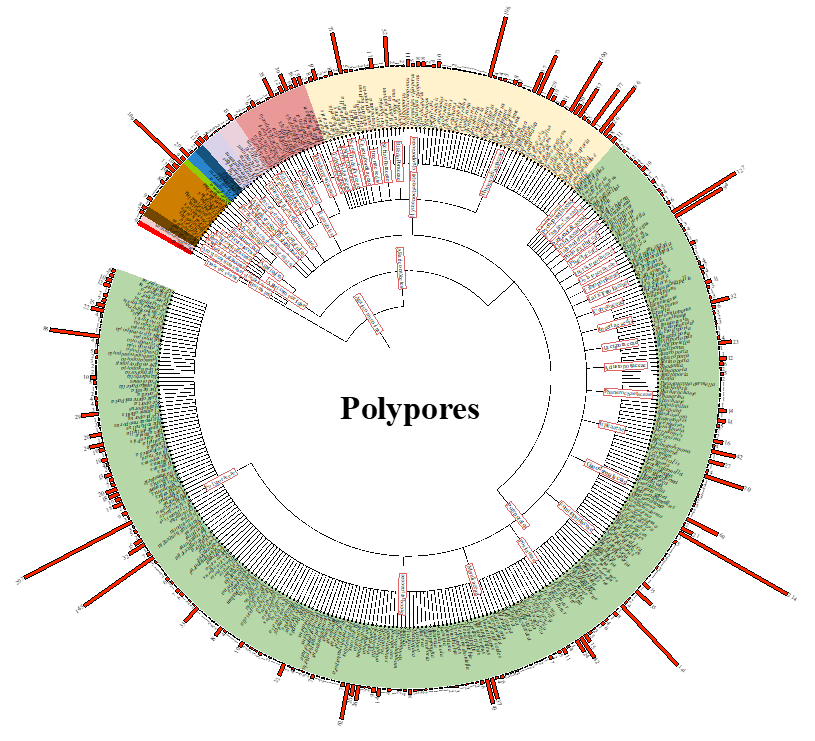
Polypores were mostly defined as wood-inhabiting basidio-mycetes with a poroid hymenophore, traditionally, polypores belonged to the Aphyllophorales (Fig. 1). So, some species with a hymenophore configuration other than poroid are also included, for instance, some species with lamellae or sublam-ellate, irpicoid, hydnoid, and corticioid hymenophore (Ryvarden 1991; Wu et al. 2022a; Zhao et al. 2024). Currently, polypores belong to 11 orders within the Agaricomycetes, namely Agaricales, Amylocorticiales, Auriculariales, Boletales, Can-tharellales, Gloeophyllales, Hymenochaetales, Polyporales, Russulales, Thelephorales, and Trechisporales (Ryvarden 1991; Zhao et al. 2015; Wu et al. 2022a; Zhao et al. 2024). In addition, a classification hierarchy of genus and family was generated with Lifemap (https://lifemap-ncbi.univ-lyon1.fr/, 20th July 2025) using the checklist of polypores (File S1), to compare with the previous studies (Zhou et al. 2023; Hyde et al. 2024b; Xu et al. 2025; Zhao et al. 2025a), a diagram was generated with iTOL (https://itol.embl.de/) with the number of species in each genus.
Nutritional modes
Nutritional modes of polypores were divided into four types, including white rot, brown rot, ectomycorrhizal, and uncertain (Wu et al. 2022a; Zhao et al. 2024). It was noted that some species of Coltricia have been identified as ectomycorrhizal, including C. abieticola, C. dependens, C. perennis, and C. weii, while many others were treated as uncertain (Tedersoo et al. 2007; Wu et al. 2022b; Zhao et al. 2023b).
Distribution patterns of polypores
The distribution was also divided into four zones, namely bo-real, temperate, subtropical, and tropical. The geographical distribution included six continents, viz., Africa, Asia, Europe, North America, Oceania, and South America.
Bibliometric analyses
To obtain the trends in research concerned with polypores, the bibliometric analyses were performed using the search keywords “polypores”, “Hymenochaetaceae”, and “Polypo-raceae” in the “Web of Science Core Collection” database for 2000–2024. The species numbers of the families Hymenochaetaceae and Polyporaceae accounted for ap-proximately 60 % of the polypores according to Zhao et al. (2024), so these keywords were added in this study. We se-lected “tab defined file format” to export author, title, source, abstract, and other information, the co-occurrence network and research hotspot plots were visualized using VOSviewer 1.6.20 (Arruda et al. 2022).
Data analyses
The Sørensen Similarity index (SS) among the studied continents was tested using the following equation: SS=2C/(A+B), where A and B were the species numbers in the two compared continents, and C was the number of species recorded in both continents (Sørensen 1948; Wu et al. 2022a; Zhao et al. 2024). Columnar and line charts, and Voronoi diagrams were performed using the R programs ggplot2 (Wilkinson 2011), and voronoiTreemap (https://github.com/uRosConf/voronoiTreemap, accessed on 10th February 2024), respectively, in the R package v4.1.2 (R Core Team 2013). Flower plots were tested using the imageGP 2 website (Chen et al. 2024; http://www.bic.ac.cn/BIC/).
Results
Global species composition of polypores
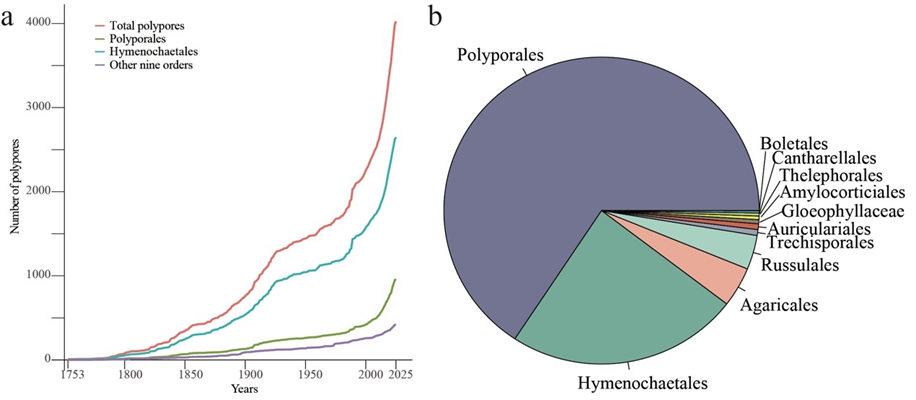
Since Linnaeus named polypore species using binomial no-menclature in 1753, the number of polypore species has steadily increased. By 1912, after 159 years, the number of polypores exceeded 1,000, reaching 1,009. By 1989, 77 years later, it surpassed 2,000, reaching 2,031. By 2016, it exceeded 3,000 in just 27 years, reaching 3,010, and more than 1,000 new species have been described from 2017 to March 2025. Currently, 4,026 species have been described worldwide until May 2025 (Fig. 2, Fig. 3a, and File S1). Meanwhile, the pol-ypore numbers in the main orders, Polyporales and Hy-menochaetales, show similar trends.
In this study, a total of 4,026 polypores were collated worldwide, belonging to 11 orders, 60 families, and 368 genera within the class Agaricomycetes (Fig. 3b, Table 1, and File S1). Among these species, the order Polyporales has 2,648 species, accounting for 65.77 %, in 26 families and 262 genera (Table 2). The order Hymenochaetales has 961 species, accounting for 23.87 %, in 13 families and 64 genera. The order Agaricales has 169 species, accounting for 4.20 %, in eight families and 11 genera. The order Russulales has 145 species, accounting for 3.60 %, in five families and 15 genera. The order Auricu-lariales has 24 species, accounting for 0.60 %, in one family and four genera. The order Trechisporales has 24 species, accounting for 0.60 %, in one family and two genera. The order Gloeophyllaceae has 17 species, accounting for 0.42 %, in one family and four genera. The order Amylocorticiales has 15 species, accounting for 0.38 %, in one family and two genera. The order Thelephorales has 13 species, accounting for 0.32 %, in two families and two genera. The order Can-tharellales has nine species, accounting for 0.22 %, in one family and one genus. The order Boletales has one species, accounting for 0.02%, in one family and one genus.
At the family level, Polyporaceae (Polyporales), Hy-menochaetaceae (Hymenochaetales), and Steccherinaceae (Polyporales) contained the greatest number of genera, with 103, 40, and 23, respectively and Polyporaceae, Hy-menochaetaceae, and Ganodermataceae (Polyporales) had the most species, with 1,170, 725, and 318 species, respectively. At the genus level, there were eight genera that consisted of more than 100 species (Fig. 2, Table 1), namely Favolaschia (109 species), Fomitopsis (141 species), Fuscoporia (106 species), Ganoderma (214 species), Inonotus (100 species), Polyporus (207 species), Trametes (145 species), and Tyromyces (127 species).
| Orders | Number of families | Number of genera | Number of species | Proportion of total polypores |
| Polyporales | 26 | 262 | 2,648 | 65.77% |
| Hymenochaetales | 13 | 64 | 961 | 23.87% |
| Russulales | 5 | 15 | 145 | 3.60% |
| Auriculariales | 1 | 4 | 24 | 0.60% |
| Trechisporales | 1 | 2 | 24 | 0.60% |
| Gloeophyllaceae | 1 | 4 | 17 | 0.42% |
| Amylocorticiales | 1 | 2 | 15 | 0.38% |
| Thelephorales | 2 | 2 | 13 | 0.32% |
| Cantharellales | 1 | 1 | 9 | 0.22% |
| Boletales | 1 | 1 | 1 | 0.02% |
In addition, we compiled the locality data for type materials of all polypore species, which were distributed in 154 countries or regions (File S2). Among the top 20 countries with type materials, there are a maximum of seven Asian countries and at least one African country (Table 3), totalling 2,815 species found in these regions, which accounts for 69.92 %. Moreover, 2,285 polypores had reference sequences, accounting for 56.76 %, while sequences of 1,741 species are not available so far, accounting for 43.24 % (File S1).
| Ranks | Countries | Number of types | Continents | Ranks | Countries | Number of types | Continents |
| 1 | China | 803 | Asia | 11 | Costa Rica | 69 | North America |
| 2 | USA | 315 | North America | 12 | Venezuela | 68 | South America |
| 3 | Brazil | 312 | South America | 13 | Argentina | 64 | South America |
| 4 | Malaysia | 179 | Asia | 14 | Cuba | 64 | North America |
| 5 | Australia | 138 | Oceania | 15 | New Zealand | 63 | Oceania |
| 6 | Indonesia | 107 | Asia | 16 | Philippines | 62 | Asia |
| 7 | Japan | 104 | Asia | 17 | Cameroon | 60 | Africa |
| 8 | India | 101 | Asia | 18 | Sri Lanka | 48 | Asia |
| 9 | Russia | 77 | Europe | 19 | Sweden | 48 | Europe |
| 10 | France | 72 | Europe | 20 | Finland | 47 | Europe |
| Note: All countries with taxonomic types in polypores are listed in File S2. | |||||||
The highest species richness of Asia
Among 4,026 polypores across six continents, Asia had the highest number of species with 2,014 species from 11 orders, 59 families, and 303 genera (Fig. 4 and Table 4). North Amer-ica followed with 968 species distributed among ten orders, 51 families, and 226 genera. South America ranked third with 795 species in eight orders, 41 families, and 163 genera. Africa came fourth with 686 species, belonging to nine orders, 40 families, and 138 genera. Europe has 538 species from 11 orders, 50 families, and 162 genera, and Oceania has the fewest, with 442 species in nine orders, 40 families, and 142 genera.
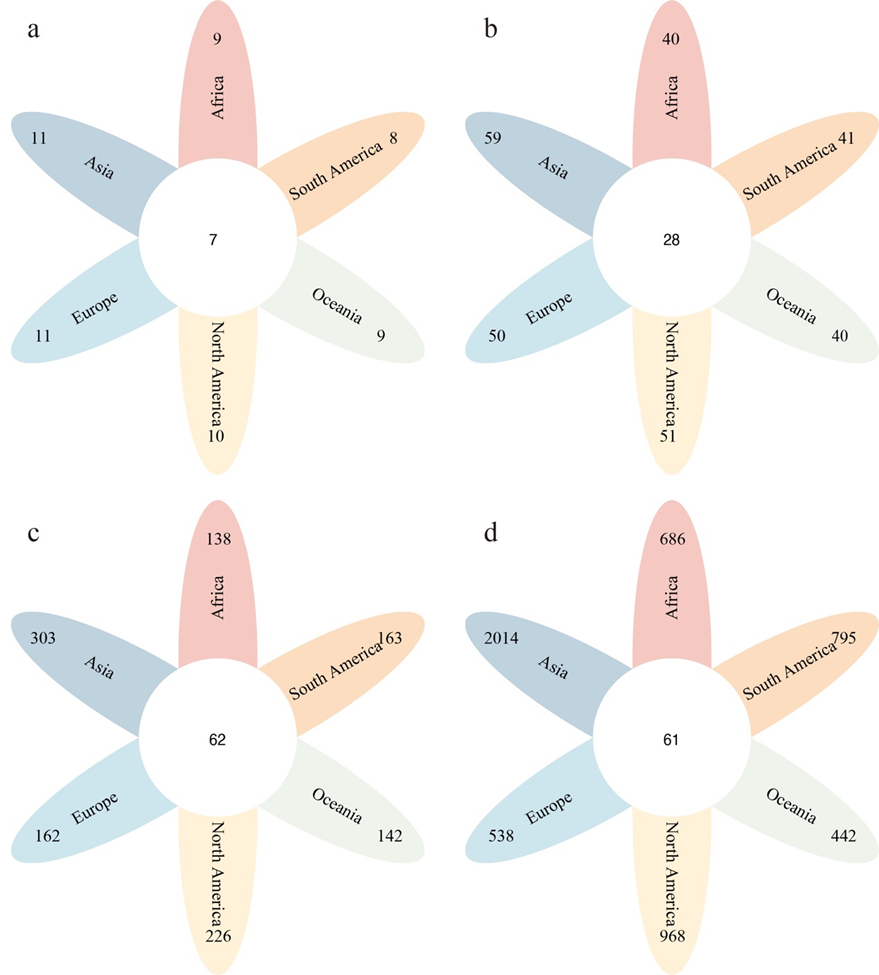
Currently, there are 11 orders of polypores, with seven of them found in the six continents, viz., Agaricales, Auriculariales, Gloeophyllales, Hymenochaetales, Polyporales, Russulales, and Trechisporales (Fig. 4a), accounting for 63.6 %. Only Asia and Europe contain all 11 orders, and South America has the fewest, with nine orders. At the family level, a total of 60 fami-lies was collected, with 28 families found in the six continents, comprising 46.7 % (Fig. 4b). Asia, North America, and Europe (mainly located in the Northern Hemisphere) have a higher number of families, with counts of 59, 51, and 50, respectively, compared to South America, Africa, and Oceania (mainly lo-cated in the Southern Hemisphere), which have 41, 40, and 40 families, respectively. Regarding genera, there were 368 gen-era of polypores, with 62 shared genera found in the six con-tinents, making up 16.8 % (Fig. 4c). Asia and North America have the largest number of genera. In addition, there are only 61 shared species found in the six continents, which repre-sents only 1.5 % of all polypores, and Asia has the highest species richness among all six continents (Fig. 4d).
| Orders | Families (Abbreviation) | Number of genera | Number of species | ||||||||||
|---|---|---|---|---|---|---|---|---|---|---|---|---|---|
| Africa | Asia | Europe | North America | Oceania | South America | Africa | Asia | Europe | North America | Oceania | South America | ||
| Agaricales | Cystostereaceae (Cy) | 0 | 1 | 0 | 0 | 0 | 0 | 0 | 1 | 0 | 0 | 0 | 0 |
| Fistulinaceae (Fi) | 1 | 2 | 1 | 2 | 1 | 2 | 1 | 4 | 1 | 4 | 3 | 5 | |
| Mycenaceae (My) | 2 | 3 | 1 | 3 | 3 | 3 | 22 | 56 | 1 | 23 | 17 | 51 | |
| Pleurotaceae (Pl) | 0 | 1 | 1 | 1 | 1 | 0 | 0 | 3 | 2 | 4 | 2 | 0 | |
| Porotheleaceae (Po) | 0 | 1 | 1 | 1 | 0 | 0 | 0 | 1 | 1 | 1 | 0 | 0 | |
| Radulomycetaceae (Ra) | 0 | 1 | 0 | 0 | 0 | 0 | 0 | 1 | 0 | 0 | 0 | 0 | |
| Schizophyllaceae (Sc) | 1 | 0 | 0 | 1 | 1 | 1 | 1 | 0 | 0 | 1 | 1 | 1 | |
| Stephanosporaceae (St) | 1 | 1 | 1 | 1 | 0 | 0 | 1 | 1 | 5 | 6 | 0 | 0 | |
| Amylocorticiales | Amylocorticiaceae (Am) | 1 | 2 | 2 | 2 | 0 | 1 | 1 | 11 | 5 | 6 | 0 | 1 |
| Auriculariales | Auriculariaceae (Au) | 1 | 1 | 1 | 1 | 1 | 1 | 1 | 9 | 1 | 2 | 3 | 3 |
| Incertae sedis (In) | 1 | 3 | 2 | 1 | 1 | 1 | 3 | 6 | 2 | 3 | 1 | 2 | |
| Boletales | Tapinellaceae (Ta) | 0 | 1 | 1 | 0 | 0 | 0 | 0 | 1 | 1 | 0 | 0 | 0 |
| Cantharellales | Hydnaceae (Hy) | 0 | 1 | 1 | 1 | 1 | 0 | 0 | 5 | 8 | 3 | 1 | 0 |
| Gloeophyllales | Gloeophyllaceae (Gl) | 1 | 4 | 1 | 2 | 1 | 1 | 4 | 14 | 7 | 8 | 6 | 3 |
| Hymenochaetales | Chaetoporellaceae (Ch) | 1 | 2 | 1 | 2 | 0 | 2 | 1 | 5 | 1 | 2 | 0 | 3 |
| Coltriciaceae (Co) | 1 | 1 | 1 | 1 | 1 | 1 | 6 | 47 | 5 | 11 | 5 | 11 | |
| Hirschioporaceae (Hi) | 1 | 4 | 2 | 4 | 2 | 2 | 1 | 20 | 4 | 9 | 3 | 6 | |
| Hymenochaetaceae (Hm) | 13 | 31 | 18 | 27 | 15 | 19 | 73 | 377 | 54 | 181 | 57 | 123 | |
| Hyphodontiaceae (Hp) | 1 | 1 | 1 | 1 | 1 | 1 | 1 | 1 | 1 | 1 | 2 | 1 | |
| Incertae sedis (In) | 0 | 3 | 2 | 2 | 1 | 0 | 0 | 4 | 3 | 2 | 1 | 0 | |
| Neoantrodiellaceae (Ne) | 0 | 1 | 0 | 0 | 0 | 0 | 0 | 2 | 0 | 0 | 0 | 0 | |
| Nigrofomitaceae (Ni) | 1 | 1 | 1 | 1 | 1 | 1 | 1 | 3 | 1 | 1 | 1 | 1 | |
| Rigidoporaceae (Ri) | 2 | 3 | 1 | 2 | 3 | 1 | 15 | 35 | 8 | 16 | 12 | 18 | |
| Schizoporaceae (Sh) | 1 | 3 | 1 | 1 | 1 | 1 | 3 | 16 | 4 | 5 | 5 | 6 | |
| Sideraceae (Si) | 0 | 1 | 1 | 1 | 1 | 1 | 0 | 14 | 3 | 3 | 5 | 2 | |
| Trichaptaceae (Tr) | 1 | 1 | 0 | 1 | 1 | 1 | 1 | 4 | 0 | 4 | 1 | 2 | |
| Tubulicrinaceae (Tu) | 1 | 1 | 1 | 1 | 0 | 1 | 1 | 5 | 6 | 3 | 0 | 1 | |
| Umbellaceae (Um) | 0 | 1 | 1 | 1 | 1 | 0 | 0 | 1 | 1 | 1 | 1 | 0 | |
| Polyporales | Adustoporiaceae (Ad) | 1 | 5 | 4 | 4 | 0 | 2 | 1 | 17 | 7 | 12 | 0 | 2 |
| Auriporiaceae (Ar) | 0 | 1 | 1 | 1 | 0 | 1 | 0 | 3 | 1 | 1 | 0 | 1 | |
| Cerrenaceae (Ce) | 4 | 4 | 3 | 5 | 3 | 3 | 8 | 11 | 4 | 13 | 5 | 11 | |
| Fibroporiaceae (Fb) | 2 | 2 | 1 | 1 | 1 | 1 | 2 | 7 | 6 | 3 | 1 | 1 | |
| Fomitopsidaceae (Fo) | 3 | 13 | 5 | 4 | 5 | 4 | 24 | 98 | 49 | 56 | 29 | 24 | |
| Fragiliporiaceae (Fr) | 0 | 1 | 0 | 0 | 0 | 0 | 0 | 1 | 0 | 0 | 0 | 0 | |
| Ganodermataceae (Ga) | 7 | 10 | 1 | 6 | 3 | 9 | 97 | 137 | 11 | 47 | 22 | 71 | |
| Gelatoporiaceae (Ge) | 0 | 3 | 2 | 2 | 1 | 2 | 0 | 5 | 2 | 2 | 1 | 3 | |
| Grifolaceae (Gr) | 0 | 1 | 1 | 1 | 1 | 2 | 0 | 4 | 1 | 1 | 3 | 5 | |
| Incertae sedis (In) | 3 | 5 | 4 | 5 | 3 | 4 | 20 | 10 | 8 | 10 | 3 | 16 | |
| Incrustoporiaceae (Ic) | 2 | 2 | 2 | 2 | 3 | 2 | 41 | 94 | 37 | 42 | 31 | 23 | |
| Irpicaceae (Ir) | 6 | 9 | 9 | 11 | 7 | 6 | 20 | 83 | 41 | 50 | 25 | 36 | |
| Ischnodermataceae (Is) | 1 | 1 | 2 | 1 | 1 | 1 | 1 | 2 | 2 | 1 | 2 | 2 | |
| Laetiporaceae (La) | 3 | 4 | 2 | 4 | 2 | 1 | 6 | 16 | 4 | 12 | 2 | 3 | |
| Laricifomitaceae (Lr) | 0 | 1 | 1 | 2 | 1 | 0 | 0 | 1 | 1 | 2 | 2 | 0 | |
| Meripilaceae (Me) | 0 | 1 | 1 | 1 | 1 | 0 | 0 | 2 | 1 | 2 | 1 | 0 | |
| Meruliaceae (Mr) | 3 | 15 | 7 | 10 | 4 | 9 | 27 | 51 | 21 | 31 | 6 | 22 | |
| Phaeolaceae (Ph) | 2 | 2 | 1 | 2 | 1 | 1 | 2 | 7 | 1 | 3 | 1 | 1 | |
| Phanerochaetaceae (Pa) | 3 | 9 | 3 | 2 | 3 | 2 | 6 | 19 | 8 | 12 | 4 | 9 | |
| Piptoporellaceae (Pi) | 1 | 1 | 1 | 0 | 0 | 0 | 1 | 4 | 1 | 0 | 0 | 0 | |
| Podoscyphaceae (Pd) | 1 | 1 | 1 | 1 | 2 | 1 | 2 | 2 | 2 | 2 | 2 | 2 | |
| Polyporaceae (Py) | 44 | 88 | 30 | 54 | 37 | 48 | 225 | 517 | 91 | 232 | 128 | 249 | |
| Postiaceae (Ps) | 4 | 14 | 14 | 13 | 11 | 4 | 6 | 89 | 42 | 34 | 20 | 8 | |
| Pycnoporellaceae (Pc) | 0 | 1 | 1 | 1 | 0 | 0 | 0 | 1 | 1 | 1 | 0 | 0 | |
| Sarcoporiaceae (Sa) | 0 | 1 | 1 | 1 | 0 | 1 | 0 | 2 | 2 | 3 | 0 | 1 | |
| Steccherinaceae (Se) | 5 | 15 | 12 | 16 | 8 | 12 | 32 | 75 | 39 | 43 | 16 | 42 | |
| Taiwanofungaceae (Ta) | 0 | 1 | 0 | 0 | 0 | 0 | 0 | 2 | 0 | 0 | 0 | 0 | |
| Russulales | Albatrellaceae (Al) | 2 | 2 | 3 | 4 | 0 | 0 | 3 | 30 | 7 | 17 | 0 | 0 |
| Bondarzewiaceae (Bo) | 3 | 6 | 2 | 4 | 3 | 3 | 12 | 47 | 5 | 14 | 6 | 12 | |
| Echinodontiaceae (Ec) | 1 | 1 | 0 | 2 | 0 | 1 | 1 | 1 | 0 | 2 | 0 | 1 | |
| Hericiaceae (He) | 2 | 2 | 0 | 2 | 1 | 1 | 3 | 10 | 0 | 3 | 1 | 2 | |
| Terrestriporiaceae (Te) | 0 | 1 | 0 | 0 | 0 | 0 | 0 | 1 | 0 | 0 | 0 | 0 | |
| Thelephorales | Bankeraceae (Ba) | 1 | 1 | 1 | 1 | 1 | 0 | 1 | 5 | 5 | 5 | 1 | 0 |
| Thelephoraceae (Th) | 0 | 1 | 1 | 0 | 0 | 0 | 0 | 1 | 1 | 0 | 0 | 0 | |
| Trechisporales | Hydnodontaceae (Hd) | 2 | 2 | 1 | 2 | 1 | 1 | 8 | 12 | 12 | 12 | 3 | 8 |
The Sørensen similarity index (SS) values were also cal-culated for six continents (Table 5). Europe and North America had the highest SS values, indicating greater species similarity. North and South America followed closely in similarity. Africa and Asia exhibited the highest species similarities with Oce-ania and Europe, respectively, while the lowest SS value was observed between Asia and South America.
| Continents | Africa | Asia | Europe | North-America | Oceania | South-America |
| Africa | 0.1519 | 0.1471 | 0.2019 | 0.2358 | 0.1999 | |
| Asia | 0.1519 | 0.2322 | 0.2200 | 0.1417 | 0.1089 | |
| Europe | 0.1471 | 0.2322 | 0.3692 | 0.1694 | 0.1185 | |
| North-America | 0.2019 | 0.2200 | 0.3692 | 0.1858 | 0.3358 | |
| Oceania | 0.2358 | 0.1417 | 0.1694 | 0.1858 | 0.1956 | |
| South-America | 0.1999 | 0.1089 | 0.1185 | 0.3358 | 0.1956 |
Polyporales and Hymenochaetales dominated six continents
The order Polyporales dominated across six continents, with proportions ranging from 62.5% in Asia and 75.95% in Africa (Fig. 5). Next was the Hymenochaetales, comprising 15.01 % in Africa to 26.51 % in Asia. Agaricales ranked third, with a range of 1.86 % in Europe to 7.17 % in South America. Russulales followed in fourth, showing proportions from 1.61 % in Oceania to 4.5 % in Asia. Additionally, eight other orders collectively accounted for only 4.02 % in South America to 10.04 % in Europe.
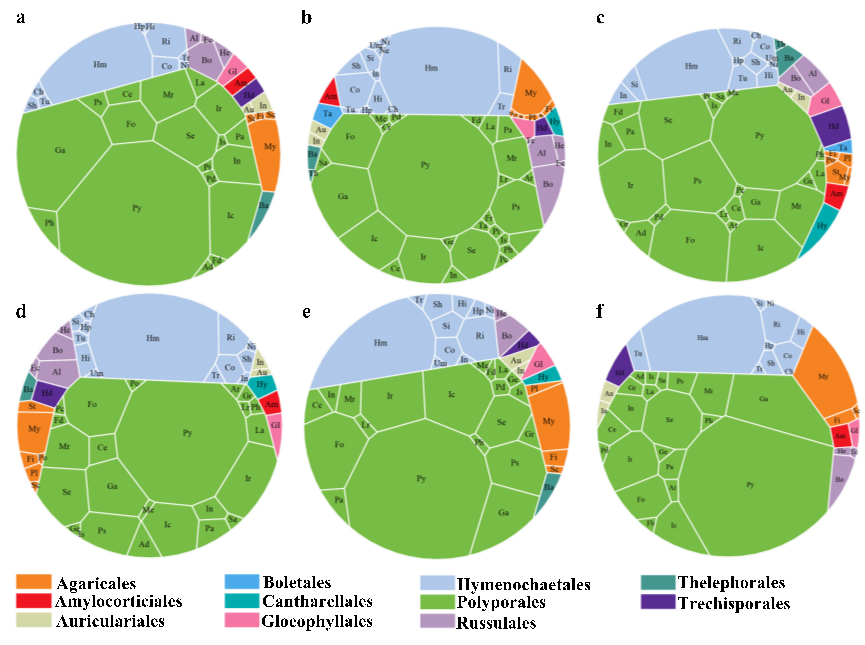
At the family level, Polyporaceae of Polyporales was prev-alent across six continents, ranging from 16.91 % in Europe to 32.80 % in Africa. Hymenochaetaceae from Hymenochaetales followed, making up 10.64 % in Africa and 18.72 % in Asia. In addition, some families within Polyporales, such as Fomitop-sidaceae, Ganodermataceae, Incrustoporiaceae, Irpicaceae, and Meruliaceae, as well as Mycenaceae from Agaricales also contributed significantly to the overall proportions of polypores.
Polypore distribution in four climate zones
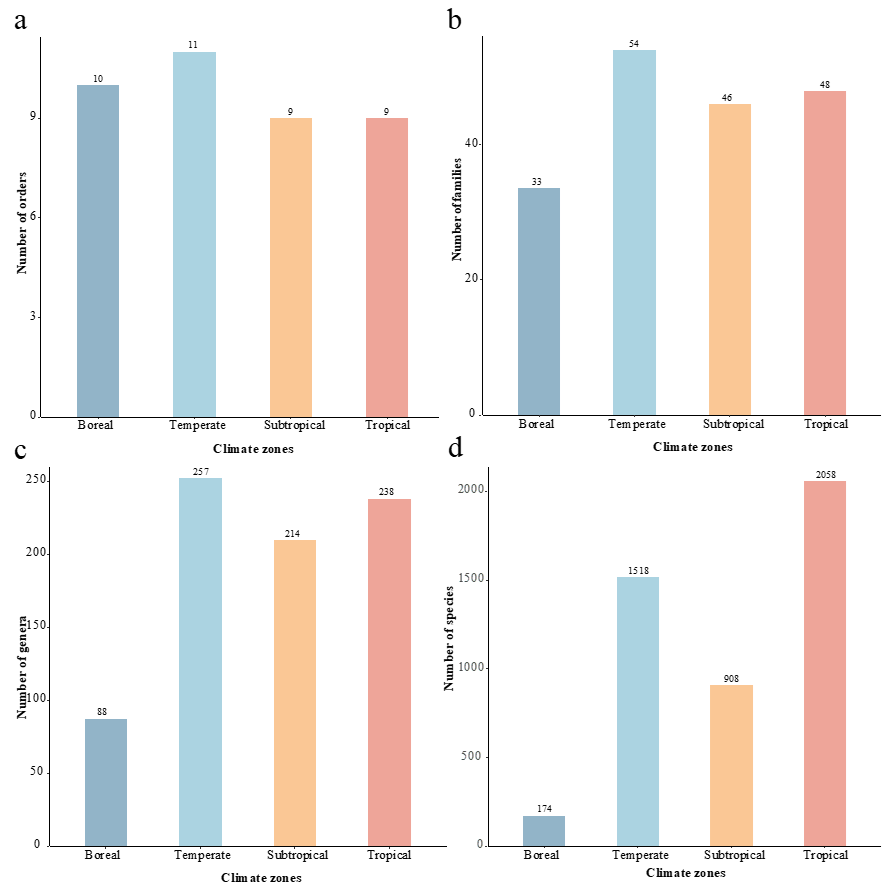
In this study, four climate zones were classified, viz., boreal, temperate, subtropical, and tropical. The distribution of pol-ypores is listed in File S1. The temperate zone has the highest richness of order, family, and genus with 11, 54, 257, respec-tively, compared to the boreal zone (10 orders, 33 families, and 88 genera), the subtropical zone (9 orders, 46 families, and 214 genera), and the tropical zone (9 orders, 48 families, and 238 genera, Fig. 6a-c). At the species level, the tropical and tem-perate zones have the greatest number, with 2,058 and 1,518 species, respectively, followed by the subtropical zone with 908 species and the boreal zone with 174 species (Fig. 6d).
On the other hand, the distribution of polypore species across four climate zones on six continents reveals three distinct trends (Fig. S1). In Africa and South America, the number of species increased from the boreal zone to the tropical zone, with the highest species richness in the tropical zones. In Asia, North America, and Oceania, the number of species initially increased, then decreased, and increased again, with the highest species richness in the temperate or tropical zones. In Europe, the trend shows an initial increase followed by a de-crease from the boreal to the subtropical zones, with the highest species richness found in the temperate zone.
The relationships between nutritional modes and climate zones
Four nutritional modes were identified, including white rot, brown rot, mycorrhizae, and unknown. Of the 4,026 species, the majority were white rot fungi, comprising 3,391 species, or 84.22 % of the total polypores (Fig. 7a). Brown rot fungi in-cluded 510 species, making up 12.67 % of the total polypores (Fig. 7a). Mycorrhizal fungi and those treated as unknown accounted for a smaller number, with 57 and 68 species, respectively, rep-resenting 1.42 % and 1.69 % of the total polypores (Fig. 7a).
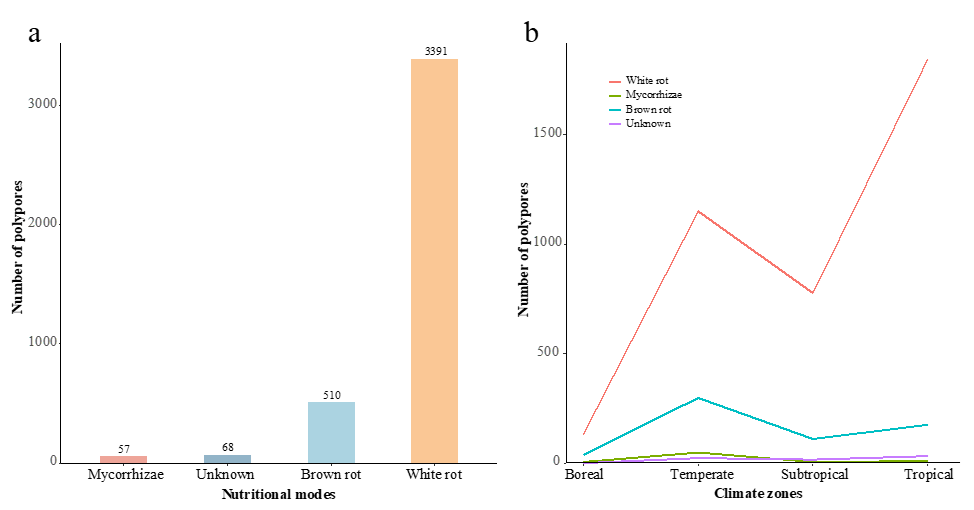
White rot polypores were mainly located in the tropical zone followed by the temperate and subtropical zones (Fig. 7b). In contrast, brown rot polypores predominantly occurred in the temperate zone, with fewer species in the tropical and sub-tropical zones (Fig. 7b). The majority of mycorrhizal fungi were found in the temperate zone (Fig. 7b). Furthermore, white rot fungi were the most prevalent across all six continents, fol-lowed by brown rot fungi, while mycorrhizal fungi were the least common (Fig. S2).
Research trends in polypores
The search query obtained 1,148 articles from the “Web of Science Core Collection” database during the 24 years (2000–2024) using three keywords, viz., polypores, Hymenochaeta-ceae, and Polyporaceae. From these articles, 91 unique keywords were identified (File S3), with 30 appearing more than 100 times. Notably, nine terms, activity, basidiomata, China, compound, forest, hyphae, new species, phylogenetic analysis, and species richness, each exceeded 400 occur-rences.
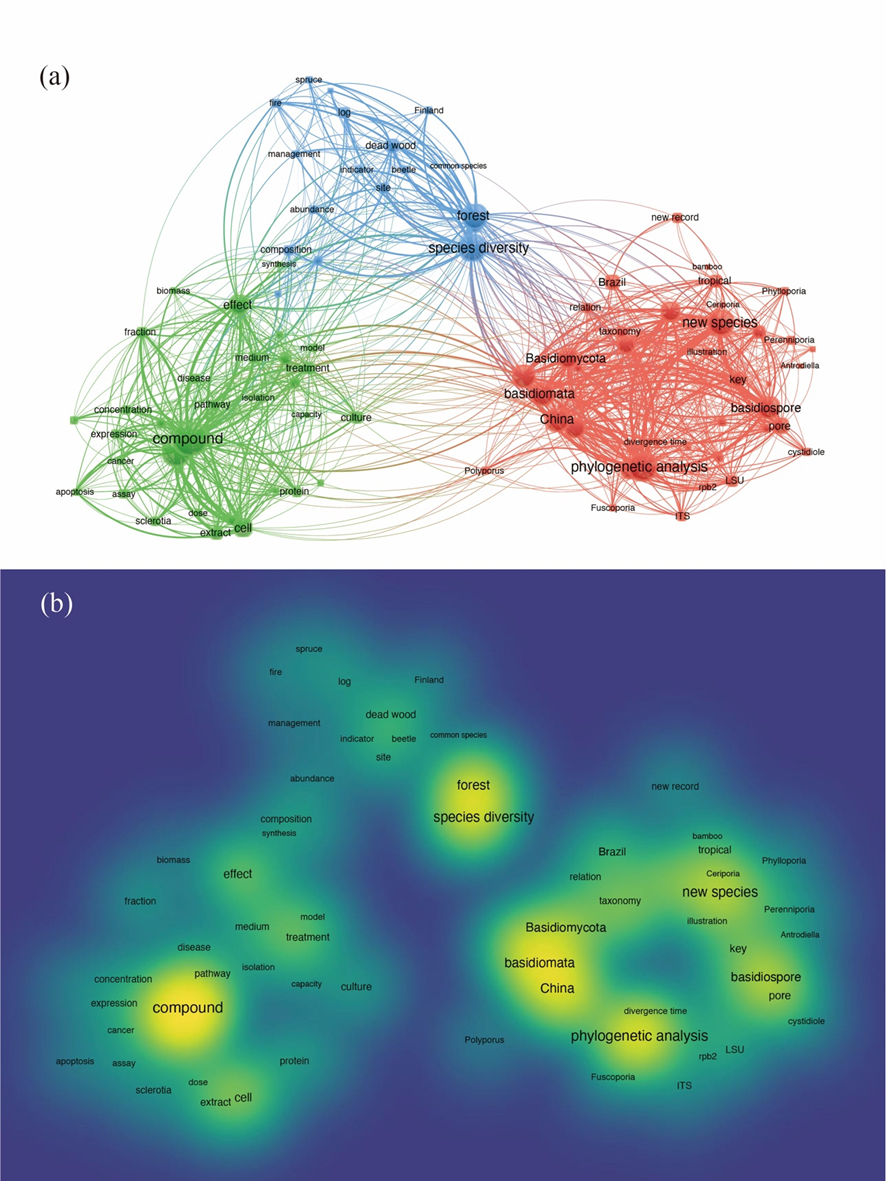
Co-occurrence network analysis of the keywords revealed three distinct clusters (Fig. 8a). Cluster 1, containing 41 key-words centred around “phylogenetic analyses” and “new spe-cies”, was linked to terms such as Basidiomycota, China, genus, and morphological characters, indicating a focus on the taxonomy of polypores based on morphological and mo-lecular phylogenetic studies. Cluster 2 comprised 32 keywords, with “activity” and “compound” as the core, connected to terms like disease, effect, rat, and treatment. This cluster suggests research related to the applications of polypores. Cluster 3 included 18 keywords, with “forest” and “species diversity” at its centre, linked to factors such as amount, fire, and habitat, highlighting the ecological relationships involving polypores. Furthermore, the research hotspot map corroborated these three clusters as key trends in polypore studies (Fig. 8b).
Discussion
Since the start of the 21st century, the use of molecular biology in fungal taxonomy has led to a significant increase in the number of polypores, a key group within Basidiomycota. Since 2000 to May 2025, 1,808 new polypores have been described, making up 43.54 % of the total according to this study. Notably, since 2018, more than 100 new species have been described almost each year (File S1). Although there were many articles and books decribling new taxa of polypore, some aspects needed futher development, such as global polypore composition and distribution, as well as ge-nomics and ecological. Thus, we focused on the global species richness and distribution patterns of polypores, provide an overview of research trends, and discussed potential issues.
Morphological evidence has long been crucial in fungal taxonomy, but advances in molecular biology over the past 20 years have significantly transformed traditional research methods. The polypores were traditionally treated in the order Aphyllophorales, but now are divided into 11 orders, with new families, genera, and species proposed using molecular analysis (Wu et al. 2022a, 2022b; Ji et al. 2023; Liu et al. 2023a, 2023c; Zhou et al. 2023; Hussain et al. 2024b; Spirin et al. 2024; Spirin & Ryvarden 2024; Zhao et al. 2025b, 2025c). In addition, phylogenetic analyses have revealed cryptic species, further enhancing our understanding of polypore diversity. For in-stance, Korhonen et al. (2018) recognized 11 species from the Skeletocutis nivea species complex based on nuclear ribo-somal internal transcribed spacer (ITS) and translation elon-gation factor TEF1 sequences. Another example is that of one of the most common polypores, Fomes fomentarius. Numerous specimens previously classified as Fomes fomentarius, have been shown to include three distinct species, viz., F. fomentarius, F. heng-duanensis, and F. inzengae, based on ecological, morpholog-ical, phylogenetic, and physiological characteristics (Peintner et al. 2019; Tomšovský et al. 2023; Cui et al. 2024). Cui et al. (2025a) studied the species diversity of the phytopathogenic fungal genus Phaeolus based on phylogeny, divergence times, and biogeography. However, many polypores still lack molec-ular data, particularly type materials, posing a significant challenge to accurately assessing species diversity, as some cannot be reliably identified through morphology alone. Alt-hough some widely distributed species may be comprised of several cryptic species based on molecular evidence, and some species lacking molecular markers may be a synonym of an existing species, we were not willing to discuss these re-lated issues because insufficient evidence supports such species. About 43 % of known polypore species currently are without reference DNA sequences, and even recently, some new species have been proposed based on morphological characteristics only, such as Diplomitoporus and Tyromyces (Hjortstam & Ryvarden 2009; Ryvarden 2018a, 2018b, 2020,2024a, 2024b; Tsigaing et al. 2020; Decock et al. 2021a, 2021b). Hence, the ongoing enrichment of molecular sequence datasets, especially in type specimens or voucher materials, is essential for resolving taxonomic uncertainties and promoting a more robust and comprehensive understanding of fungal diversity.
Many mycologists have collected and studied polypores worldwide, but numerous species remain to be discovered due to factors such as geographical isolation, funding limitations, and the challenges of accessing harsh environments (Zhao et al. 2024). This study finds that Asia has the highest species number of polypores compared to the other five continents, particularly in contrast to Africa, and Central and South Amer-ica. Fortunately, some new polypore species have been de-scribed in countries that were previously under-researched, such as India (Crous et al. 2021; Jayawardena et al. 2022; Senanayake et al. 2023; Gunaseelan et al. 2024), Kenya (Ryvarden 2018a; Decock et al. 2021a; Ryvarden 2023; Jérusalem et al. 2025), Mexico (Valenzuela et al. 2023; Suh et al. 2024), Pakistan (Ahmed et al. 2023; Bashir et al. 2024; Gafforov et al. 2025; Hussain et al. 2024a, 2024b, 2025), and South Korea (Tibpromma et al. 2017; Jung et al. 2018; Cho et al. 2023, 2024), which promoted our understanding of species richness and distribution patterns of polypores across six continents. Moreover, the new taxa of polypores are typically described based on morphology and phylogeny, such as new species within Ceriporia, Coltricia, Fomitiporia, Fulvifomes, Ganoderma, Meripilus, and Nigroporus (Chen et al. 2025a, 2025b; Li et al. 2025; Kumar et al. 2025; Olou et al. 2025; Wang et al. 2025a; Zhao et al. 2025b).
It is important to note that the climate zones and geo-graphical distribution of polypores may be incomplete due to limited research on the species numbers in certain areas and a lack of comprehensive literature records. Previous studies indicated that the temperate zone has the highest number within the class Agaricomycetes, while the latitudinal diversity gradient (LDG) hypothesis suggests that tropical regions har-bour the greatest species diversity of many groups, such as plants and animals (Mittelbach et al. 2007; Varga et al. 2019). Our earlier research (Zhao et al. 2024) also indicated that the tropical zone has the highest species number of polypores. While the lower species number in the subtropical zone compared to the temperate zone suggested that there may be a large number of species in this area it has not yet been investigated.
Studying the species richness of polypores may promote the development and utilization of biological resources. There has been increasing interest in the medicinal properties of polypores, as highlighted by bibliometric analyses that under-score their importance in traditional medicines. For instance, Fomes fomentarius and Inonotus obliquus are recognized as valuable medicinal polypores in European tradition (Grienke et al. 2014; Peintner et al. 2019; Szychowski et al. 2021), and species from the genera Sanghuangporus and Ganoderma are entrenched in traditional Chinese medicine (Ren et al. 2021; Sun et al. 2022a, 2022b; Lin et al. 2023; Wang et al. 2023c; Wu et al. 2024a). Currently, many polypores have been proven to have medicinal properties (Sangdee et al. 2017; Campi et al. 2021; Szychowski et al. 2021; Chafouz et al. 2023; Cheng et al. 2023; Hua et al. 2023; Ghobad-Nejhad et al. 2024; Jiang et al. 2024; Luo et al. 2024b; Shen et al. 2024), indicating further exploration is needed. It is worth noting that in recent years, more than 20 species of polypores have been successfully cultivated in China (Dai 2022).
Most polypores, as wood-decaying fungi, are closely associ-ated with their host trees and play an important role in the stability and regeneration of forest ecosystems (Palviainen et al. 2010; Berglund et al. 2011; Vainio et al. 2011; Zhou & Dai 2012; Krah et al. 2018; Dai et al. 2021; Huang et al. 2022). In this study, the results of co-occurrence network analysis showed that the keyword “forest” and “species diversity” formed another grouping at core, strongly emphasizing signif-icant relationship with polypores. However, due to the impact of human activities, such as forestry practices, polypores are facing severe challenges. Forestry affects biodiversity in vari-ous interconnected ways across multiple temporal and spatial scales (Asplund et al. 2024). The reduction in structural and functional diversity caused by for-estry limits the diversity of habitats and substrates, negatively impacting biodiversity by providing fewer ecological niches for wood-decaying fungi (Sippola et al. 2001; Ranius et al. 2019; Moor et al. 2021; Asplund et al. 2024). On the other hand, the restoration of richness of deadwood in forests can increase the species diversity and populations of wood-decaying fungi (Pasanen et al. 2014; Zibold et al. 2024). Therefore, the conservation of forest ecosystems plays a vital role in maintaining the diversity of polypores.
In recent years, the advancement of multiomics studies on polypores has steadily progressed, which holds great promise for the discovery, development, and application of polypore resources. For example, comparative genomics showed that white-rot and brown-rot fungi had significant distinctions in carbohydrate-active enzyme (CAZyme) gene families, partic-ularly in class II lignin-modifying peroxidase (POD) genes (Floudas et al. 2012; Kohler et al. 2015; Krah et al. 2018). Combining genomics, transcriptomics, and metabolomics to uncover the biosynthetic pathways of secondary metabolites in medicinal polypores has become a major research focus in recent years, especially in the genera Ganoderma and Sanghuangporus (Sun et al. 2022b; Cho et al. 2025; Wang et al. 2025b). Moreover, many studies focused on ecological diver-sification, phylogenomics, mitochondrial genome, and the pathogenic mechanisms of polypore pathogens using multi-omics (Chung et al. 2017; Zhao et al. 2023b, 2025a; Feng et al. 2024; Garcia et al. 2024; Liu et al. 2025b; Ma et al. 2025; Nie et al. 2025). These studies of polypores may be lagging behind other fungal groups, such as ectomycorrhizae and yeasts, not only in the number of published genomes, but, more im-portantly, in study depth (Martin et al. 2016; Miyauchi et al. 2020; Rossi et al. 2021; Sahu et al. 2023; Deng et al. 2025; Mondo & Grigoriev 2025; Qu et al. 2025; Tremble et al. 2024; Yan et al. 2025). Hence, comprehensive multiomics investiga-tions on polypores should be regarded as a long-term research priority, requiring ongoing commitment and innovation.
Conclusions
In this study, we present a comprehensive global polypore richness and distribution based on an extensive compilation of database and literature records. A total of 4,026 accepted species belonging to 11 orders, 60 families, and 368 genera within Agaricomycetes highlights the remarkable species richness of polypores and their uneven taxonomic composition, laying a solid foundation for future study on their evolutionary origins and resource utilization.
Acknowledgments
The research is supported by the National Natural Science Foundation of China (Project No. U23A20142 and 32161143013), Hainan Province Science and Technology Special Fund (Project No. ZDYF2023RDYL01), the Hainan Institute of National Park (Project No. HINP, KY-24ZK02), and Young Elite Scientists Sponsorship Program by CAST (Project No. 2023QNRC001).
Author contributions
Conceptualization, Zhao H., Yuan H.-S., Dai Y.-C., and Yuan Y.; methodology, Zhao H., Cui Y.-J., and Wang K.; formal analysis, Zhao H. and Cui Y.-J.; resources, Yuan H.-S., Wu F., Dai Y.-C., and Yuan Y.; data curation, Zhao H.; writing—original draft preparation, Zhao H.; writing—review and editing, Yuan H.-S., Wu F., Dai Y.-C., and Yuan Y.; supervision, Dai Y.-C.; project administration, Yuan Y.; funding acquisition, Dai Y.-C., and Yuan Y. All authors have read and agreed to the published version of the manuscript.
Conflict of interest statement
All authors declare that they have no competing interests.
Supplemental Information
The online version contains supplemental information available at https://doi.org/10.65390/fdiv.2026.136002. Supplementary File 1 Supplementary materials to this study.
Rights and permissions
The Author(s) 2026. Published by BioAcademic Press on behalf of Kunming Institute of Botany,Chinese Academy of Sciences (CAS) and Mushroom Research Foundation. This is an open accessarticle under the Creative Commons Attribution license ( http://creativecommons.org/licenses/by/4.0), which permits use, distribution and reproduction in any medium, provided the originalwork is properly cited.
References
- Abrego N, Furneaux B, Hardwick B, Somervuo P, Palorinne I, Aguilar-Trigueros CA, Andrew NR, Babiy UV, Bao T, Bazzano G, Bondarchuk SV, Bonebrake TC, Brennan GL, Bret-Harte Y, Bässler C et al. (2024) Airborne DNA reveals predictable spatial and seasonal dynamics of fungi. Nature 631: 835–842. https://doi.org/10.1038/s41586-024-07658-9
- Ahmed S, Awais M, Sadiq MM, Umar A, Dufossé L, Khan MT, Alkahtani J, Mahmoud RM (2023) Ganoderma multistipitatum sp. nov. from Chir pine tree (Pinus roxburghii Sarg.) in Pakistan. J King Saud Univ Sci 35: 102554. https://doi.org/10.1016/j.jksus.2023.102554
- Alem D, Dejene T, Oria-de-Rueda JA, Martín-Pinto P (2021) Survey of macrofungal diversity and analysis of edaphic factors influ-encing the fungal community of church forests in Dry Afromon-tane areas of Northern Ethiopia. Forest Ecol Manag 496: 119391. https://doi.org/10.1016/j.foreco.2021.119391
- Arruda H, Silva ER, Lessa M, Proença Jr D, Bartholo R (2022) VOSviewer and bibliometrix. J Med Libr Assoc 110: 392–395. https://doi.org/10.5195/jmla.2022.1434
- Asplund J, Nordén J, Kjønaas OJ, Madsen RL, Lunde LF, Birkemoe T, Ronold EK, Norkute M, Jansson KU, Karlsen DP, Sverdrup-Thygeson A, Skrede I, Methlie IH, Maurice S, Botten UG, Krok RJ, Kauserud H, Nybakken L (2024) Long term effects of forest management on forest structure and dead wood in mature boreal forests. Forest Ecol Manag 572: 122315. https://doi.org/10.1016/j.foreco.2024.122315
- Baldrian P, Větrovský T, Lepinay C, Kohout P (2022) High-throughput sequencing view on the magnitude of global fungal diversity. Fungal Divers 114: 539–547. https://doi.org/10.1007/s13225-021-00472-y
- Bao DF, Zhang JY, Lu YZ, Tian XG, Hyde KD, Liu NG, Xiao YP, Luo ZL, Karunarathna SC, Samarakoon MC, Xiao XJ, Ma J, Yang Y, Han JJ, Zhao GL, He ZJ, Wen TC, Liu ZH, Kang JC (2025) Endophytic fungi associated with medicinal ferns in Guizhou Province, China Ⅰ: Morpho-molecular characterization of culturable endophytic fungi associated with Dicranopteris spp. Mycosphere 16: 2259–2455, https://doi.org/10.5943/mycosphere/16/1/13
- Bashir H, Jabeen S, Naseer A, Khalid AN. (2024) Onnia pakistanica sp. nov., (Hymenochaetaceae, Basidiomycota) from Pakistan. Phytotaxa 658: 251–260. https://doi.org/10.11646/PHYTOTAXA.658.3.3
- Berglund H, Jönsson MT, Penttilä R, Vanha-Majamaa I (2011) The effects of burning and dead-wood creation on the diversity of pioneer wood-inhabiting fungi in managed boreal spruce forests. Forest Ecol Manag 261: 1293–1305. https://doi.org/10.1016/j.foreco.2011.01.008
- Bhunjun CS, Niskanen T, Suwannarach N, Wannathes N, Chen YJ, McKenzie EHC, Maharachchikumbura SSN, Buyck B, Zhao CL, Fan YG, Zhang JY, Dissanayake AJ, Marasinghe DS, Jaya-wardena RS, Kumla J et al. (2022) The numbers of fungi: are the most speciose genera truly diverse? Fungal Divers 114: 387–462. https://doi.org/10.1007/s13225-022-00501-4
- Bittencourt F, Alves-Silva G, Goes-Neto A, Drechsler-Santos ER. (2024a) Neomensularia meridionalis sp. nov. (Hymenochaetales, Basidiomycota), a new species from South America. Phytotaxa 659: 67–76. https://doi.org/10.11646/PHYTOTAXA.659.1.5
- Bittencourt F, Costa-Rezende DH, Kout J, Góes-Neto A, Vlasák J, Drechsler-Santos ER (2024b) On Neotropical Fuscoporia with strigose pileus surface: redescription and phylogenetic study of Polyporus sarcites and a new species Fuscoporia dollingeri (Hymenochaetaceae, Basidiomycota). Plant and Fungal Systematics 69: 23–38. https://doi.org/10.35535/pfsyst-2024-0004
- Blundell R, Camilleri E, Baral B, Karpiński TM, Neza E, Atrooz OM (2023) The phytochemistry of Ganoderma species and their medicinal potentials. Am J Chinese Med 51: 859–882. https://doi.org/10.1142/s0192415x23500404
- Campi M, Mancuello C, Ferreira F, Maubet Y, Cristaldo E, Robledo G (2021) Bioactive compounds and antioxidant activity of four native species of the Ganodermataceae Family (Agaricomycetes) from Paraguay. Int J Med Mushrooms 23: 65–76. https://doi.org/10.1615/IntJMedMushrooms.2021039298
- Chafouz R, Karavergou S, Tsiftsoglou OS, Maskovic P, Lazar D (2023) Ganoderma adspersum (Ganodermataceae): investiga-tion of its secondary metabolites and the antioxidant, antimicro-bial, and cytotoxic potential of its extracts. Int J Mol Sci 25: 516. https://doi.org/10.3390/ijms25010516
- Chen T, Liu YX, Chen T, Yang M, Fan S, Shi M, Wei B, Lv H, Cao W, Wang C, Cui J, Zhao J, Han Y, Xi J, Zheng Z, Huang L (2024) ImageGP 2 for enhanced data visualization and reproducible analysis in biomedical research. iMeta 3: e239. https://doi.org/10.1002/imt2.239
- Chen J, Vlasák J, Luo KY, Yuan Y (2025a) Three new species of Fomitiporia (Hymenochaetales, Basidiomycota) from tropical dry forests in Ecuador and Peru. MycoKeys 118: 267–287. https://doi.org/10.3897/mycokeys.118.154175
- Chen J, Yuan Y, Vlasák J, Luo KY (2025b) Two new species of Fulvifomes (Hymenochaetales, Basidiomycota) from South America. MycoKeys 119: 263–279. https://doi.org/10.3897/mycokeys.119.158957
- Cheng Y, Zhou LJ, Jiang JH, Tian XM, Zhou LW (2023) Phylloporia (Hymenochaetales, Basidiomycota), a medicinal wood-inhabiting fungal genus with much potential for commercial development. Food Rev Int 39: 2776–2789. https://doi.org/10.1080/87559129.2021.1967382
- Cho Y, Kim D, Lee Y, Jeong J, Lim YW (2023) Validation of Fuscoporia (Hymenochaetales, Basidiomycota) ITS sequences and five new species based on multi-marker phylogenetic and morphological analyses. IMA Fungus 14: 12. https://doi.org/10.1186/s43008-023-00117-6
- Cho Y, Kim D, Lim YW (2024) Phylogenetic assessment of under-studied families in Hymenochaetales (Basidiomycota, Fun-gi)-reporting uncovered species and reflecting the recent taxo-nomic updates in the Republic of Korea. J Microbiol 62: 429–447. https://doi.org/10.1007/s12275-024-00120-5
- Cho Y, Seo CW, Cho H, Jin Y, Lupala AS, Shim SH, Lim YW (2025) A conserved terpene cyclase gene in Sanghuangporus for ab-scisic acid-related sesquiterpenoid biosynthesis. BMC Genomics 26: 378. https://doi.org/10.1186/s12864-025-11542-9
- Choudhary S, Uniyal P (2025) Coltricia sharmae, a new species of Hymenochaetaceae from Indian Himalaya. Taiwania, 70: 81–86. https://doi.org/10.6165/tai.2025.70.81
- Chung CL, Lee TJ, Akiba M, Lee HH, Kuo T, Liu D, Ke HM, Yokoi T, Roa MB, Lu MJ, Chang YY, Ann PJ, Tsai JN, Chen CY, Tzean SS et al. (2017) Comparative and population genomic landscape of Phellinus noxius: A hypervariable fungus causing root rot in trees. Mol Ecol 26: 6301–6316. https://doi.org/10.1111/mec.14359
- Crous PW, Osieck ER, Jurjević Z, Boers J, Van Iperen AL, Starink-Willemse M, Dima B, Balashov S, Bulgakov TS, Johnston PR, Morozova OV, Pinruan U, Sommai S, Alvarado P, Decock CA et al. (2021) Fungal planet description sheets: 1284-1382. Persoonia 47: 178–374. https://doi.org/10.3767/persoonia.2021.47.06
- Cui BK, Li HJ, Ji X, Zhou JL, Tian XM, Zhou LW (2019) Species diversity, taxonomy and phylogeny of Polyporaceae (Basidiomycota) in China. Fungal Divers 97: 137–392. https://doi.org/10.1007/s13225-019-00427-4
- Cui YJ, Liu HG, Dai Y, Wang CG (2024) A new species of Fomes (Polyporaceae, Basidiomycota) from southwestern China. Phytotaxa 661: 282–292. https://doi.org/10.11646/PHYTOTAXA.661.3.5
- Cui YJ, Wang CG, Dai YC, Liu S, Ren YH, Schultes NP, Kaishian PO, Paine E, Yuan Y, Li DW, Zhao H (2025a) Phylogeny, di-vergence times, and biogeography of the phytopathogenic fun-gal genus Phaeolus (Basidiomycota, Polyporales). J Syst Evol. https://doi.org/10.1111/jse.13187
- Cui YJ, Wu YD, Jiang YH, Zhu AH, Wu F, Liu HG, Dai YC, Yuan Y (2025b) Diversity of macrofungi in southeast Xizang 1. the wood-decay fungi. Mycology 16: 635–669. https://doi.org/10.1080/21501203.2024.2379476
- Dai YC (2010) Hymenochaetaceae (Basidiomycota) in China. Fungal Divers 45: 131–343. https://doi.org/10.1007/s13225-010-0066-9
- Dai YC (2012) Polypore diversity in China with an annotated check-list of Chinese polypores. Mycoscience 53: 49–80. https://doi.org/10.1007/s10267-011-0134-3
- Dai YC (2022) Research progress on polypore domesticated cultivation in China. J Fungal Res 21: 151–156. https://doi.org/10.13341/j.jfr.2023.1602
- Dai YC, Yang ZL, Cui BK, Wu G, Yuan HS, Zhou LW, He SH, Ge ZW, Wu F, Wei YL, Yuan Y, Si J (2021) Diversity and systematics of the important macrofungi in Chinese forests. Mycosystema 40: 770–805. https://doi.org/10.13346/j.mycosystema.210036
- de Targino OVR, de Assis Alves PR, de Lima-Junior NC, Santos C, Lima N, Ryvarden L, Vlasák J, Gibertoni TB (2024) Novelties in Funalia and the status of Fomitella (Polyporaceae, Basidiomycota). Turk J Bot 48: 194–208. https://doi.org/10.55730/1300-008X.2808
- Decock C, Ryvarden L, Wagara I. (2021a) Aphyllophorales of Africa 52 Some poroid species from Kakamega Forest National Re-serve in Kenya. Synop Fungorum 44: 32–35.
- Decock C, Yombiyeni P, Ryvarden L. (2021b) Aphyllophorales of Africa 46 some polypores from Mont de Crystal National Park in Gabon. Synop Fungorum. 44: 5–8.
- Deng ZL, Dissanayake AJ, Zhu JT, Wu N, Deng J, Du HJ, Li WL, Lu YH, Tang X, Xu J, Zhang Y, Liu JK (2025) Genomic evolution and diversity in Botryosphaeriales: insights from pan-genomic and population genetic analyses of representative species. Fungal Divers 134: 1–18. https://doi.org/10.1007/s13225-025-00565-y
- Dissanayake AJ, Shang QJ, Chi MF, Hyde KD, Liu JK (2025) Insights into the taxonomy and phylogeny of Diatrypaceae. Fungal Divers 134: 461–634. https://doi.org/10.1007/s13225-025-00563-0
- Dong JH, Li Q, Yuan Q, Luo Y, Zhang XC, Dai YF, Zhou Q, Liu XF, Deng YL, Zhou HM, Akmal M, Zhao CL (2024) Species diversity, taxonomy, molecular systematics and divergence time of wood-inhabiting fungi in Yunnan-Guizhou Plateau, Asia. Mycosphere 15: 1110–1293. https://doi.org/10.5943/mycosphere/15/1/10
- Dong JH, Chen ML, Chen M, Li Q, Zhu YJ, Zhang XC, Zhou CQ, Li W, Akmal M, Zhou HM, Jabeen S, Zhao CL (2025) Notes, outline, taxonomy and phylogeny of wood-inhabiting Agaricales. Myco-sphere 16: 2599–2711. https://doi.org/ 10.5943/mycosphere/16/1/16
- Feng XL, Xie TC, Wang ZX, Lin C, Li ZC, Huo J, Li Y, Liu C, Gao JM, Qi J (2024) Distinguishing Sanghuangporus from sanghuang-related fungi: a comparative and phylogenetic anal-ysis based on mitogenomes. Appl Microbiol Biot 108: 423. https://doi.org/10.1007/s00253-024-13207-1
- Floudas D, Binder M, Riley R, Barry K, Blanchette RA, Henrissat B, Martínez AT, Otillar R, Spatafora JW, Yadav JS, Aerts A, Benoit I, Boyd A, Carlson A, Copeland A et al. (2012) The Paleozoic origin of enzymatic lignin decomposition reconstructed from 31 fungal genomes. Science 336: 1715–1719. https://doi.org/10.1126/science.1221748
- Fryssouli V, Polemis E, Typas MA, Zervakis GI. (2024) Revisiting the phylogeny and taxonomy of the genus Sidera (Hymenochaetales, Basidiomycota) with particular emphasis on S. vulgaris. MycoKeys 105: 119–137. https://doi.org/10.3897/mycokeys.105.121601
- Gafforov Y, Yarasheva M, Wang XW, Rašeta M, Rakhimova Y, Kyzmetova L, Bavlankulova K, Rapior S, Chen JJ, Langer E, Munnavararov B, Aslonov Z, Bakokhoja B, Zhou LW (2025) Annotated checklist of poroid Hymenochaetoid fungi in Central Asia: taxonomic diversity, ecological roles, and potential distribution patterns. J Fungi 11: 37. https://doi.org/10.3390/jof11010037
- Garcia JF, Figueroa-Balderas R, Comont G, Delmas CEL, Baumgartner K, Cantu D (2024) Genome analysis of the esca-associated Basidiomycetes Fomitiporia mediterranea, Fomitiporia polymorpha, Inonotus vitis, and Tropicoporus texanus reveals virulence factor repertoires characteristic of white-rot fungi. G3-Genes Genom Genet 14: jkae189. https://doi.org/10.1093/g3journal/jkae189
- Ghobad-Nejhad M, Zhou LW, Tomšovský M, Angelini P, Cusumano G, Angeles Flores G, Venanzoni R, Wang XW, Cha-harmiri-Dokhaharani S, Moridi Farimani M, Pärtel K, Dai YC, Wu F (2024) Unlocking nature’s pharmacy: diversity of medicinal propertiesand mycochemicals in the family Hymenochaetaceae (Agaricomycetes, Basidiomycota). Mycosphere 15: 6347–6438. https://doi.org/10.5943/mycosphere/15/1/27
- Gibertoni TB, Medeiros PS, Soares AMS, Gomes-Silva AC, Santos PJP, Sotão HMP, Ferreira LV, Savino E (2016) The distribution of polypore fungi in endemism centres in Brazilian Amazonia. Fungal Ecol 20: 1–6. https://doi.org/10.1016/j.funeco.2015.09.012
- Gibertoni TB, Ryvarden L (2014) Studies in Neotropical polypores 36. a note on the genus Henningsia. Synop Fungorum 32: 55–57.
- Gibertoni TB, Ryvarden L, Queiros CMA (2004) Studies in neo-tropical polypores 18. New species from Brazil. Synop Fungorum 18: 44–56.
- Gilbertson RL (1991) A new species of Albatrellus (Aphyllophorales: Albatrellaceae) from Arizona. Boletus 15: 99–102
- Gilbertson RL, Hemmes DE (2004) New species of lignicolous basidiomycetes from Hawaii. Memoirs of the New York Botanical Garden 89: 81–92
- Grienke U, Zöll M, Peintner U, Rollinger JM (2014) European medicinal polypores – a modern view on traditional uses. J Ethnopharmacol 154: 564–583. https://doi.org/10.1016/j.jep.2014.04.030
- Gunaseelan S, Kezo K, Karunarathna SC, Yang E, Zhao C, Elgorban AM, Tibpromma S, Kaliyaperumal M (2024) New species of Tropicoporus (Basidiomycota, Hymenochaetales, Hymenochaetaceae) from India, with a key to Afro-Asian Tropicoporus species. MycoKeys 102: 29–54. https://doi.org/10.3897/mycokeys.102.117067
- Han SL, Wang MM, Ma ZY, Raza M, Zhao P, Liang JM, Gao M, Li YJ, Wang JW, Hu DM, Cai L (2023) Fusarium diversity associ-ated with diseased cereals in China, with an updated phylo-genomic assessment of the genus. Stud Mycol 104: 87–148. https://doi.org/10.3114/sim.2022.104.02
- Hawksworth DL, Lücking R (2017) Fungal diversity revisited: 2.2 to 3.8 million species. Microbiol Spectr 5: 4. https://doi.org/10.1128/microbiolspec.FUNK-0052-2016
- He J, Li XJ, Tan WZ, Wu XQ, Wu D, Luo ZL, Zhou QW, Li EX, Li SH (2024b) Two new species of Ganoderma (Ganodermataceae, Basidiomycota) from Southwest China. MycoKeys 106: 97–116. https://doi.org/10.3897/mycokeys.106.121526
- He MQ, Cao B, Liu F, Boekhout T, Denchev TT, Schoutteten N, Denchev CM, Kemler M, Gorjón SP, Begerow D, Valenzuela R, Davoodian N, Niskanen T, Vizzini A, Redhead SA, et al. (2024a) Phylogenomics, divergence times and notes of orders in Basidiomycota. Fungal Divers 126: 127–406. https://doi.org/10.1007/s13225-024-00535-w
- Hibbett D, Nagy LG, Nilsson RH (2025) Fungal diversity, evolution, and classification. Curr Biol 35: R463–R469. https://doi.org/10.1016/j.cub.2025.01.053
- Hjortstam K, Ryvarden L (2009) A preliminary checklist of Aphyl-lophorales from the Seychelles. Synop Fungorum 26: 10–23.
- Hongsanan S, Khuna S, Manawasinghe IS, Tibpromma S, Chethana KWT, Xie N,Bagacay JFE, Calabon MS, Chen C, Doilom M, Du HY, Gafforov Y, Huang SK, Li JX, LuangharnT, et al. (2025) Mycosphere Notes 521–571: A special edition of fungal biodiversity to celebrate Kevin D. Hyde's 70th birthday and his exceptional contributions to Mycology. Mycosphere 16: 1–178. https://doi.org/10.5943/mycosphere/16/2/1
- Hottola J, Siitonen J (2008) Significance of woodland key habitats for polypore diversity and red-listed species in boreal forests. Biodivers Conserv 17: 2559–2577. https://doi.org/10.1007/s10531-008-9317-4
- Hua L, Zhang S, Yang J, Zhou X, Shi S (2023) Sanghuangporus vaninii ethanol extract alleviates hyperuricemic renal injury by regulating the uric acid transporters and inhibiting HK-2 apoptosis. Biomed Pharmacother 164: 114970. https://doi.org/10.1016/j.biopha.2023.114970
- Huang C, Wu X, Liu X, Fang Y, Liu L, Wu C (2022) Functional fungal communities dominate wood decomposition and are modified by wood traits in a subtropical forest. Sci Total Environ 806: 151377. https://doi.org/10.1016/j.scitotenv.2021.151377
- Hussain S, Al-Kharousi M, Al-Maqbali D, Al-Owaisi AA, Velazhahan R, Al-Sadi AM, Al-Yahya’ei MN (2024a) Notes on the ecology and distribution of species of the genera of Bondarzewiaceae (Russulales and Basidiomycota) with an emphasis on Amylosporus. J Fungi 10: 625. https://doi.org/10.3390/jof10090625
- Hussain S, Nisar M, Lim YW, Cho Y, Sher H, Jan T, Ahmad W (2024b) Morphology and multigene phylogeny reveal two novel species and three new records of polypores in Swat, Pakistan. Studies in Fungi 9: e004. https://doi.org/10.48130/sif-0024-0005
- Hussain S, Nisar M, Lim YW, Sher H, Ahmad W, Lee W (2025) Two new species of Polyporales from Swat, Pakistan: a phylogenetic and morphological study. Mycol Prog 24: 15. https://doi.org/10.1007/s11557-025-02040-z
- Hyde KD, Saleh A, Aumentado HDR, Boekhout T, Bera I, Khyaju S, Bhunjun CS, Chethana KWT, Phukhamsakda C, Doilom M, Thiyagaraja V, Mortimer PE, Maharachchikumbura SSN, Hongsanan S, Jayawardena RS, Dong W, Jeewon R, Al-Otibi F, Wijesinghe SN, Wanasinghe DN (2024a) Fungal numbers: global needs for a realistic assessment. Fungal Divers 128: 191–225. https://doi.org/10.1007/s13225-024-00545-8
- Hyde KD, Noorabadi MT, Thiyagaraja V, He MQ, Johnston PR, Wijesinghe SN, Armand A, Biketova AY, Chethana KWT, Erdoğdu M, Ge ZW, Groenewald JZ, Hongsanan S, Kušan I, Leontyev DV, et al. (2024b) The 2024 Outline of Fungi and fungus-like taxa. Mycosphere 15: 5146–6239. https://doi.org/10.5943/mycosphere/15/1/25
- Jayawardena RS, Hyde KD, Wang S, Sun YR, Suwannarach N, Sysouphanthong P, Abdel-Wahab MA, Abdel-Aziz FA, Abeywickrama PD, Abreu VP, Armand A, Aptroot A, Bao DF, Begerow D, et al. (2022) Fungal diversity notes 1512–1610: taxonomic and phylogenetic contributions on genera and species of fungal taxa. Fungal Divers 117: 1–272. https://doi.org/10.1007/s13225-022-00513-0
- Jérusalem M, Amalfi M, Yombiyeni P, Castillo Cabello G, Decock C (2025) A comprehensive multigene phylogeny of Phylloporia (Hymenochaetaceae, Basidiomycota), with an emphasis on tropical African species. Persoonia 54: 1–46. https://doi.org/10.3114/persoonia.2025.54.01
- Ji XH, Sun YF, Wu DM, Gao N, Cui BK (2023) An updated phylo-genetic assessment and taxonomic revision of Perenniporia sensu lato (Polyporales, Basidiomycota). J Fungi 9: 173. https://doi.org/10.3390/jof9020173
- Ji XH, He G, Sun QB, Chen Y (2024) Fulvifomes parviungulatus (Hymenochaetales, Basidiomycota), a new species from China based on morphological and molecular evidence. Phytotaxa 641: 219–227. https://doi.org/10.11646/PHYTOTAXA.641.3.4
- Jiang JH, Li ZQ, Luo X, Yu J, Zhou LW (2024) Transcriptome and metabolome reveal accumulation of key metabolites with me-dicinal properties of Phylloporia pulla. Int J Mol Sci 25: 11070. https://doi.org/10.3390/ijms252011070
- Jung PE, Lee H, Wu SH, Hattori T, Tomsovsky M, Rajchenberg M, Zhou M, Lim YW (2018) Revision of the taxonomic status of the genus Gloeoporus (Polyporales, Basidiomycota) reveals two new species. 17: 855–863. https://doi.org/10.1007/s11557-018-1400-y
- Kohler A, Kuo A, Nagy LG, Morin E, Barry KW, Buscot F, Canbäck B, Choi C, Cichocki N, Clum A, Colpaert J, Copeland A, Costa MD, Doré J, Floudas D, et al. (2015) Convergent losses of decay mechanisms and rapid turnover of symbiosis genes in mycorrhizal mutualists. Nat Genet 47: 410–415. https://doi.org/10.1038/ng.3223
- Korhonen A, Penttilä R, Siitonen J, Miettinen O, Immonen A, Hamberg L (2021) Urban forests host rich polypore assem-blages in a Nordic metropolitan area. Landscape Urban Plan 215: 104222. https://doi.org/10.1016/j.landurbplan.2021.104222
- Korhonen A, Seelan JSS, Miettinen O (2018) Cryptic species diversity in polypores: the Skeletocutis nivea species complex. MycoKeys 18: 45–82. https://doi.org/10.3897/mycokeys.36.27002
- Kotiranta H (2009) Aphyllophoroid fungi of Finland. A check-list with ecology, distribution, and threat categories. Norrlinia 19: 1–223.
- Krah FS, Bässler C, Heibl C, Soghigian J, Schaefer H, Hibbett DS (2018) Evolutionary dynamics of host specialization in wood-decay fungi. BMC Evol Biol 18: 1–13. https://doi.org/10.1186/s12862-018-1229-7
- Kumar SB, Kumar AM, Nagadesi PK (2025) New host record, phenotypic, and genotypic identification: one new species of Ganoderma from western ghats of Karnataka, India. J Sustain Forest 44: 764–794. https://doi.org/10.1080/10549811.2025.2525204
- Li XL, Dai YC, Liu ZB, Jiang YH, Liu HG, Yuan Y (2025) Phylogeny and taxonomy of Nigroporus (Polyporales, Basidiomycota) with four new species from Asia and Oceania. MycoKeys 112: 211–232. https://doi.org/10.3897/mycokeys.112.127011
- Lin CG, Hyde KD, Feng Y, Xiao YP, Liu NG, Lu YZ, Luo ZL, Liu JK (2025) Notes, outline, systematics and phylogeny of hya-line-spored hyphomycetes. Fungal Divers 135: 57–467. https://doi.org/10.1007/s13225-025-00561-2
- Lin G, Li Y, Chen X, Zhang F, Linhardt RJ, Zhang A (2023) Extrac-tion, structure and bioactivities of polysaccharides from Sanghuangporus spp.: A review. Food Biosci 53: 102587. https://doi.org/10.1016/j.fbio.2023.102587
- Liu S, Chen YY, Sun YF, He XL, Song CG, Si J, Liu DM, Gates G, Cui BK (2023a) Systematic classification and phylogenetic relationships of the brown-rot fungi within the Polyporales. Fungal Divers 118: 1–94. https://doi.org/10.1007/s13225-022-00511-2
- Liu S, Cui BK, Zhu B (2024a) Morphological characters and molec-ular data reveal ten new forest macrofungi species from Hebei Province, North China. Mycology 16: 690–737. https://doi.org/10.1080/21501203.2024.2390967
- Liu S, Shen LL, Xu TM, Song CG, Gao N, Wu DM, Sun YF, Cui BK (2023b) Global diversity, molecular phylogeny and divergence times of the brown‑rot fungi within the Polyporales. Mycosphere 14: 1564–1664. https://doi.org/10.5943/mycosphere/14/1/18
- Liu S, Zhou JL, Song J, Sun YF, Dai YC, Cui BK (2023c) Climaco-cystaceae fam. nov. and Gloeoporellaceae fam. nov., two new families of Polyporales (Basidiomycota). Front Microbiol 14: 1115761. https://doi.org/10.3389/fmicb.2023.1115761
- Liu SB, Zhao H, Wu F (2025b) High-quality genome assembly and annotation of Porodaedalea mongolica and Porodaedalea schrenkiana provide insights into potential industrial and medical application. G3-Genes Genom Genet 15: jkaf195. https://doi.org/10.1093/g3journal/jkaf195
- Liu SL, Wang XW, Li GJ, Deng CY, Rossi W, Leonardi M, Liima-tainen K, Kekki T, Niskanen T, Smith ME, Ammirati J, Bojant-chev D, Abdel-Wahab MA, Zhang M, Tian E, et al. (2024b) Fungal diversity notes 1717–1817: taxonomic and phylogenetic contributions on genera and species of fungal taxa. Fungal Di-vers 124: 1–216. https://doi.org/10.1007/s13225-023-00529-0
- Liu ZB, Liu HG, Vlasák J, Gates GM, Li ZH, Dai YC, Yuan Y (2025a) Global diversity and phylogeny of Incrustoporiaceae (Polyporales, Basidiomycota) with an emphasis on Skeletocutis. Mycology 16: 1083–1140. https://doi.org/10.1080/21501203.2024.2448145
- Luo KY, Yuan Y, Liu HG, Ghobad-Nejhad M, Dai YC (2024a) Luteoporia tenuissima sp. nov. (Polyporales, Basidiomycota), evidenced by morphological characteristics and phylogenetic analysis. Phytotaxa 649: 270–278. https://doi.org/10.11646/PHYTOTAXA.649.3.4
- Luo X, Jiang JH, Liu SL, Gao JY, Zhou LW (2024b) Metabolomics analysis of rice fermented by medicinal fungi providing insights into the preparation of functional food. Food Chem 459: 140372. https://doi.org/10.1016/j.foodchem.2024.140372
- Ma HX, Si J, Dai YC, Zhu AH, Cui BK, Fan YG, Yuan Y, He SH (2022) Diversity of wood-inhabiting macrofungi in Hainan Province, South China. Mycosystema 41: 695–712. https://doi.org/10.13346/j.mycosystema.210424
- Ma JX, Li HJ, Jin C, Wang H, Tang LX, Si J, Cui BK (2025) Assembly and comparative analysis of the complete mitochondrial genome of Daedaleopsis sinensis (Polyporaceae, Basidiomycota), contributing to understanding fungal evolution and ecological functions. IMA Fungus 16: e141288. https://doi.org/10.3897/imafungus.16.141288
- Martin F, Kohler A, Murat C, Veneault-Fourrey C, Hibbett DS (2016) Unearthing the roots of ectomycorrhizal symbioses. Nat Rev Microbiol 14: 760–773. https://doi.org/10.1038/nrmicro.2016.149
- Mittelbach GG, Schemske DW, Cornell HV, Allen AP, Brown JM, Bush MB, Harrison SP, Hurlbert AH, Knowlton N, Lessios HA, McCain CM, McCune AR, McDade LA, McPeek MA, Near TJ, et al. (2007) Evolution and the latitudinal diversity gradient: specia-tion, extinction and biogeography. Ecol Lett 10: 315–331. https://doi.org/10.1111/j.1461-0248.2007.01020.x
- Miyauchi S, Kiss E, Kuo A, Drula E, Kohler A, Sánchez-García M, Morin E, Andreopoulos B, Barry KW, Bonito G, Buée M, Carver A, Chen C, Cichocki N, Clum A, et al. (2020) Large-scale ge-nome sequencing of mycorrhizal fungi provides insights into the early evolution of symbiotic traits. Nat Commun 11: 5125. https://doi.org/10.1038/s41467-020-18795-w
- Mondo SJ, Grigoriev IV (2025) A genomic perspective on fungal diversity and evolution. Nat Rev Microbiol 23: 718–733. https://doi.org/10.1038/s41579-025-01195-6
- Moor H, Nordén J, Penttilä R, Siitonen J, Snäll T (2021) Long-term effects of colonization–extinction dynamics of generalist versus specialist wood-decaying fungi. J Ecol 109: 491–503. https://doi.org/10.1111/1365-2745.13526
- Nie Y, Zhao H, Zhang MH, Lee HB, Chang Y, Liu XY, Huang B (2025) Updating taxonomy of Conidiobolus sensu lato: proposal of a new family, a new genus, 23 new species and two new combinations. Mycosphere 16: 4594–4662. https://doi.org/10.5943/mycosphere/16/1/34
- Niego AGT, Lambert C, Mortimer P, Thongklang N, Rapior S, Grosse M, Schrey H, Charria-Girón E, Walker A, Hyde KD, Stadler M (2023) The contribution of fungi to the global economy. Fungal Divers 121: 95–137. https://doi.org/10.1007/s13225-023-00520-9
- Nikitsky N, Schigel D (2004) Beetles in polypores of the Moscow region: checklist and ecological notes. Entomologica Fennica 15: 6–22. https://doi.org/10.33338/ef.84202
- Niskanen T, Lücking R, Dahlberg A, Gaya E, Suz LM, Mikryukov V, Liimatainen K, Druzhinina I, Westrip JRS, Mueller GM, Mar-tins-Cunha K, Kirk P, Tedersoo L, Antonelli A (2023) Pushing the frontiers of biodiversity research: unveiling the global diversity, distribution, and conservation of fungi. Annu Rev Env Resour 48: 149–176. https://doi.org/10.1146/annurev-environ-112621-090937
- Niu KY, He J, Tang SM, Su XJ, Luo ZL (2024) Morphological and phylogenetic analyses reveal three novel species of Sanguinoderma (Ganodermataceae, Basidiomycota) from Yunnan province, China. J Fungi 10: 589. https://doi.org/10.3390/jof10080589
- Nunez M, Ryvarden L (1999) New and interesting polypores from Japan. Fungal Divers 3: 107–121.
- Oliveira VRT, Gibertoni TB (2023) New records on Fomitiporia and Fuscoporia (Hymenochaetaceae) in areas of the Atlantic Forest in Northeastern Brazil: Fomitiporia and Fuscoporia in Northeast Brazil. Lilloa 60: 41–57. https://doi.org/10.30550/j.lil/2023.60.1/2023.03.20
- Oliveira VRT, Lima VX, Oliveira Filho JRC, Gibertoni TB (2023) Three new species of Fulvifomes (Hymenochaetales, Basidiomycota) from Brazil. Sydowia 75: 1–12. https://doi.org/10.12905/0380.sydowia75-2022-0001
- Oliveira VRT, de Lima VX, Gibertoni TB (2025) A contribution to Phylloporia (Hymenochaetaceae) in Brazil: four new species from the Atlantic Forest. Sydowia 77: 39–52. https://doi.org/10.12905/0380.sydowia77-2025-0039
- Olou BA, Piepenbring M, Yorou NS (2025) Two new species of Coltricia (Hymenochaetales, Basidiomycota) from West Africa based on morphological and molecular phylogenetic evidence. Mycologia. https://doi.org/10.1080/00275514.2025.2559555
- Palviainen M, Finer L, Laiho R, Shorohova E, Kapitsa E, Vanha-Majamaa I (2010) Carbon and nitrogen release from decomposing Scots pine, Norway spruce and silver birch stumps. Forest Ecol Manag 259: 390–398. https://doi.org/10.1016/j.foreco.2009.10.034
- Pasanen H, Junninen K, Kouki J (2014) Restoring dead wood in forests diversifies wood-decaying fungal assemblages but does not quickly benefit red-listed species. Forest Ecol Manag 312: 92–100. https://doi.org/10.1016/j.foreco.2013.10.018
- Peintner U, Kuhnert-Finkernagel R, Wille V, Biasioli F, Shiryaev A, Perini C (2019) How to resolve cryptic species of polypores: an example in Fomes. IMA fungus 10: 1–21. https://doi.org/10.1186/s43008-019-0016-4
- Qu H, Cai Q, Redhead SA, Chen X, Ge ZW, Yang ZL (2025) Exploring criteria for constructing suprageneric classifications of fungi in the genomic era: a case study of suborders Agaricineae, Pluteineae, and Tricholomatineae (Agaricales). Fungal Divers 32: 127–150. https://doi.org/10.1007/s13225-025-00557-y
- R Core Team R (2013) R: A language and environment for statistical computing. Vienna, Austria.
- Ranius T, Snäll T, Nordén J (2019) Importance of spatial configuration of deadwood habitats in species conservation. Conserv Biol 33: 1205–1207. https://doi.org/10.1111/cobi.13387
- Ren L, Zhang J, Zhang T (2021) Immunomodulatory activities of polysaccharides from Ganoderma on immune effector cells. Food Chem 340: 127933. https://doi.org/10.1016/j.foodchem.2020.127933
- Rossi MJ, Kuntala PK, Lai WKM, Yamada N, Badjatia N, Mittal C, Kuzu G, Bocklund K, Farrell NP, Blanda TR, Mairose JD, Basting AV, Mistretta KS, Rocco DJ, Perkinson ES, Kellogg GD, Mahony S, Pugh BF (2021) A high-resolution protein architecture of the budding yeast genome. Nature 592: 309–314. https://doi.org/10.1038/s41586-021-03314-8
- Ryvarden L (1991) Genera of polypores. Nomenclature and tax-onomy. Synop Fungorum 5: 1–363.
- Ryvarden L (2000) Studies in neotropical polypores 2: a preliminary key to neotropical species of Ganoderma with a laccate pileus. Mycologia 92: 180–191. https://doi.org/10.1080/00275514.2000.12061142
- Ryvarden L (2004) Neotropical polypores: Part 1: Introduction, Ganodermataceae and Hymenochaetaceae. Synop Fungorum 19: 1–227.
- Ryvarden L (2015) Neotropical polypores: Part 2: Polyporaceae Abortiporus-Meripilus. Synop Fungorum 34: 232–443.
- Ryvarden L (2016) Neotropical polypores part 3. Polyporaceae, Obba-Wrightoporia. Synop Fungorum 36: 445–613.
- Ryvarden L (2018a) Studies in African Aphyllophorales 23 Some new species in Ceriporiopsis and Diplomitoporus. Synop Fun-gorum 38: 12–19.
- Ryvarden L (2018b) Studies in African Aphyllophorales 24. A first checklist of polypores from Mozambique. Synop Fungorum 38: 20–24.
- Ryvarden L (2020) Studies in African Aphyllophorales 40 Some new polypores from Cameroon. Synop Fungorum 41: 19.
- Ryvarden L (2023) Aphyllophorales of Africa 54 Some new pol-ypores from Africa. Synop Fungorum 47: 5–15.
- Ryvarden L (2024a) Some rare and new poroid species from Africa. Synop Fungorum 48: 19–25.
- Ryvarden L (2024b) Aphyllophorales of Africa 62: the genus Tyro-myces in Africa. 48: 38–43.
- Ryvarden L, Decock C, Mossebo D, Masuka A (2022) Poroid fungi of Africa. Synop Fungorum 45: 1–271.
- Ryvarden L, Gilbertson RL (1986) North American Polypores 1. Fungiflora, Oslo, pp 1–433.
- Ryvarden L, Gilbertson RL (1987) North American Polypores 2. Fungiflora, Oslo, pp 434–855.
- Ryvarden L, Johansen I (1980) A preliminary polypore flora of East Africa. Fungiflora, Oslo, pp 1–636.
- Ryvarden L, Melo I (2014) Poroid fungi of Europe. Synop Fungorum 31: 1–455.
- Ryvarden L, Melo I (2017) Poroid fungi of Europe (2nd Edn.). Synop Fungorum 37: 1–431.
- Saha R, Dutta AK, Roy A, Acharya K (2024a) Two new polyporoid species of Fomitopsidaceae (Polyporales, Basidiomycota) from India. Eur J Taxon 935: 122–136. https://doi.org/10.5852/ejt.2024.935.2551
- Saha R, Dutta K, Acharya K (2024b) Nigrohirschioporus violacaeruleum sp. nov. and a new record of Pallidohirschioporus brastagii (Basidiomycota, Hymenochaetales) from India. Phytotaxa 634: 131–142. https://doi.org/10.11646/PHYTOTAXA.634.2.3
- Sahu N, Indic B, Wong-Bajracharya J, Merényi Z, Ke HM, Ahrendt S, Monk TL, Kocsubé S, Drula E, Lipzen A, Bálint B, Henrissat B, Andreopoulos B, Martin FM, Harder CB, et al. (2023) Vertical and horizontal gene transfer shaped plant colonization and biomass degradation in the fungal genus Armillaria. Nat Microbiol 8: 1668–1681. https://doi.org/10.1038/s41564-023-01448-1
- Salvador-Montoya CA, Alves-Silva G, Kossmann T, Bittencourt F, Werner D, Martins-Cunha K, Popoff OF, Góes-Neto A, Rajchenberg M, Drechsler-Santos ER (2024) A new and threatened species of Bondarzewia from the Brazilian cloud forests. Mycologia 116: 1–17. https://doi.org/10.1080/00275514.2024.2355337
- Samaradiwakara NP, Perera RH, Tennakoon DS, Aluthmuhandiram JVS, Bhat DJ, Senarathna M, Farias ARG, Bhunjun CS, Suwannarach N, Al-Otibi F, Hyde KD, Lumyong S (2025) Taxonomy, phylogeny, diversity and host preference of leaf litter inhabiting microfungi across six host species in northern Thailand. Fungal Divers 134: 19–183. https://doi.org/10.1007/s13225-025-00562-1
- Sangdee K, Buranrat B, Naksuwankul K, Jaihan P, Sangdee A (2017) Antibacterial and anti-breast cancer cell line activities of Sanghuangporus sp. 1 extracts. Trop J Pharm Res 16: 613–620. https://doi.org/10.4314/tjpr.v16i3.16
- Senanayake IC, Rossi W, Leonardi M, Weir A, McHugh M, Rajeshkumar KC, Verma RK, Karunarathna SC, Tibpromma S, Ashtekar N, Ashtamoorthy SK, Raveendran S, Kour G, Singh A, De la Peña-Lastra S, et al. (2023) Fungal diversity notes 1611–1716: taxonomic and phylogenetic contributions on fungal genera and species emphasis in south China. Fungal Divers 122: 161–403. https://doi.org/10.1007/s13225-023-00523-6
- Shao Y, Zheng H, Huang H, Wei Q, Huang F, Liu B (2025) Two new species of Phylloporia (Hymenochaetaceae, Basidiomycota) from the karst region in southern China. Phytotaxa 693: 221–234. https://doi.org/10.11646/phytotaxa.693.3.3
- Shen RM, Lu JY, Zhang Y, Wei H, Lu L (2024) Hypolipidemic functions of edible and medicinal mushrooms: a review. Mycosystema 43: 240050. https://doi.org/10.13346/j.mycosystema.240050
- Sippola AL, Lehesvirta T, Renvall P (2001) Effects of selective logging on coarse woody debris and diversity of wood-decaying polypores in eastern Finland. Ecol Bullet 49: 243–254. https://www.jstor.org/stable/20113280
- Sørensen T (1948) A method of establishing groups of equal am-plitude in plant sociology based on similarity of species content. Kongelige Danske Videnskabernes Selskab, Biol. krifter. Bd V, pp 6.
- Spirin V, Runnel K, Vlasák J, Viner I, Barrett MD, Ryvarden L, Bernicchia A, Rivoire B, Ainsworth AM, Grebenc T, Cartabia M, Niemelä T, Larsson KH, Miettinen O (2024) The genus Fom-itopsis (Polyporales, Basidiomycota) reconsidered. Stud Mycol 107: 149–249. https://doi.org/10.3114/sim.2024.107.03
- Spirin V, Ryvarden L (2024) Aphyllophorales of Africa 60. Some wood inhabiting species from Zimbabwe. Synop Fungorum 48: 26–30.
- Suh H, Cho Y, Seo CW, Kim D, Lee HS, Lim YW (2024) A taxonomic study of Fulvifomes (Hymenochaetales, Basidiomycota) in the Federated States of Micronesia and identification of two new species. 23: 15. https://doi.org/10.1007/s11557-024-01946-4
- Sułkowska-Ziaja K, Balik M, Szczepkowski A, Trepa M, Zengin G, Kała K, Muszyńska B (2023) A review of chemical composition and bioactivity studies of the most promising species of Ganoderma spp. Diversity 15: 882. https://doi.org/10.3390/d15080882
- Sun YF, Xing JH, He XL, Wu DM, Song CG, Liu S, Vlasák J, Gates G, Gibertoni TB, Cui BK (2022a) Species diversity, systematic revision and molecular phylogeny of Ganodermataceae (Polyporales, Basidiomycota) with an emphasis on Chinese collections. Stud Mycol 101: 287–415. https://doi.org/10.3114/sim.2022.101.05
- Sun YF, Lebreton A, Xing JH, Fang YX, Si J, Morin E, Miyauchi S, Drula E, Ahrendt S, Cobaugh K, Lipzen A, Koriabine M, Riley R, Kohler A, Barry K, Henrissat B, Grigoriev IV, Martin FM, Cui BK (2022b) Phylogenomics and comparative genomics highlight specific genetic features in Ganoderma species. J Fungi 8: 311. https://doi.org/10.3390/jof8030311
- Szychowski KA, Skóra B, Pomianek T, Gmiński J (2021) Inonotus obliquus – from folk medicine to clinical use. J Tradit Compl Med 11: 293–302. https://doi.org/10.1016/j.jtcme.2020.08.003
- Tang SM, Chen DC, Wang S, Wu XQ, Ao CC, Li EX, Luo HM, Li SH (2024) Morphological and molecular analyses reveal two new species of Grifola (Polyporales) from Yunnan, China. MycoKeys 102: 267–284. https://doi.org/10.3897/mycokeys.102.118518
- Tedersoo L, Suvi T, Beaver K, Saar I (2007) Ectomycorrhizas of Coltricia and Coltriciella (Hymenochaetales, Basidiomycota) on Caesalpiniaceae, Dipterocarpaceae and Myrtaceae in Seychelles. Mycol Prog 6: 101–107. https://doi.org/10.1007/s11557-007-0530-4
- Tibpromma S, Hyde KD, Jeewon R, Maharachchikumbura SSN, Liu JK, Bhat DJ, Jones EBG, McKenzie EHC, Camporesi E, Bulgakov TS, Doilom M, Monteiro de Azevedo Santiago ALC, Das K, Manimohan P, Gibertoni TB, et al. (2017) Fungal diversity notes 491–602: taxonomic and phylogenetic contributions to fungal taxa. Fungal Divers 83: 1–261. https://doi.org/10.1007/s13225-017-0378-0
- Tian R, Qin HZ, Zhong Q, Liang ZQ, Zhang XY, Mu XD, Xu L, Wen TC, Chen XD, Zeng NK (2025) What are “Lingzhi Wang” or “Zhu Lingzhi”? notes on Ganoderma (Ganodermataceae, Polyporales) species characterized by diminutive pilei and gracile stipes from Hainan Island, Tropical China. J Fungi 11: 237. https://doi.org/10.3390/jof11030237
- Tomšovský M, Kaeochulsri S, Kudláček T, Dálya LB (2023) Ecological, morphological and phylogenetic survey of Fomes fomentarius and F. inzengae (Agaricomycetes, Polyporaceae) co-occurring in the same geographic area in Central Europe. Mycol Prog 22: 79. https://doi.org/10.1007/s11557-023-01928-y
- Tremble K, Henkel T, Bradshaw A, Domnauer C, Brown LM, Thám LX, Furci G, Aime MC, Moncalvo JM, Dentinger B (2024) A revised phylogeny of Boletaceae using whole genome sequences. Mycologia 116: 392–408. https://doi.org/10.1080/00275514.2024.2314963
- Tsigaing TF, Metsebind BP, Mossebo DC, Oba R (2020) Studies in African Aphyllophorales 43. Tyromyces chlamydosporus a new species from Cameroon. Synop Fungorum 42: 21–22.
- Umar A, Yuan W, Lu J, Ameen F (2024) Fungal–plant interaction: a pathogenic relationship between Ganoderma segmentatum sp. nov. and Vachellia nilotica. Front Microbiol 15: 1411264. https://doi.org/10.3389/fmicb.2024.1411264
- Vainio EJ, Hakanpääa J, Dai YC, Hansenc E, Korhonena K, Hantulaa J (2011) Species of Heterobasidion host a diverse pool of partitiviruses with global distribution and horizontal transmis-sion between species. Fungal Biol 115: 1234–1243. https://doi.org/10.1016/j.funbio.2011.08.008
- Valenzuela R, Luna-Vega I, Martínez-Pineda M, Martínez-González CR, García-Jiménez J, de la Fuente J, Bautista-Hernández S, Acosta-Castellanos S, Raymundo T (2023) Novelties in macro-fungi of the tropical montane Cloud Forest in Mexico. J Fungi 9: 477. https://doi.org/10.3390/jof9040477
- Varga T, Krizsán K, Földi C, Dima B, Sánchez-García M, Sánchez-Ramírez S, Szöllősi GJ, Szarkándi JG, Papp V, Albert L, Andreopoulos W, Angelini C, Antonín V, Barry KW, Bougher NL, et al. (2019) Megaphylogeny resolves global patterns of mushroom evolution. Nat Ecol Evol 3: 668–678. https://doi.org/10.1038/s41559-019-0834-1
- Viner I, Larsson KH, Spirin V, Langer E, Miettinen O (2024) Revision of Kneiffiella with segregation of Egonia gen. nov. (Hy-menochaetales, Agaricomycetes): how similar morphology can hide taxonomic diversity in the molecular era. Persoonia 53: 1–28. https://doi.org/10.3767/persoonia.2024.53.01
- Wang CG, Chen J, Liu HG, Dai YC, Yuan Y (2024a) Two new species of Perenniporia sensu lato (Polyporales, Basidiomycota) from China and two new combinations in Crassisporus. MycoKeys 105: 97–118. https://doi.org/10.3897/mycokeys.105.121858
- Wang CG, Dai YC, Kout J, Gates G, Liu HG, Yuan Y (2024b) Multi–gene phylogeny and taxonomy of Physisporinus (Polyporales, Basidiomycota). Mycosphere 15: 1455–1521. https://doi.org/10.5943/mycosphere/15/1/12
- Wang CG, Liu S, Ghobad-Nejhad M, Liu HG, Dai YC, Yuan Y (2024c) Three new species of Cyanosporus (Polyporales, Basidiomycota) from China. MycoKeys 107: 249–272. https://doi.org/10.3897/mycokeys.107.126139
- Wang CG, Wu YD, Zhang X, Dai YC, Li ZH, Yuan Y (2025a) Studies in phylogeny and divergence times of Irpicaceae and Meripilaceae (Polyporales, Basidiomycota), with an emphasis on Ceriporia and Meripilus including ten new species. IMA Fungus 16: e161336. https://doi.org/10.3897/imafungus.16.161336
- Wang CG, Zhao H, Liu HG, Zeng GY, Yuan Y, Dai YC (2023a) A multi‐gene phylogeny clarifies species diversity, taxonomy, and divergence times of Ceriporia and other related genera in Ir-picaceae (Polyporales, Basidiomycota). Mycosphere 14: 1665–1729. https://doi.org/10.5943/mycosphere/14/1/19
- Wang F, Wang K, Cai L, Zhao M, Kirk PM, Fan G, Sun Q, Li B, Wang S, Yu Z, Han D, Ma J, Wu L (2023b) Fungal names: a comprehensive nomenclatural repository and knowledge base for fungal taxonomy. Nucleic Acids Res 51: D708–D716. https://doi.org/10.1093/nar/gkac926
- Wang H, Ma JX, Wu DM, Gao N, Si J, Cui BK (2023c) Identifying bioactive ingredients and antioxidant activities of wild Sanghuangporus species of medicinal fungi. J Fungi 9: 242. https://doi.org/10.3390/jof9020242
- Wang H, Ma JX, Zhou M, Si J, Cui BK (2022) Current advances and potential trends of the polysaccharides derived from medicinal mushrooms sanghuang. Front Microbiol 13: 965934. https://doi.org/10.3389/fmicb.2022.965934
- Wang L, Su JQ, Muhammad A, Zhao CL (2024d) Two new wood-inhabiting fungal species (Polyporales, Basidiomycota) from Yunnan Province, China. Phytotaxa 647: 1–18. https://doi.org/10.11646/PHYTOTAXA.647.1.1
- Wang YX, Hou YQ, Wang Q, Wei YL, Zhou LW, Yuan HS (2025b) Taxonomy-based molecular networks for discovery of triterpenoids from functional mushroom Ganoderma shandongense and their acetylcholinesterase inhibitory activity. Food Biosci 68: 106740. https://doi.org/10.1016/j.fbio.2025.106740
- Wei HW, Zhao J, Wang Y, Liu SL, Wang XW, Zhou LW (2024a) Phylloporia vietnamensis sp. nov. (Hymenochaetales, Basidio-mycota) from Vietnam. Phytotaxa 640: 243–254. https://doi.org/10.11646/PHYTOTAXA.640.3.2
- Wei QL, Zheng HF, Shao YY, Rasheed U, Lin JT, Huang FC, Liu B (2024b) A new species of Ganoderma (Ganodermataceae, Polyporales) from southern China and optimum condition for mycelia production. Mycobiology 52: 58–67. https://doi.org/10.1080/12298093.2024.2306012
- Wilkinson L (2011) ggplot2: Elegant Graphics for Data Analysis by WICKHAM, H. Biometrics 67: 678–679. https://doi.org/10.1111/j.1541-0420.2011.01616.x
- Wu B, Hussain M, Zhang W, Stadler M, Liu X, Xiang M (2019a) Current insights into fungal species diversity and perspective on naming the environmental DNA sequences of fungi. Mycology 10: 127–140. https://doi.org/10.1080/21501203.2019.1614106
- Wu F, Man X, Tohtirjap A, Dai YC (2022a) A comparison of polypore funga and species composition in forest ecosystems of China, North America, and Europe. For Ecosyst 9, 100051. https://doi.org/10.1016/j.fecs.2022.100051
- Wu F, Zhou LW, Josef V, Dai YC (2022b) Global diversity and systematics of Hymenochaetaceae with poroid hymenophore. Fungal Divers 113: 1–192. https://doi.org/10.1007/s13225-021-00496-4
- Wu F, Zhou LW, Yang ZL, Bau T, Li TH, Dai YC (2019b) Resource diversity of Chinese macrofungi: edible, medicinal and poisonous species. Fungal Divers 98: 1–76. https://doi.org/10.1007/s13225-019-00432-7
- Wu S, Zhang S, Peng B, Tan D, Wu M, Wei J, Wang Y, Luo H (2024b) Ganoderma lucidum: a comprehensive review of phytochemistry, efficacy, safety and clinical study. Food Sci Hum Well 13: 568–596. https://doi.org/10.26599/FSHW.2022.9250051
- Wu YD, Bian LS, Vlasák J, Liu HG, Dai YC (2024a) Coltricia aridicola sp. nov. derived from the Coltricia perennis complex (Hymenochaetaceae) confirmed by molecular phylogeny. Phytotaxa 642: 182–190. https://doi.org/10.11646/PHYTOTAXA.642.2.6
- Wu YD, Man X, Yuan Y, Dai YC (2022c) Species diversity, distribution and composition of polypores occurring in botanical gardens in China. Biodiver Sci 30: 22213. https://doi.org/10.17520/biods.2022213
- Wu YD, Mao WL, Yuan Y (2021) Comparison of polypore florae and diversity from temperate to subtropical forest zones in China. Biodiver Sci 29: 1369–1376. https://10.17520/biods.2021094
- Xie XJ, Wu F, Li SM, Vlasák J, Zhang X, Tian JH, Li M, Li GJ (2024) Revision of the scientific name for edible and medicinal fungus huishuhua (maitake) in China. Mycosystema 43: 230303. https://doi.org/10.13346/j.mycosystema.230303
- Xu TM, Wu DM, Gao N, Liu S, Sun YF, Cui BK (2025) Species diversity, taxonomic classification and ecological habits of polypore fungi in China. Mycology 16: 419–544. https://doi.org/10.1080/21501203.2024.2384567
- Xu TM, Wu DM, Gao N, Zeng L, Xu YH, Fan XP, Sun YF, Cui BK (2024) Five new species of wood-decaying brown-rot fungi within Postiaceae (Polyporales, Basidiomycota) from Xinjiang, Northwest China. J Fungi 10: 655. https://doi.org/10.3390/jof10090655
- Yan QL, Li SH, Yan QS, Huo XK, Wang C, Wang XF, Sun Y, Zhao WY, Yu ZL, Zhang Y, Guo RC, Lv QB, He X, Yao CL, Li ZM, et al. (2025) A genomic compendium of cultivated human gut fungi characterizes the gut mycobiome and its relevance to common diseases. Cell 187: 2969–2989. https://doi.org/10.1016/j.cell.2024.04.043
- Yayoro RY, Dumez S, Courtecuisse R, Decock C, Cabarroi-Hernández M, Amalfi M, Moreau PA, Welti S (2025) The reassessment of Lignosus dimiticus (Basidiomycota, Polyporales), an enigmatic polypore rediscovered in the Central African Republic, and the new genus Microporellopsis (Fibroporiaceae). Mycol Prog 24: 6. https://doi.org/10.1007/s11557-024-02018-3
- Yuan Q, Zhao CL (2024) Morphology and multigene phylogeny revealed four new species of Xylodon (Schizoporaceae, Basidiomycota) from southern China. MycoKeys 107: 161–187. https://doi.org/10.3897/mycokeys.107.128223
- Yuan Y, Bian LS, Wu YD, Chen JJ, Wu F, Liu HG, Zeng GY, Dai YC (2023) Species diversity of pathogenic wood-rotting fungi (Agaricomycetes, Basidiomycota) in China. Mycology 14: 204–226. https://doi.org/10.1080/21501203.2023.2238779
- Yuan Y, Chen JJ, Korhonen K, Martin F, Dai YC (2021) An updated global species diversity and phylogeny in the forest pathogenic genus Heterobasidion (Basidiomycota, Russulales). Front Microbiol 11: 596393. https://doi.org/10.3389/fmicb.2020.596393
- Zabin DA, Spirin V, Vlasák J, Coelho-Nascimento C, Menolli N Jr (2024) Taxonomic reinvestigation of Favolus in the Neotropics utilizing morphological and multigene phylogenetic analyses. 23: 44. https://doi.org/10.1007/s11557-024-01979-9
- Zhang L, Luo KY (2025) Polyporus sinosquamosus sp. nov. (Pol-yporales, Basidiomycota), evidenced by morphological charac-teristics and phylogenetic analysis. Phytotaxa 691: 93–102. https://doi.org/10.11646/phytotaxa.691.1.8
- Zhang J, Luo KY, Yuan Y, Bian LS (2024a) A new species of Coltricia (Hymenochaetaceae, Basidiomycota) and a key to species in China. Mycosystema 43: 230365. https://doi.org/10.13346/j.mycosystema.230365
- Zhang JL, Gu ZR, Zhou CQ, Zhou HM (2025) Molecular phylogeny and morphology reveal four new species in Hymenochaetales and one new species in Cantharellales from Southwestern China. MycoKeys 115: 87–135. https://doi.org/10.3897/mycokeys.115.142433
- Zhang QY, Liu HG, Li WY, Zhang X, Dai YC, Wu F, Bian LS (2024b) Three new species of Favolaschia (Mycenaceae, Agaricales) from South China. MycoKeys 104: 71–89. https://doi.org/10.3897/mycokeys.104.117310
- Zhang QY, Liu HG, Zeng GY, Dai YC (2024c) Polyporus miscanthi (Polyporaceae, Basidiomycota), a new polypore on Miscanthus (Poaceae) from Guangxi, South China. Phytotaxa 655: 249–260. https://doi.org/10.11646/PHYTOTAXA.655.3.3
- Zhang X, Zhou HM, Ghobad-Nejhad M, Liu HG, Vlasák J, Dai YC, Yuan Y (2024d) Molecular and morphological data reveal two new polypores (Polyporales, Basidiomycota) with reddish brown to orange basidiomata from China. MycoKeys 107: 75–94. https://doi.org/10.3897/mycokeys.107.126176
- Zhao CL, Cui BK, Song J, Dai YC (2015) Fragiliporiaceae, a new family of Polyporales (Basidiomycota). Fungal Divers 70: 115–126. https://doi.org/10.1007/s13225-014-0299-0
- Zhao H, Dai YC, Wu F, Liu XY, Maurice S, Krutovsky KV, Pavlov IN, Lindner DL, Martin FM, Yuan Y (2023b) Insights into the ecological diversification of the Hymenochaetales based on comparative genomics and phylogenomics with an emphasis on Coltricia. Genome Biol Evol 15: evad136. https://doi.org/10.1093/gbe/evad136
- Zhao H, Nie Y, Zong TK, Wang K, Lv ML, Cui YJ, Tohtirjap A, Chen JJ, Zhao CL, Wu F, Cui BK, Yuan Y, Dai YC, Liu XY (2023a) Species diversity, updated classification and divergence times of the phylum Mucoromycota. Fungal Divers 123: 46–157. https://doi.org/10.1007/s13225-023-00525-4
- Zhao H, Wu YD, Yang ZY, Liu HG, Dai YC, Yuan Y (2024) Polypore funga and species diversity in tropical forest Ecosystems of Af-rica, America and Asia, and a comparison with temperate and boreal regions of the Northern Hemisphere. For Ecosyst 11: 100200. https://doi.org/10.1016/j.fecs.2024.100200
- Zhao H, Zhou M, Liu XY, Wu F, Dai YC (2022) Phylogeny, diver-gence time estimation and biogeography of the genus Onnia (Basidiomycota, Hymenochaetaceae). Front Microbiol 13: 907961. https://doi.org/10.3389/fmicb.2022.907961
- Zhao H, Wu F, Maurice S, Pavlov IN, Krutovsky KV, Liu HG, Yuan Y, Dai YC (2025a) Large-scale phylogenomic insights into the evolution of the Hymenochaetales. Mycology 16: 617–634. https://doi.org/10.1080/21501203.2024.2391527
- Zhao H, Wu F, Dai YC, Vlasák J, Ghobad-Nejhad M, Liu HG, Yuan Y (2025b) Divergence time and biogeography of the fungal genus Porodaedalea (Basidiomycota, Hymenochaetales), obligate phytopathogens on coniferous trees. Mol Phylogenet Evol 212: 108425. https://doi.org/10.1016/j.ympev.2025.108425
- Zhao H, Cui YJ, Guan QX, Wang K, Zhuang L, Zeng GY, Wei YL, Wu F, Yuan HS (2025c) Global species diversity and distribution patterns within the order Hymenochaetales (Agaricomycetes, Basidiomycota). Mycosphere 16: 3257–3280. https://doi.org/10.5943/mycosphere/16/1/24
- Zheng ZW, Zhang QY, Zhang LR, Yuan HS, Wu F (2024) Morpho-logical and molecular data reveal Cerrena caulinicystidiata sp. nov. and Polyporus minutissimus sp. nov. in Polyporales from Asia. MycoKeys 106: 1–21. https://doi.org/10.3897/mycokeys.106.121840
- Zhou HM, Dai YC, Bian LS, Liu HG, Vlasák J, Yuan Y (2024a) Diversity, divergence time, and biogeography of the genus Al-batrellus (Agaricomycetes, Russulales). Mycology 16: 738–776. https://doi.org/10.1080/21501203.2024.2386021
- Zhou LW, Dai YC (2012) Recognizing ecological patterns of wood-decaying polypores on gymnosperm and angiosperm trees in northeast China. Fungal Ecol 5: 230–235. https://doi.org/10.1016/j.funeco.2011.09.005
- Zhou LW, Nakasone KK, Burdsall HH Jr, Ginns J, Vlasak J, Miettinen O, Spirin V, Niemela T, Yuan HS, He SH, Cui BK, Xing JH, Dai YC (2016) Polypore diversity in North America with an annotated checklist. Mycol Prog 15: 771–790. https://doi.org/10.1007/s11557-016-1207-7
- Zhou M, Dai YC, Vlasák J, Liu HG, Yuan Y (2023) Revision and updated systematics of Trichaptum s.l. (Hymenochaetales, Basidiomycota). Mycosphere 14: 815–917. https://doi.org/10.5943/mycosphere/14/1/11
- Zhou Q, Jiang Q, Yang X, Yang J, Zhao C, Zhao J (2024b) Phylogenetic and taxonomic analyses of five new wood-inhabiting fungi of Botryobasidium, Coltricia and Coltriciella (Basidiomycota) from China. J Fungi 10: 205. https://doi.org/10.3390/jof10030205
- Zhu AH, Liu ZB, Li Y, Liu HG, Yuan Y, He SH (2024) Molecular and morphological data reveal two new species of Tropicoporus (Hymenochaetaceae, Basidiomycota) from Australia and tropical Asia. MycoKeys 103: 57–70. https://doi.org/10.3897/mycokeys.103.119027
- Zibold M, Bässler C, Hauck M, Scherer-Lorenzen M (2024) Fungi and deadwood diversity: a test of the area-heterogeneity trade-off hypothesis. J Ecol 112: 1701–1718. https://doi.org/10.1111/1365-2745.14352