



-
Since its establishment, Fungal Diversity has sought to advance the understanding of the Fungal Kingdom in all its complexity, from taxonomy and systematics to ecology, evolution, and applied research. Over the past decades, the journal has grown into a widely recognized international forum for mycological research, publishing work that has not only documented fungal diversity but has also shaped contemporary thinking in the discipline.
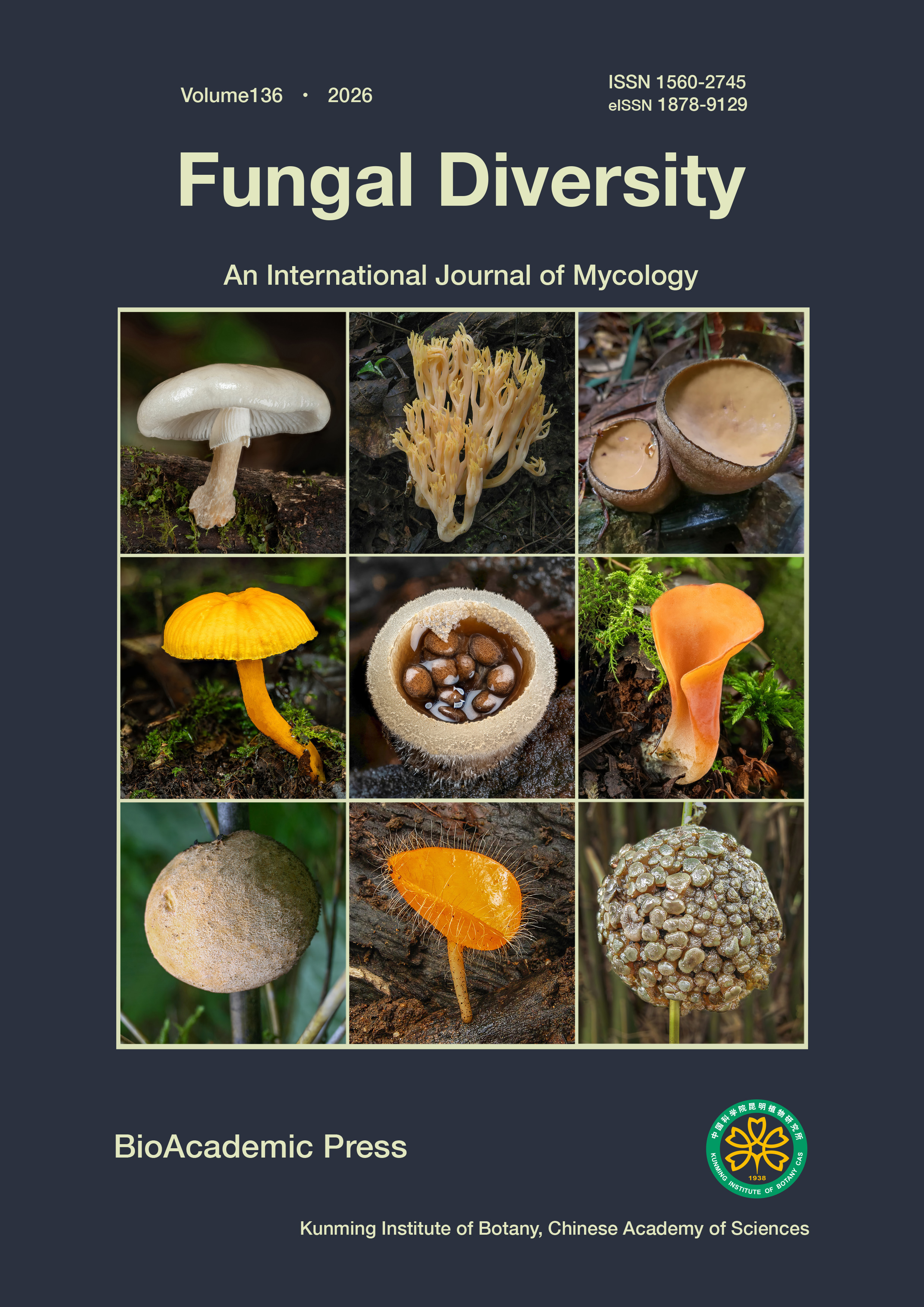
As the journal moves forward, we are pleased to announce that from January 2026, Fungal Diversity will be published by BioAcademic Press. This change ends our long and productive association with Springer Nature, which has served as the journal’s publisher for many years. The transition marks both a moment of reflection on what has been achieved and a considered step towards the future of scholarly publishing.
Our collaboration with Springer Nature began during a period when mycology was expanding rapidly and increasingly intersecting with molecular biology, ecology, and other life sciences. During this time, Fungal Diversity has benefited from Springer Nature’s extensive publishing expertise, international reach, and consistent emphasis on quality. Under its stewardship, the journal has experienced sustained growth in readership, visibility, and scientific influence. We are deeply grateful to the Springer Nature publishing team—across editorial coordination, production, digital platforms, and dissemination— whose professionalism and commitment were central to this progress. Their efforts ensured that the journal maintained high standards of editorial integrity, efficiency and academic rigor.
The decision to transition Fungal Diversity to the BioAcademic Press reflects a shared vision for the journal’s continued development. As fungal research continues to broaden, embracing genomics, biotechnology, ecosystem science, and interdisciplinary approaches, it is essential that the journal’s publishing framework remains responsive and adaptable. BioAcademic Press is a recently established academic publisher with a clear focus on open-access, accessible, and sustainable scholarly communication. This partnership offers greater flexibility in publishing models, enhanced digital capabilities, and improved integration of research data, while preserving the principles of rigorous peer review and scientific excellence.
The editorial board, aims, and scope of Fungal Diversity will remain unchanged, and all manuscripts currently under review or in production will be managed seamlessly during the transition. Authors, reviewers, and readers can expect continuity in editorial practices and publication standards. Our priority throughout this process was to ensure stability while creating space for thoughtful innovation. Thus, 2026 will mark a new phase in the journal’s history. Working with Bio- Academic Press, we aim to strengthen the journal’s digital presence, explore new formats for scholarly communication, and expand initiatives that support transparency, reproducibility, and international collaboration. We also look forward to closer engagement with mycological societies and research networks and the development of thematic collections that reflect emerging directions in fungal research.
At this point of transition, we wish to express once again our sincere appreciation to Springer Nature for its years of partnership and shared commitment to advancing mycological science. The success and standing of Fungal Diversity today are built in no small part on that collaboration. We also thank our authors, reviewers, and readers, whose contributions and trust have sustained the journal over time. We invite you to continue this journey with us as Fungal Diversity enters its next chapter under BioAcademic Press, committed to documenting and understanding the extraordinary diversity and significance of the Fungal Kingdom.
-
Zhu-Liang Yang serves as the Editor‐in‐Chief of Fungal Diversity; Jian-Kui Liu serves as Managing Editors of Fungal Diversity. The authors declare that they have no conflicts of interest.
-
Copyright: The Author(s) 2026. Published by BioAcademic Press on behalf of Kunming Institute of Botany, Chinese Academy of Sciences (CAS) and Mushroom Research Foundation. This is an open access article under the Creative Commons Attribution license (http://creativecommons.org/licenses/by/4.0), which permits use, distribution and reproduction in any medium, provided the original work is properly cited.
-
Main
Since its establishment, Fungal Diversity has sought to advance the understanding of the Fungal Kingdom in all its complexity, from taxonomy and systematics to ecology, evolution, and applied research. Over the past decades, the journal has grown into a widely recognized international forum for mycological research, publishing work that has not only documented fungal diversity but has also shaped contemporary thinking in the discipline.
As the journal moves forward, we are pleased to announce that from January 2026, Fungal Diversity will be published by BioAcademic Press. This change ends our long and productive association with Springer Nature, which has served as the journal’s publisher for many years. The transition marks both a moment of reflection on what has been achieved and a considered step towards the future of scholarly publishing.
Our collaboration with Springer Nature began during a period when mycology was expanding rapidly and increasingly intersecting with molecular biology, ecology, and other life sciences. During this time, Fungal Diversity has benefited from Springer Nature’s extensive publishing expertise, international reach, and consistent emphasis on quality. Under its stewardship, the journal has experienced sustained growth in readership, visibility, and scientific influence. We are deeply grateful to the Springer Nature publishing team—across editorial coordination, production, digital platforms, and dissemination— whose professionalism and commitment were central to this progress. Their efforts ensured that the journal maintained high standards of editorial integrity, efficiency and academic rigor.
The decision to transition Fungal Diversity to the BioAcademic Press reflects a shared vision for the journal’s continued development. As fungal research continues to broaden, embracing genomics, biotechnology, ecosystem science, and interdisciplinary approaches, it is essential that the journal’s publishing framework remains responsive and adaptable. BioAcademic Press is a recently established academic publisher with a clear focus on open-access, accessible, and sustainable scholarly communication. This partnership offers greater flexibility in publishing models, enhanced digital capabilities, and improved integration of research data, while preserving the principles of rigorous peer review and scientific excellence.
The editorial board, aims, and scope of Fungal Diversity will remain unchanged, and all manuscripts currently under review or in production will be managed seamlessly during the transition. Authors, reviewers, and readers can expect continuity in editorial practices and publication standards. Our priority throughout this process was to ensure stability while creating space for thoughtful innovation. Thus, 2026 will mark a new phase in the journal’s history. Working with Bio- Academic Press, we aim to strengthen the journal’s digital presence, explore new formats for scholarly communication, and expand initiatives that support transparency, reproducibility, and international collaboration. We also look forward to closer engagement with mycological societies and research networks and the development of thematic collections that reflect emerging directions in fungal research.
At this point of transition, we wish to express once again our sincere appreciation to Springer Nature for its years of partnership and shared commitment to advancing mycological science. The success and standing of Fungal Diversity today are built in no small part on that collaboration. We also thank our authors, reviewers, and readers, whose contributions and trust have sustained the journal over time. We invite you to continue this journey with us as Fungal Diversity enters its next chapter under BioAcademic Press, committed to documenting and understanding the extraordinary diversity and significance of the Fungal Kingdom.
Conflict of Interest Statement
Zhu-Liang Yang serves as the Editor‐in‐Chief of Fungal Diversity; Jian-Kui Liu serves as Managing Editors of Fungal Diversity. The authors declare that they have no conflicts of interest.
-
Copyright
Copyright: The Author(s) 2026. Published by BioAcademic Press on behalf of Kunming Institute of Botany, Chinese Academy of Sciences (CAS) and Mushroom Research Foundation. This is an open access article under the Creative Commons Attribution license (http://creativecommons.org/licenses/by/4.0), which permits use, distribution and reproduction in any medium, provided the original work is properly cited.